20.10.2026 18:21
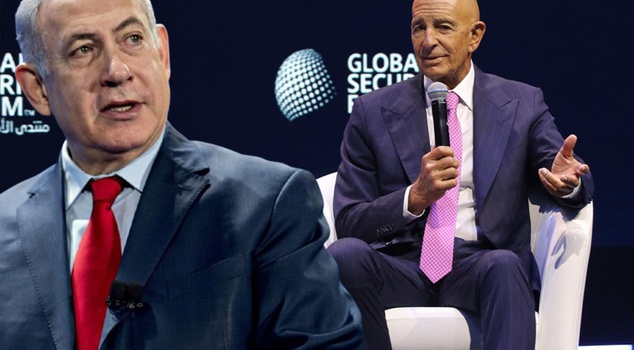
US Ambassador to Ankara Tom Barrack made a striking statement at the Global Security Forum in Doha. Barrack said, "Israel is smart enough not to actually enter into a conflict with Turkey. Turkey is also smart enough not to back down in the face of these threats. This is nothing but politics."
US Ambassador to Ankara and Special Envoy for Syria and Iraq Tom Barrack said that the Washington administration is providing logistical support to Saudi Arabia, but that a US intervention with ground troops against the Houthis in Yemen 'seems pointless.'
In a speech at the Global Security Forum held in Doha, the capital of Qatar, Tom Barrack questioned the results of the US's past military interventions in the Middle East.
BARRACK: THE US CANNOT BE EXPECTED TO SOLVE EVERY CONFLICT
Stating that countries in the region should establish regional alliances instead of relying on Washington to solve their problems, Barrack said that the US is redefining its role in the Middle East.
Noting that Washington is moving away from direct control and intervention and toward supporting regional countries in providing for their own security, Barrack stressed that the US has not abandoned its partners in the region, but that it cannot be expected to solve every conflict.
Questioning the effectiveness of military intervention against the Houthis regarding Yemen, Barrack said, 'A US ground intervention in Yemen seems pointless.'
Expressing that negotiations to be attended by Saudi Arabia, the Houthis and regional mediators offer a better alternative, Barrack emphasized the importance of diplomatic initiatives and dialogue in resolving political crises.
'THE US WANTS A PEACEFUL AGREEMENT WITH IRAN'
Barrack stated that while tensions between Washington and Tehran continue, the US wants to reach a peaceful agreement with Iran.
Conveying that US President Donald Trump is open to negotiations with Tehran, Barrack said that Washington is seeking a diplomatic solution rather than escalating military tension.
Pointing to the mediation efforts of Qatar, Oman, Pakistan and Switzerland, Barrack stressed that the lack of trust between Washington and Iran's Islamic Revolutionary Guard Corps continues to be a significant obstacle.
Barrack, stating that a modified version of the Islamabad memorandum could form the basis for renewed negotiations, touched on issues such as a ceasefire, the reopening of maritime transport routes and the easing of economic pressure on Iranians.
'IRANIANS SHOULD DECIDE IRAN'S POLITICAL FUTURE'
Ambassador Barrack described the Middle East as a region that has been searching for itself for 3,000 years, and said, 'Hundreds of prophets came here. None of them could solve this matter. It is not very likely that we will solve these problems within a few years.'
Stressing that Iran's political future should be decided by the will of the Iranian people, not by a regime change imposed from outside, Barrack criticized the results of the US's past regime change attempts.
Noting that the US has been involved in 23 regime change attempts in the broader Middle East region, Barrack said, 'Every time we try to intervene, change a person or a regime, it turns out to be a mistake.'
When asked whether the war the US and Israel are waging against Iran was a mistake, Barrack replied, 'I don't know whether it was a mistake.'
Barrack said that when the Trump administration launched military operations against Iran on February 28, its initial goal was not regime change but preventing a situation that Washington regarded as an imminent nuclear threat.
Stating that the US and Israel's war against Iran has led to undesirable consequences in the Middle East and beyond, Barrack said that the administration does not want the war to continue and described the resulting situation as 'terrible.'
'TURKEY IS SMART ENOUGH NOT TO BACK DOWN IN THE FACE OF THREATS'
Stating that the current situation consists only of political rhetoric, Barrack said, 'Israel is smart enough not to actually enter into a conflict with Turkey. Turkey is also smart enough not to back down in the face of these threats. This is just politics. Turkey and Israel had a honeymoon period in the early 2000s. The trade balance was good, their relations were problem-free, and the Jewish population in Turkey did not pose any problem.'
Pointing out that the real frightening factor in the region is the possibility of unwanted incidents, Barrack recalled the Russian Su-24 warplane that Turkish F-16s shot down on November 24, 2015, for violating the Syrian border, and said:
'An Israeli strike was carried out on an airbase 35 kilometers from Turkey. Communication was interrupted and there were glitches. Therefore, Turkey was not notified that Israeli aircraft would come. We were not notified that Israeli aircraft would come either. This incident could have turned into a situation similar to the Russia-origin incident we experienced before. Turkey could have scrambled its fighter jets very quickly, and suddenly we could have found ourselves in a completely different crisis.'