12.08.2026 12:40
The mass crossing movement in Ceuta, Spain's territory in Africa, has not only been an irregular migration movement; it has revealed the limits of the EU's external border security model and the shifting balances in the Western Mediterranean. The crisis, which gained a geopolitical dimension through Israel's diplomatic statement, points to a new era in the region where security, diplomacy, and strategic discourse competition are intertwined.
The mass crossings in Ceuta, Spain's autonomous city in North Africa, have reopened the debate on Europe's security architecture. The crisis, at the intersection of migration management, regional alliances, and discourse struggles, became the most concrete indicator of transformation in the Western Mediterranean.
Tunç Demirtaş, foreign policy researcher at SETA Foundation (Foundation for Political, Economic and Social Research) and faculty member at Mersin University's Department of International Relations, analyzed the "Ceuta" crisis. The article written by Demirtaş is as follows:
EUROPE'S BORDER SECURITY OPENED FOR DISCUSSION
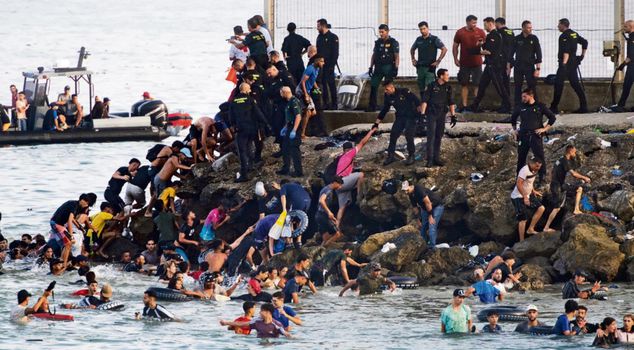
The mass irregular crossings in Ceuta, Spain's autonomous city in North Africa, on July 30, 2026, brought Europe's migration management and border security debates back to the agenda. The attempts of tens of thousands of people to cross the border within approximately 24 hours and the deaths of at least 57 people had significant consequences not only in humanitarian terms but also regarding the management of Europe's external borders.
"BORDER SECURITY" DEBATE MOVED TO GEOPOLITICAL CONTEXT
Immediately after the crisis, Israel's Permanent Representative to the United Nations, Danny Danon, described Ceuta and Melilla as "colonial settlements in Africa," moving the border security debate into a broader geopolitical context. Although the Israeli Ministry of Foreign Affairs later announced that the statement did not reflect official state policy, the development revealed that competition in the Western Mediterranean continues not only in security and diplomacy but also at the level of strategic discourse.
What happened in Ceuta cannot be evaluated solely as a new wave of irregular migration. The crisis simultaneously made visible the limits of the externalized border management model that the European Union has implemented for years, the changing geopolitical balances in the Western Mediterranean, and the increasingly diversified competition for influence in Africa. Therefore, the Ceuta crisis should be addressed within the framework of structural dynamics shaping Europe's security architecture, rather than attributing unproven agency to a specific actor. This study evaluates the crisis through the background of the migration movement, Europe's border management model, and the geopolitical context created by Israel's expanding diplomatic and technological presence in Africa.
THE CEUTA CRISIS: MORE THAN MIGRATION
At first glance, developments in Ceuta can be assessed as a new wave of irregular migration facing Europe. However, the timing, scale, and political consequences of the crisis make it difficult to explain the event solely through migration dynamics. The movement of 50 to 60 thousand people toward the Ceuta border within approximately 24 hours, the deaths of at least 57 people, and the border quickly exceeding its normal capacity were recorded as one of the most notable developments on Europe's southern borders.
One of the striking aspects of the crisis was that a significant portion of those crossing the border consisted not of the classic transit migrant profile trying to reach Europe from Sub-Saharan Africa, but of young people coming from the northern regions of Morocco. The return of tens of thousands of people to Morocco within a short time after the events also showed that this movement diverged to a certain extent from classic irregular migration dynamics. This situation makes it difficult to explain the crisis solely by economic reasons and necessitates evaluating the social, economic, and administrative conditions that enable migration movements together.
WAS THERE AN "EXTERNAL FACTOR"?
However, current open sources do not reveal concrete evidence confirming that the mass movement in Ceuta was planned by any external actor or organized by a specific state. Therefore, approaches trying to explain the crisis through a single perpetrator, as well as interpretations evaluating the events as a completely spontaneous migration movement, remain analytically insufficient. A more accurate assessment is to address the Ceuta crisis at the intersection of Europe's migration management policies, regional socioeconomic dynamics, and the changing security environment in the Western Mediterranean.
In this regard, the Ceuta crisis shows that the fundamental problem facing Europe is not only irregular migration; a new security environment is emerging where border security, regional stability, and geopolitical competition are increasingly intertwined.
EUROPE'S EXTERNALIZED BORDER SECURITY MODEL
The Ceuta crisis reopened the debate on the externalized border management approach adopted by the European Union in recent years. This model aims to stop irregular migration before it reaches European borders and, to this end, conducts comprehensive cooperation with transit and origin countries in the areas of border security, readmission, combating human trafficking, and capacity building. Especially after the 2015 migration crisis, this approach became one of the fundamental elements of Europe's migration policy.
In this framework, Morocco is one of the European Union's most important partners. The Rabat administration has for years conducted close cooperation with Spain and the European Union in border security, combating human trafficking, and preventing irregular migration. Similarly, new mechanisms developed with Mauritania and Senegal have contributed to a significant reduction in irregular crossings, especially on the Atlantic route. According to Frontex data, irregular border crossings to the European Union decreased by 37 percent in the first half of 2026 compared to the same period the previous year, while this decrease exceeded 70 percent on the West African route. This picture shows that Europe's cooperation with third countries can produce concrete results.
However, the same model also increases interdependence. The fact that Europe's external border security largely depends on cooperation with third countries has transformed migration management from merely a technical border security issue into an integral part of foreign policy. Therefore, any disruption or coordination problem in border management can quickly produce consequences affecting Europe's domestic politics, security agenda, and diplomatic relations.
What happened in Ceuta also made this structural fragility visible. The crisis once again revealed that the security of Europe's southern borders depends not only on physical border measures but also on sustainable and predictable cooperation with neighboring countries. This situation shows that, for the European Union, the externalized border management model should not be abandoned but should be developed on the basis of stronger institutional mechanisms, crisis coordination, and mutual trust. Otherwise, border security, migration management, and regional diplomacy will continue to be fields that directly affect each other.
ISRAEL'S EXPANDING PRESENCE IN AFRICA AND THE DISCOURSE COMPETITION
One of the developments that drew attention after the Ceuta crisis was the statement by Israel's Permanent Representative to the United Nations, Danny Danon, describing Ceuta and Melilla as "colonial settlements in Africa." Although the Israeli Ministry of Foreign Affairs soon announced that this statement did not reflect official state policy, this discourse brought the border disputes in the Western Mediterranean into the international diplomatic agenda. In this respect, the statement can be considered one of the first significant discursive interventions that emerged during the crisis.
This development should also be read within the context of Israel's broader strategy in Africa in recent years. Although Israel lost its observer status in the African Union in 2023, its relations with the continent have not weakened. On the contrary, they have continued to deepen through bilateral relations in the fields of technology, defense industry, agriculture, health, and cybersecurity. Development projects carried out especially through MASHAV, agricultural capacity-building programs, and health investments have extended Israel's visibility in Africa beyond diplomatic representation.
Additionally, some incidents that have come to public attention in recent years have increased debates about the role played by Israeli-based technology and private security companies in African political processes. Investigations into the Pegasus spyware revealed that the phones of several high-ranking officials, including Spanish Prime Minister Pedro Sanchez, were targeted, although no legal certainty has been established regarding the perpetrators. Similarly, private companies reported to be linked to Israel, such as Team Jorge and BlackCore, have come to the fore with allegations of digital influence operations aimed at election processes in Africa. These examples point to a new security domain where the boundaries between state policy and private sector activities are increasingly debated.
The defense and security cooperation that has developed between Morocco and Israel in recent years is also one of the important elements of this transformation. Following the normalization of relations within the framework of the Abraham Accords in 2020, significant agreements have been signed between the two countries in the fields of defense industry, intelligence sharing, and military modernization, joint military commissions have been established, and various defense systems have been procured. These developments are considered one of the main factors increasing Israel's strategic visibility in North Africa.
However, there is no open-source evidence that would establish a direct link between the mass migration movement that occurred in Ceuta and Israel's diplomatic, technological, or security activities in Africa. Therefore, it is not possible to characterize the Ceuta crisis as an operation planned or directed by Israel in light of available data. Nevertheless, when Danon's statement is evaluated together with Israel's expanding strategic presence in Africa and the digital influence debates that have emerged in recent years, it becomes clear that the crises in the Western Mediterranean must be considered within an increasingly broader geopolitical and discursive competition environment. Thus, the issue is significant not so much as a direct discussion of agency, but rather in terms of the diversification of tools used by regional power competition and the effective use of crises at the level of international discourse.
GEOPOLITICAL BALANCES SHIFTING IN THE WESTERN MEDITERRANEAN
The Ceuta crisis, beyond being one of the most striking border incidents Europe has faced in recent years, is also a reflection of the changing geopolitical balances in the Western Mediterranean. The events demonstrate that irregular migration can no longer be addressed solely as a humanitarian or security-focused issue; it must be evaluated together with different policy areas such as energy security, regional diplomacy, border management, and strategic communication. In this respect, the crisis has simultaneously revealed the strengths and weaknesses of the externalized border management model that the European Union has implemented for many years.
The Ceuta example has once again highlighted the importance of the migration and border security cooperation that Europe has developed with neighboring countries. Mechanisms established with countries such as Morocco, Mauritania, and Senegal have made concrete contributions to reducing irregular migration in recent years. However, this model also increases interdependence between the parties, making the relationship between border security and foreign policy more visible. Therefore, the main issue for Europe is to maintain the existing cooperation model while making it more institutional, predictable, and resilient to crises.
Israel's discursive intervention following the Ceuta crisis, on the other hand, points to new dimensions of geopolitical competition in the Western Mediterranean. When Danny Danon's statement is evaluated together with Israel's expanding diplomatic, technological, and security networks in Africa in recent years, it shows that regional crises can be effectively used at the level of international discourse. However, existing open sources do not provide any evidence that would establish a direct link between the mass migration movement in Ceuta and Israel. Therefore, it is of great importance for analytical consistency that critical assessments distinguish between verifiable facts and assumptions.
From Turkey's perspective, developments in the Western Mediterranean once again demonstrate the importance of multilateral cooperation rather than zero-sum competition. While Spain continues to be a NATO ally and one of the important strategic partners in Europe, Morocco is also among Turkey's prominent partners in terms of its Africa opening policy, Mediterranean security, and economic relations. Similarly, considering Algeria's role in energy security and the relations developed with West African countries, Turkey's balanced and multidimensional approach to the region gains importance.
In conclusion, the Ceuta crisis should be evaluated not through discussions of agency attributed to a specific actor, but rather for understanding the transforming security architecture in the Western Mediterranean. When Europe's border management model, cooperation developed with regional partners, the intensifying geopolitical competition in Africa, and strategic discourse struggles are considered together, what happened in Ceuta should be read as one of the important indicators of a new era in international politics where security and diplomacy are increasingly intertwined.