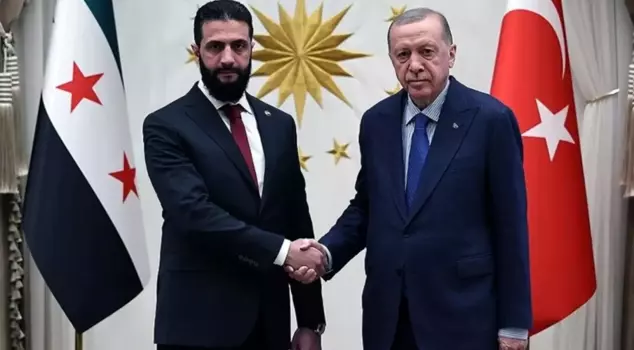
18.01.2026 23:40
After the ceasefire agreement between the Damascus government and the terrorist organization YPG/SDG in Syria, President Erdoğan met with Syrian President Ahmed Shara. In the meeting, President Erdoğan stated that Turkey's support for Syria, particularly in the fight against terrorism, will continue to increase.
The Syrian army and the terrorist organization YPG/SDG reached a ceasefire agreement following the clashes between them and the Damascus administration.
In his statement announcing the ceasefire agreement, Syrian President Shara said, "We had a planned meeting with Mazlum Abdi, but it was postponed to tomorrow due to weather conditions. All issues related to the SDG will be resolved."
PRESIDENT ERDOĞAN'S CRITICAL CONTACT
After the ceasefire agreement was reached between the Damascus administration and the terrorist organization YPG/SDG in Syria, President Erdoğan spoke with Syrian President Ahmed Shara.
During the meeting, President Erdoğan stated that Turkey's support for Syria, especially in the fight against terrorism, will continue to increase.
"LATEST DEVELOPMENTS WERE DISCUSSED"
Communications Director Burhanettin Duran stated regarding the meeting, "Our President, Mr. Recep Tayyip Erdoğan, had a phone conversation with Syrian President Ahmed Shara. The meeting addressed bilateral relations between Turkey and Syria and the latest developments in Syria."
Our President emphasized that Turkey values Syria's territorial integrity, unity, stability, and security. He expressed that the complete cleansing of Syrian territory from terrorism is necessary for both Syria and the entire region.
Our President stated that Turkey's support for Syria, especially in the fight against terrorism, will continue to increase," he said.
HERE ARE THE CEASEFIRE ARTICLES
The articles of the reached ceasefire agreement were also shared with the public. The full text of the 14-article agreement is as follows:
1. An immediate and comprehensive ceasefire is to be declared between the Syrian Government forces and the Syrian Democratic Forces (SDG) on all fronts and contact lines; as a preliminary redeployment step, all military elements affiliated with the SDG will withdraw to the east of the Euphrates River.
2. The administrative and military control of the Deir ez-Zor and Raqqa provinces will be immediately and completely transferred to the Syrian Government. In this context, decrees will be issued immediately to transfer all civil institutions and facilities, and to grant permanent status to existing employees within the ministries of expertise of the Syrian state.
3. The integration of all civil institutions in Hasakah province with the institutions and administrative structures of the Syrian state.
4. The Syrian Government will take control of all border gates, oil fields, and gas fields in the region; ensuring that these areas are protected by regular army forces and that resources are returned to the Syrian state, while considering the special situation of Kurdish regions.
5. The full integration of all military and security personnel affiliated with the SDG into the structures of the Syrian Ministries of Defense and Interior on an individual basis, following necessary security investigations; their military ranks, financial rights, and logistical needs will be arranged accordingly.
6. The SDG leadership will commit to avoiding the recruitment of remnants of the former regime into their ranks and will present lists of names of former regime officers and personnel located in northeastern Syria.
7. A presidential decree will be issued for a candidate to be appointed as the Governor of Hasakah to ensure political participation and local representation.
8. The heavy military presence in Ayn al-Arab (Kobani) will be removed, a security force composed of the city's residents will be established, and the local police force administratively linked to the Ministry of Interior will be maintained.
9. The administration responsible for the management of ISIS detainees and camps, and the forces ensuring the security of these facilities will be transferred to the Syrian Government, thus completely transferring the legal and security responsibility of these files to the Syrian state.
10. To ensure national partnership, the acceptance of the appointment of individuals selected from the candidate lists presented by the SDG leadership to senior military, security, and civil positions within the central state structure.
11. The welcome of Presidential Decree No. 13 dated 2026; with this decree, the recognition of the cultural and linguistic rights of the Kurds and the addressing of rights-based and civil issues, including the claims of stateless persons and property rights accumulated from previous decades.
12. The SDG will commit to the expulsion of PKK leaders and members who are not Syrian citizens outside the borders of the Syrian Arab Republic; this will be done to ensure sovereignty and regional stability.
13. The Syrian state will commit to continuing the fight against ISIS in coordination with the United States and as an active member of the International Coalition to ensure the security and stability of the region.
14. Efforts will be made to reach understandings to ensure the safe and dignified return of the residents of Afrin and Sheikh Maqsoud regions to their homes.
WHAT HAPPENED?
On January 13, the Syrian army declared the areas occupied by the terrorist organization SDG west of the Euphrates River as a "closed military zone," calling on all armed groups in the region to withdraw to the east of the Euphrates. The closed military zones included Deir Hafer and Meskene on the western bank of the Euphrates River.
Last week, the army had cleared the neighborhoods of Ashrafiyeh, Sheikh Maqsoud, and Beni Zayd from the terrorist organization SDG during operations conducted in Aleppo.