23.02.2026 14:12
Prof. Dr. Hakan Kutoğlu stated that a fault system with a homogeneous tension of 250 km in length has been detected in the east of Van through satellite radar studies. The expert warned that this system could produce a destructive tremor similar to the earthquakes of February 6.
Zonguldak Bülent Ecevit University (BEUN) Faculty of Geodesy and Photogrammetry Professor Dr. Hakan Kutoğlu announced that they detected significant seismic activity in the east of Van as a result of satellite radar studies conducted in collaboration with the University of Leeds in England. Kutoğlu stated that the fault system, which is 250 kilometers long, carries a homogeneous stress and could produce a destructive tremor similar to the earthquakes in Kahramanmaraş on February 6.
STRESS MAPS ARE GENERATED USING SATELLITE RADAR TECHNIQUE
Reminding that Turkey is an active earthquake country due to its geological structure, Professor Dr. Kutoğlu noted that there are more than 500 known faults, as well as undiscovered fractures.
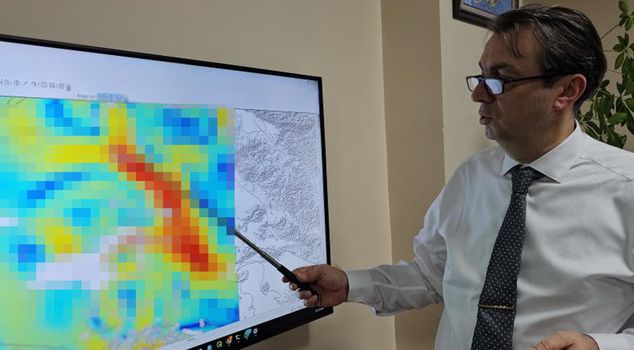
Referring to the project they are conducting in collaboration with the University of Leeds, Kutoğlu expressed that they are monitoring crustal movements across Turkey in real-time thanks to a satellite radar technique called radar interferometry. He stated that they create seismic stress maps based on the data obtained, emphasizing that the highest stress accumulation on an annual basis occurs in the fault line just east of Van.
"THERE IS NO RECORD OF A MAJOR EARTHQUAKE IN A 250 KILOMETER AREA"
Kutoğlu stated that there are many previously identified fault lines in the area under investigation, one of which is the Çaldıran Fault, which he reminded had ruptured in 1647 and 1976, producing tremors of 7.3 magnitude in the past.
Pointing out that destructive earthquakes occurred in the Van region south of the fault in 1881 and 2011, Kutoğlu explained that the red areas in the generated maps indicate a homogeneous high stress. He mentioned that this seismic stress has been increasing exponentially over the years, stating that despite the rupture of the Çaldıran fault, there is a massive area of 250 kilometers long with no record of any major earthquake.
"IT COULD WORK AT THE SAME TIME LIKE THE FEBRUARY 6 EARTHQUAKE"
Professor Dr. Kutoğlu conveyed that the uniformly red color of the 250-kilometer area on the map proves that the entire fault system works in connection with each other, continuing his warnings as follows:
When we look here, this red area uniformly obtains a high tension region, the stress area. Every year this stress accumulates and continues. The Çaldıran fault has ruptured here, but there is a huge area with no record of any major earthquake. The length of this area is 250 km from top to bottom, and the fact that they appear uniformly red indicates that this system works together. Working together means that it could be a frightening situation, but it is possible for the 250 kilometers to work simultaneously, as we saw in Hatay on February 6, 2023. The map here shows that the region is equally strained. There is homogeneous stress. We constantly talk about activities in the west because a large portion of the population lives in the west, but our studies across Turkey show that this region is one of the most visited areas. Attention should be paid to this region, and necessary precautions should be taken.
Kutoğlu also added that the earthquake that occurred in Van in 2011 did not mean that everything was over, emphasizing that the tremor at that time only covered a very small area, and a much larger mechanism continued to work and accumulate energy in the background, saying:
"There was an earthquake here in 2011. It doesn't mean everything is over. The place where the earthquake occurred in 2011 was just this small area. But as you can see, a much larger system continues to work."