11.11.2026 20:41
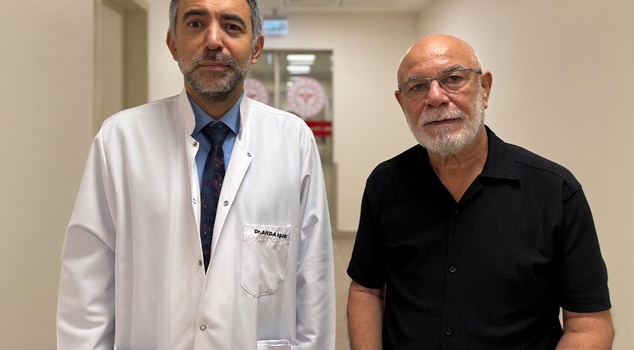
Hasan Güngör, a women's hairdresser living in Istanbul, applied to the hospital due to itching that started in his right breast and the hardness that formed afterward. Güngör, who was found to have breast cancer in the tests performed, said, "I was surprised, can men get breast cancer?" While Güngör's treatment continues after successful surgery thanks to early diagnosis, his doctor stated that approximately one out of every 100 breast cancer cases is seen in men.
Hasan Güngör, a women's hairdresser living in Istanbul's Kadıköy district, began to feel itching in his right breast some time ago. Later, also noticing hardness, Güngör went to his family physician and explained the situation.
HE LEARNED THAT IT WAS BREAST CANCER
Thereupon, Güngör was referred to Prof. Dr. Arda Işık, General Surgery Specialist at Göztepe Prof. Dr. Süleyman Yalçın City Hospital, and went to the hospital immediately. Here, detailed examinations were requested by Prof. Dr. Arda Işık and his team. A mass of about 1 centimeter was detected just behind the nipple. Afterwards, surgery was decided after a multidisciplinary evaluation. Güngör, whose treatment continues after the operation successfully performed on October 8, told what he experienced.
Güngör, who said he was astonished after the breast cancer diagnosis, stated that people should listen to the symptoms. Prof. Dr. Arda Işık, on the other hand, noted that about 1 of every 100 breast cancer cases is male and gave information about his patient's treatment. Işık drew attention to the vital role of early diagnosis and spoke about treatment processes.
“I WAS SURPRISED, [WONDERING] CAN MEN GET BREAST CANCER?”
Starting his words with ‘First there was an itching in the right breast,’ Güngör said, “At first I didn't take it seriously; men get it during adolescence, right? After 1-2 months, a hardening and a mass began to form there. When I noticed it, as they say, ‘Don't be late for diagnosis, early diagnosis is very important,’ I decided to have an examination. A biopsy etc. was done, and within 20 days I became very healthy. When they said breast cancer, I was surprised—[I wondered] can men get breast cancer? This is something I had never heard of. Men cannot attribute it to themselves; when there is hardness etc., we don't take it seriously, we say it will pass anyway, but that's not how it is. The earlier the diagnosis is made, the easier the treatment becomes. I am a women's hairdresser, and even I could not attribute it to myself. A person is a little hesitant to say ‘I have breast cancer’; because they think it won't happen in men, they ask, ‘Oh, can men get it?’ When there is any hardness or tightness in people's breasts, they absolutely must not neglect it and should make an appointment with their doctor and have it checked.” he said.
“THERE CAN BE A WRONG BELIEF AMONG MEN: ‘THERE IS NO BREAST TISSUE, SO I HAVE NO CANCER RISK’”
Prof. Dr. Işık, giving information about breast cancer, said, “Compared with breast cancer seen in every 100 women, 1 breast cancer is observed in men. It is rare in men, but when it is seen, it can present at a late stage, because the possibility of neglect in men can be somewhat higher. In men, a wrong belief such as ‘I don't have breast tissue, so I have no possibility of cancer’ can arise. This can lead to diagnosis at late stages. Male breast cancer has almost the same symptoms as breast cancer in women. What are they? It can present as a mass behind the nipple. Redness in the breast, bleeding from the nipple, flaky discharge, and a palpable lymph node in the armpit can be seen. We first perform a clinical examination of our patients. In men, we mostly proceed with ultrasound, and if necessary, we reach a diagnosis by performing a thick-needle biopsy. In patients we diagnose at an early stage, our first treatment is generally surgery. After surgery, we also use other treatment agents such as chemotherapy and radiotherapy. Screening for breast cancer is not something done in men, but screening programs are applied in women. There may be a risk in men as follows: if there is breast cancer in the family or if the man has a known genetic risk factor, personalized male screening programs are also carried out.” he spoke.
“HE WAS LUCKY; THE DIAGNOSIS WAS MADE AT AN EARLY STAGE”
“Mr. Hasan presented about 2 months ago with a complaint of a palpable mass in the breast,” said Işık, and continued: “On ultrasound, we detected a mass inside the breast and had a biopsy performed. We encountered a hormone-sensitive breast tumor. He was very lucky because the diagnosis had been made at an early stage. It was a tumor localized only in the breast; there was no distant metastasis. After a multidisciplinary evaluation, we took him to surgery. We successfully completed his surgery; he is currently continuing follow-up with hormone therapy. If there is breast cancer in the family, this increases the risk in both women and men, especially in a first-degree relative. If these have breast cancer, the incidence of breast cancer increases by an average of 2 times in both women and men. If there is a genetic risk in the family, especially BRCA (Breast Cancer Susceptibility) genes, and if there is a positivity in these, the risk increases markedly. Especially in men, BRCA-2 gene positivity greatly increases breast cancer.” he said.
“SELF-EXAMINATION AND SCREENING PROGRAMS ARE IMPORTANT”
Speaking about the process Angelina Jolie experienced, Işık continued his words as follows: “In an emotional letter she wrote to Time magazine in 2013, Angelina Jolie stated that her mother had breast cancer and that she herself was a BRCA gene carrier. She also stated that, in order not to get breast cancer in the future, she had her breasts emptied and underwent an operation we call prophylactic mastectomy. We arrange treatment on a patient-by-patient basis; we do not recommend treatment through social media. It is not a healthy thing, and it does not produce good results for the patient's future. One in every 8 women gets breast cancer during her lifetime, and one in every 4 cancers in women is breast cancer. A palpable mass is not always cancer, but it is a condition that must definitely be evaluated. We expect our women, especially from the age of 20, to examine themselves, and from the age of 40, to apply to KETEMs and health institutions every 2 years and take part in screening programs.”