05.04.2026 19:11
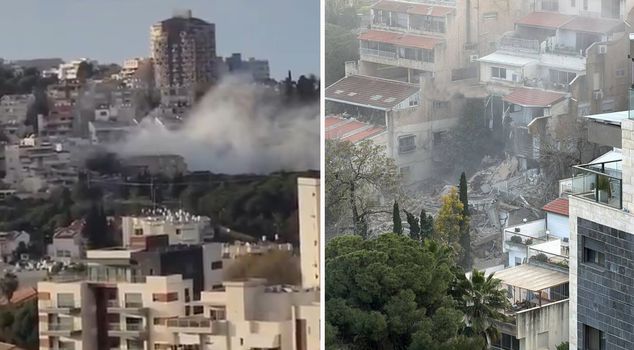
Iran intensified its attacks in the war. The Islamic Revolutionary Guard Corps drew attention as Iranian missiles once again breached the Iron Dome system while striking a refinery in the Israeli city of Haifa and some buildings in the city center. The Revolutionary Guards announced that they also targeted U.S.-linked energy and petrochemical facilities in Haifa, as well as in the United Arab Emirates, Bahrain, and Kuwait.
The Islamic Revolutionary Guard Corps announced that in the 96th wave of the "Real Promise 4" operation, attacks were carried out against the refinery in Haifa, Israel, and U.S.-linked energy and petrochemical facilities in the United Arab Emirates (UAE), Bahrain, and Kuwait.
RETALIATORY ATTACKS FROM IRAN
The Islamic Revolutionary Guard Corps (IRGC) issued a statement regarding the 96th wave of the "Real Promise 4" operation. The statement indicated that as part of a joint operation conducted by the IRGC Navy and Air Force, Israeli targets in the region and U.S. economic interests were targeted in retaliation for attacks on civilian infrastructure in Iran.
ENERGY AND PETROCHEMICAL FACILITIES TARGETED
The statement noted that a heavy attack was carried out on the refinery in Haifa, which supplies fuel to Israeli warplanes, and that the main sections of the facility were destroyed. It was reported that gas facilities belonging to U.S. energy companies Exxon Mobil and Chevron in the Habshan region of the UAE were targeted, and a large fire broke out during a missile attack on the U.S. petrochemical facility in the Al-Ruwais area of the UAE. It was mentioned that significant parts of the U.S.-linked petrochemical facility in the Sitra region of Bahrain were destroyed in a drone attack, and a large fire occurred during the attack on the U.S. petrochemical facility in the Shuaiba region of Kuwait, halting the facility's operations. Additionally, missiles hit some buildings in the city center of Haifa, bypassing the Iron Dome system.
"CLAIMS OF IRAN'S AIRSPACE DOMINANCE HAVE BEEN DISPROVEN"
The statement emphasized that the response to attacks on Iran's civilian infrastructure was the first phase of prior warnings, stating, "The enemy has suffered a heavy defeat in security, naval, and land fronts, losing its effectiveness on the battlefield. With the successive downing of its aircraft and drones, claims of dominance over Iranian airspace have been completely disproven. In light of this situation, the enemy, trying to hide its failure, has turned its focus to civilian targets. Indeed, by targeting civilian facilities, it has prepared the ground for the fires that occurred in Haifa, Habshan, Al-Ruwais, Sitra, and Shuaiba. From the very beginning, we clearly stated that every attack on civilian targets would be met with a stronger response to its interests in the region," it was stated.
"IF ATTACKS ARE REPEATED, THE SECOND PHASE WILL BE HARSHER"
The statement said, "If attacks on civilian targets are repeated, the second phase of the operation will be conducted much more harshly and comprehensively, and if the attacks continue, the damage and losses they will incur will be multiplied. In addition to retaliatory operations, the cost of all damages caused by the aggressors will be collected soon, and the financial burden of these illegal attacks will fall on American taxpayers. We warn once again that if the attacks continue and civilian facilities are targeted, the response will be much more devastating," it was stated.
Moreover, it was noted that one of the missiles launched had a photo of 8-year-old student Mehniya Hasanzade, who lost her life in the attacks initiated by Israel and the U.S. on February 28. Hasanzade was the first student to die in the attack carried out in the city of Zanjan.