19.10.2026 12:05
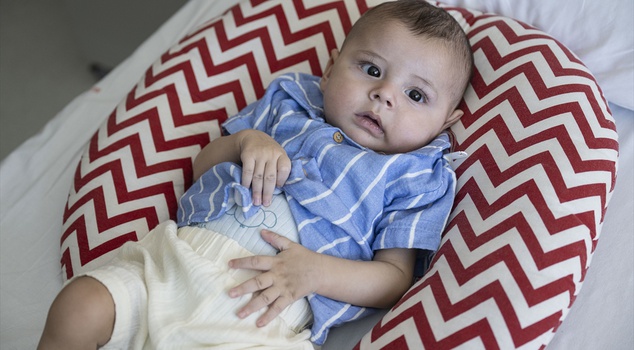
Six-month-old Osman Alp, who was diagnosed with pulmonary hypertension and associated right heart failure in Konya, was brought to Ankara Bilkent City Hospital by ambulance helicopter. After Potts shunt surgery, the baby, who received a drug treatment tried worldwide in only two infants under six months of age, came out of intensive care. Osman Alp's mother, preparing for discharge, said, 'His smiling is a miracle.'
Six-month-old Osman Alp Ordu, who was transferred from Konya to Ankara by ambulance helicopter after developing heart failure due to high pressure in the pulmonary vessels, clung to life at Ankara Bilkent City Hospital thanks to a surgery and drug treatment rarely applied in the world.
Dürdane Ordu, living in Konya, applied to the hospital after her son Osman Alp began experiencing cyanosis and seizures at two months old.
Osman Alp, diagnosed with pulmonary hypertension characterized by high pressure in the pulmonary vessels and who developed right heart failure due to this, was transferred to Ankara Bilkent City Hospital and treated for a while.
After his recovery, Osman Alp was taken to his hometown Konya; when his health condition worsened again, he was intubated and taken to Ankara by ambulance helicopter.
Osman Alp, who underwent surgery at five months old in which a bridge vessel was placed between the left pulmonary artery and the aorta, was removed from intensive care after additional drug treatment applied after surgery.
Osman Alp's family, preparing for discharge, is eagerly waiting for the day they will take their baby home.
A DISEASE THAT CAN BE FATAL
Ankara Bilkent City Hospital Pediatric Cardiology Specialist Prof. Dr. İbrahim Ece stated in his explanation to the AA correspondent that Osman Alp, who had severe pulmonary hypertension and right heart failure, was in critical health condition when brought to the hospital.
Drawing attention to the importance of early diagnosis in pulmonary hypertension, Prof. Dr. Ece said, “Pulmonary hypertension is a serious disease characterized by high lung pressure and leading to right heart failure. Although it is rare, it can be fatal. Therefore, early diagnosis and correct treatment are very important.”
Stating that the disease can occur due to genetic causes but its source cannot be identified in every patient, Ece said that the cause of the disease in Osman Alp has not yet been determined.
THE THIRD PATIENT IN THIS AGE GROUP IN THE WORLD
Ece said that the disease, which can manifest in babies with symptoms such as shortness of breath, difficulty feeding, cyanosis, and fainting, first showed itself in Osman Alp with fainting attacks.
Explaining that they planned Osman Alp's treatment step by step, Ece recounted that they first applied drug treatments; when they did not get sufficient response, a hole was created in the heart; after the baby benefited partially from this procedure, treatment was also applied intravenously in intensive care; and when the expected improvement could not be achieved, they made an evaluation with the surgical team.
Ece stated that they also considered the option of lung transplantation, but because the baby was very young and transplantation carried risks, they planned Potts shunt surgery, and recorded the following:
“This surgery, which we think was performed for the first time in Turkey, was carried out by Prof. Dr. Atakan Atalay and his team. After the surgery, Osman's intubation continued. Although he benefited from the surgery, since there was no possibility of removing him from intensive care, he needed a new drug treatment. This drug was one with which we had experience in adults, used quite rarely in children, and with which we had little experience. We started this drug after obtaining Ministry approval. The new drug we started had been initiated in only two patients in the world under six months old and shown to be beneficial. Osman Alp was the third patient in the world.”
Acting that they reviewed scientific publications for possible treatments, Ece said it was reported that the drug in question was used in two babies under six months old and provided benefit, and according to this information, Osman Alp was the third patient in the world in this age group to receive the treatment.
Prof. Dr. Ece said, “When we looked at the literature for what the world has done for these babies for treatment, and as far as we saw from publications and results published in our country too, we applied it for the first time with this baby.”
Explaining that Osman Alp can now be fed and has no complaints of fainting or cyanosis, Ece reported that discharge preparations are ongoing.
Emphasizing that the disease continues and that they will continue to follow up the baby, Ece called on families who see fainting and cyanosis in their children to apply to pediatric cardiology.
A BRIDGE VESSEL THAT REDUCES THE HEART'S BURDEN
Prof. Dr. Atakan Atalay, Administrative and Training Supervisor of the Pediatric Clinic of Cardiovascular Surgery at Bilkent City Hospital, also said that high pressure in the pulmonary vessels strains the right side of the heart, which pumps blood to the lungs.
Atalay stated that when the pressure rises very high, the right side of the heart works as if against a wall, and that with Potts shunt surgery they aim to reduce this burden, giving the information: “Normally, the main vessel leaving the heart distributes oxygenated blood to the body, while a dirty vessel goes to the lung. An artificial vessel is created between the left pulmonary vessel and the main vessel leaving the heart. In this way, we have both helped the patient recover from right heart failure and overcome hypertension crises.”
Acting that Osman Alp was being followed up after being separated from the ventilator, Prof. Dr. Atalay recorded the following:
“Potts shunt is a high-risk surgery. These patients are forced to undergo heart and lung transplantation. To be able to separate our patient from the ventilator, we created an artificial bridge between the main vessel leaving the heart and the vessel going to the left side of the lung. This treatment, which relieves our patient, reduced our need for lung transplantation. We operated on our patient at 5 months old; about 1 month has passed. As far as I know, this is the first child in Turkey to undergo this surgery and continue living.”
MOTHER: OUR DOCTORS NEVER GAVE UP
Mother Dürdane Ordu said that during seizures her son would contract and fix his eyes on one point, and afterward could not come to himself for a long time.
Stating that while in hospital in Konya her baby had six seizures in one day and was connected to a ventilator, Ordu said they experienced great anxiety during the intensive care period that lasted about 45 days.
Ordu stated that during this process they traveled back and forth from Konya to Ankara, could see their son for only half an hour a day, and on some days could not visit him.
Explaining that they often left intensive care crying, Ordu said, “We were very hopeless. Nothing was working, but our doctor never gave up. After intensive care, our son looking at us, opening his eyes, is as if he were newly born. Our son returned to his old movements; his smiling is a miracle.”
Ordu stated that she wants her son, when he grows up, to become a doctor and heal patients, and said, “Our son woke up. Holding him in our arms is a very beautiful feeling for us. We cannot put him down from our arms, we cannot bear to let him cry.”