14.10.2026 13:13
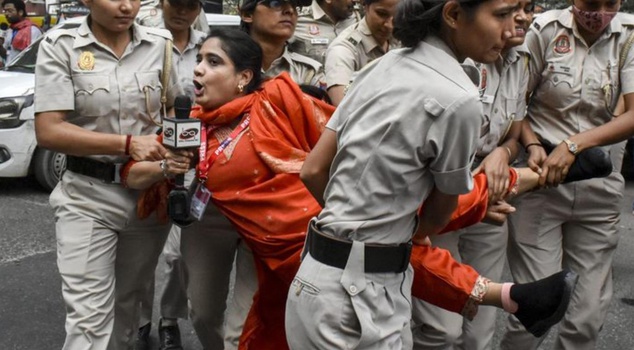
Police cracked down on journalists covering youth protests held in New Delhi over the weekend. Press freedom organizations stated that more than 30 journalists were detained, some were beaten and forced to delete their footage. A reporter who was on air was detained by police officers who carried her by her arms and legs. It drew attention that the female reporter continued to report despite her feet being off the ground.
In New Delhi, India’s capital, detentions of journalists during protests against a controversial change to voter lists have brought concerns about press freedom in India back to the agenda. Press freedom organizations called on authorities to protect journalists.
CPJ: IT CASTS A SHADOW OVER DEMOCRATIC TRADITIONS
According to reports in Indian and US media, the police intervention took place during protests against the change made to voter lists. Press freedom organizations reported that actions against journalists have caused serious concerns regarding press freedom in the country.
The Committee to Protect Journalists (CPJ) described the events as “casting a shadow over India’s democratic traditions.” The organization called on Indian authorities to ensure the safety of journalists and initiate proceedings against those responsible.
POLICE: PROTESTERS POSED AS JOURNALISTS
New Delhi Police, however, claimed that some protesters posed as journalists and obstructed police work. But footage from the scene showed that journalists carrying press cards were also dragged and detained by police.
“THEY HIT ME ON THE HEAD, NECK AND SHOULDER”
Ryan Thomas (26), a journalist working for the India-based magazine The Caravan, said in a statement to US media that he was beaten and briefly detained by police on Saturday, October 10, while covering the protests. Thomas, who described that while he was following the crowd to film detained protesters, police surrounded him and dragged him onto a bus, claimed that despite carrying a press card, he was hit on the head, neck and shoulder. Thomas also stated that police tried to take his camera and demanded that he delete the footage he had shot.
“THEY DID NOT WANT THE FOOTAGE PUBLISHED”
Jahnavi Sen, managing editor of the India-based news website The Wire, also announced that she was briefly detained along with two colleagues. Sen stated that they were released after other journalists arrived at the scene and began recording footage.
Noting that detentions of journalists have reached unusual proportions, Sen argued that the police were trying to prevent the public from seeing how they intervened in the protests. Emphasizing that the issue was not that police could not see press cards, Sen said, “It wasn’t that they couldn’t see the press cards. It was that they did not want footage of the protests published.”
The Press Club, India’s largest journalists’ organization, also described the police intervention as “a clear attack on press freedom.”
SUPREME COURT RULES IN FAVOR OF JOURNALISTS
It was reported that the Indian Supreme Court, where lawyers applied seeking protection for journalists, ruled in favor of journalists on Sunday.
MORE THAN 130 MILLION NAMES REMOVED FROM LIST
At the center of the protests is the process of redrawing voter lists in India. It was reported that more than 130 million names have been removed from voter rolls since last year. It was alleged that the practice is being carried out for political motives and that millions more people could be deprived of the right to vote. In demonstrations also supported by opposition parties, the resignation of India’s Chief Election Commissioner Gyanesh Kumar is being demanded.
The Election Commission and the government of Prime Minister Narendra Modi, however, argue that the measure aims to remove duplicate registrations and people who do not meet the conditions for being voters from the list.
157TH IN PRESS FREEDOM INDEX
In the World Press Freedom Index published by Reporters Without Borders (RSF), India ranks 157th among 180 countries. The country was ranked 133rd in the same index about 10 years ago.
It is alleged that the Modi government, which has been in power for 12 years, has increasingly restricted critical reporting and dissenting views. The Indian government rejects these accusations.