05.01.2026 14:00
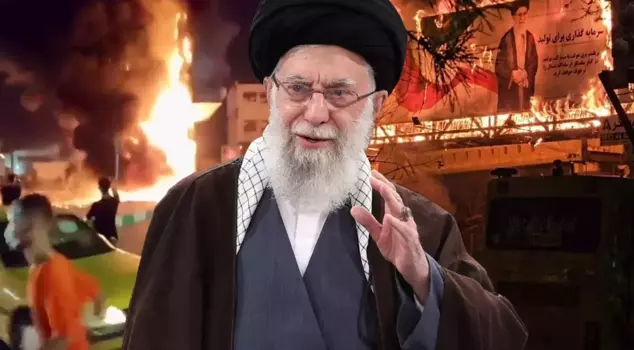
According to intelligence sources, Ayatollah Ali Khamenei has prepared a "Plan B" to leave Tehran with his family and close associates in case the protests in Iran cannot be suppressed by security forces or the army fails to carry out orders. It is suggested that the plan is modeled after Bashar al-Assad's escape to Moscow and that Khamenei's possible escape route could be Russia.
The claim that Venezuelan leader Nicolas Maduro was kidnapped by the U.S. and U.S. President Donald Trump's harsh criticisms regarding the protests in Iran have raised tensions on the international agenda. As assessments of deepening regional instability increase, eyes are turned to developments in Iran.
THE TIMES: "PLAN B" FROM HAMANEY
According to intelligence sources who provided information to The Times, 86-year-old Iranian leader Ayatollah Ali Khamenei plans to leave Tehran if he sees that the army and security forces are not carrying out orders or are hesitating. Sources indicated that this plan also includes Khamenei's close aides and family members, numbering up to 20.
Khamenei's son and designated heir Mojtaba is also noted to be part of this plan. Former Israeli intelligence officer Beni Sabti predicted that Khamenei could flee to Moscow. The report suggested that the plan is modeled after Syrian leader Bashar al-Assad's escape to Moscow before the opposition captured the capital in December 2024.
CLAIM THAT HE IS "COLLECTING ASSETS FOR SAFE PASSAGE"
The report also claimed that Khamenei is gathering his assets, properties, and cash reserves abroad for "safe passage." It was stated that the Setad institution, under Khamenei's control, manages assets worth $95 billion, including companies and real estate. It was suggested that some of the families of his closest aides live in the U.S., Canada, and Dubai.
PROTESTS CONTINUE IN IRAN
It is reported that protests have occurred in many cities across the country in recent weeks due to economic difficulties. Demonstrators say that the Islamic Revolutionary Guard Corps (IRGC), Basij militias, police, and army are using live ammunition, tear gas, and water cannons to suppress the protests.
According to a Western intelligence assessment, Khamenei has weakened both mentally and physically after the 12-day war with Israel last year and has not appeared in public recently.
"THOSE WANTING CONFLICT WITH IRAN WILL TAKE ACTION"
Jamal Abdi, President of the National Iranian-American Council (NIAC), expressed the view that the Venezuelan operation has increased regional instability, stating, "A new environment of lawlessness makes everything more unstable and increases the likelihood of war."
According to Al Jazeera, Abdi stated that the Trump administration's stance could mobilize those wanting conflict with Iran, and that Maduro's kidnapping could lead Iran to strengthen its military deterrence or take steps to prevent a possible attack.
"CHANCES FOR DIPLOMACY ARE LOW, RISK OF CONFLICT IS INCREASING"
Negar Mortazavi, a senior researcher at the International Policy Center, expressed similar concerns, stating, "There is not much chance for diplomacy right now, which leads to the opposite path, that is, conflict. Currently, Israel, Iran, and the U.S. are moving towards a potential conflict."
TRUMP: "OUR WEAPONS ARE READY AND ON ALERT"
U.S. President Donald Trump stated in a post on his Truth Social account regarding the protests in Iran, "If Iran opens fire and kills peaceful protesters, the U.S. will come to their aid. Our weapons are ready and on alert."
HARSH RESPONSE FROM IRAN TO TRUMP
Following Trump's statements, a response came from Iran. Ali Larijani, Secretary of the Supreme National Security Council of Iran and Khamenei's advisor, stated in a social media post that a possible U.S. intervention would lead to chaos throughout the region.
Larijani said, "Trump should know that U.S. intervention in this internal matter will disrupt the stability of the entire region and harm U.S. interests." He also expressed that U.S. intervention is a "red line" and that there would be a response in the event of intervention.
WHAT HAPPENED?
Protests initiated by shopkeepers in Tehran's Grand Bazaar on December 28, 2025, due to the rapid depreciation of the national currency against foreign currencies and economic problems, spread to many cities across the country. President Masoud Pezeshkian acknowledged the public's dissatisfaction, stating that the government is responsible for the current economic problems and called on officials not to blame external actors like the U.S.