12.10.2026 23:20
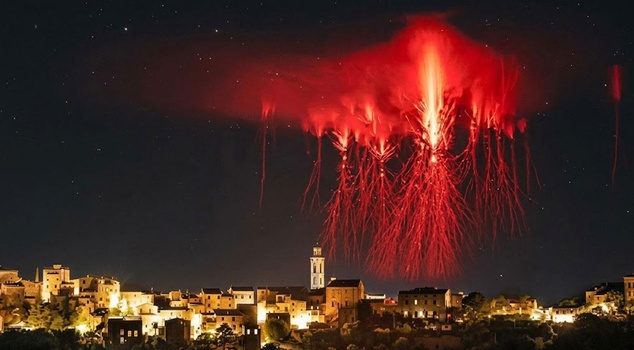
Photographer Florian Riu, who was imaging the night sky on France's island of Corsica, captured enormous red light formations appearing above a village. It was determined that the branching lights, which appeared to rise just behind the houses, actually originated from a storm on the Spanish coast 500 to 700 kilometers away. The rare atmospheric phenomenon known in the scientific world as a "red sprite" inspired awe with the resulting images.
French photographer Florian Riu made preparations on France's island of Corsica to photograph the severe storm expected off the coast of Spain.
After studying weather movements and choosing the village of Montemaggiore as his shooting location, Riu watched the sky throughout the night. When the moment he had been waiting for arrived, enormous red, branching light formations were reflected in his lens along with the silhouette of the village.
IT WAS HUNDREDS OF KILOMETERS AWAY
The source of the lights that appear in the photographs to rise just behind the houses was in fact the powerful storm off the coast of Spain.
There was a distance of about 500 to 700 kilometers between Montemaggiore and the area where the flashes occurred.
The event, which took place in the upper parts of the atmosphere, could be captured from Corsica thanks to favorable viewing conditions.
NOT LIGHTNING, BUT AN ELECTRICAL GLOW IN THE UPPER LAYERS OF THE ATMOSPHERE
Known in the scientific world as a "Red sprite" and in Turkish as "Kızıl cin," this phenomenon occurs in connection with powerful thunderstorms.
Unlike ordinary lightning, it appears not between clouds and the earth, but much higher above storm clouds.
Electrical discharges occurring in a very small fraction of a second can create red patterns in the sky resembling roots and branches.
WHY DOES IT PAINT THE SKY RED?
The main factor determining the color of this extraordinary image is nitrogen gas in the atmosphere.
Nitrogen molecules excited by electrical energy release light as they return to their former energy levels.
The resulting glows can be seen in different shades of red and pink depending on observation conditions.