20.07.2026 08:51
NASA has captured images from space of the turquoise color change observed in the Black Sea and the Sea of Marmara during spring and summer. In images taken by the PACE satellite and the International Space Station, it is stated that the color change is caused by the concentration of microscopic phytoplankton called coccolithophores, and this natural phenomenon plays a significant role in the marine ecosystem and carbon cycle.
The US National Aeronautics and Space Administration (NASA) has released new satellite and space images showing the seasonal turquoise color change occurring in the Black Sea and the Sea of Marmara.
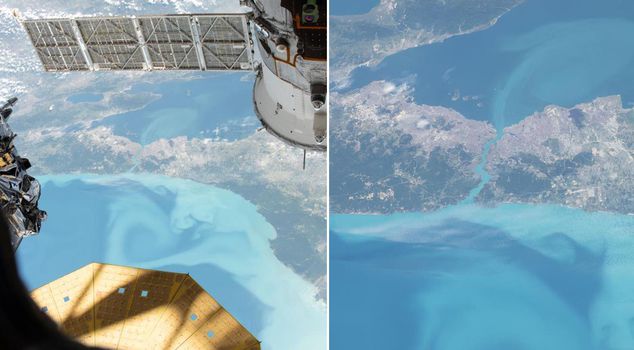
In the images captured by NASA's PACE satellite and the International Space Station (ISS), turquoise-colored areas extending along the Black Sea, the Sea of Marmara, and the Bosphorus were clearly visible.
PACE SATELLITE CAPTURED
The Ocean Color Instrument (OCI) on NASA's PACE (Plankton, Aerosol, Cloud, Ocean Ecosystem) satellite, launched into space on February 8, 2024, recorded the striking color change in the Black Sea with high precision on June 22, 2026. The satellite images showed that a large portion of the Black Sea had turned into light blue and turquoise tones.
PHYTOPLANKTON CAUSE THE TURQUOISE COLOR
According to NASA's statement, while the Black Sea and the Sea of Marmara appear in dark blue and near-black tones for most of the year, a turquoise color change spreads over large areas in late spring and early summer.
Scientists indicate that this change is caused by the intense proliferation of microscopic phytoplankton called "coccolithophores." These organisms, covered with calcium carbonate plates, reflect sunlight, giving the sea surface a turquoise appearance.
NASA also stated that silica-shelled diatoms are more dominant during other times of the year, which is why the sea appears darker.
BOSPHORUS ALSO IMAGED FROM SPACE
Approximately one month ago, on May 27, 2026, a photograph taken by an astronaut from the Expedition 74 crew on the International Space Station also captured turquoise currents extending along the Bosphorus.
It was noted that the phytoplankton movements and current patterns progressing from the Black Sea toward the Sea of Marmara could be discerned even from space.
PART OF THE NATURAL CYCLE
NASA reported that the satellite and space station images, obtained about a month apart, reveal the seasonal phytoplankton movements in the region and the natural change in the marine ecosystem.
Experts highlighted that phytoplankton form the basis of the marine food chain and also play a significant role in sequestering carbon from the atmosphere.
Meanwhile, the same turquoise color change had previously been captured by a drone over the Bosphorus and the Sea of Marmara. Thus, the natural change in the sea has been recorded with images obtained both from sea level and from space.