31.08.2026 17:11
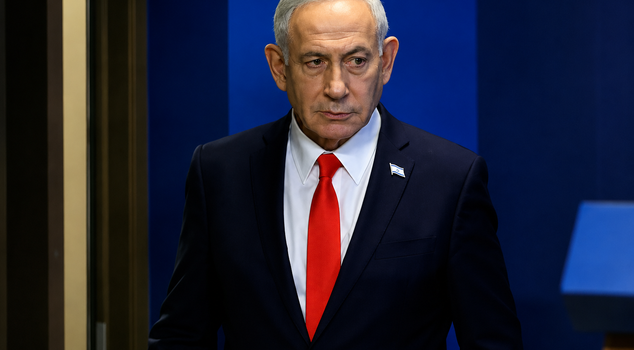
After Israeli Prime Minister Benjamin Netanyahu's increasingly harsh rhetoric ahead of the elections, poor poll results emerged. While the latest public opinion polls show that the bloc led by Netanyahu cannot reach the majority needed to form a government, parties formed by Palestinian citizens of Israel have risen to a key position in the post-election coalition equation.
The poor showing in public opinion polls emerged behind the increasingly harsh and aggressive rhetoric of Israeli Prime Minister Benjamin Netanyahu in recent times. The latest polls published ahead of the elections planned for October 27 revealed that the coalition led by Netanyahu cannot reach the majority needed to form a government in the Parliament.
In the latest poll conducted by the Kantar Institute for Israeli state television KAN, Netanyahu's bloc of far-right and Ultra-Orthodox Jewish parties lagged behind the opposition.
NETANYAHU'S BLOC REMAINS AT 52 SEATS
In Israel, forming a government requires the support of at least 61 members of parliament in the 120-seat Parliament.
However, according to the latest poll, the parties expected to support Netanyahu can win a total of 52 seats. This result shows that it is very difficult for the Prime Minister to form a government again with his current coalition partners.
It is seen that Netanyahu, who has intensified his rhetoric as he falls behind in the polls, has nevertheless been unable to turn the election picture in his favor.
Last week, Netanyahu called on the far-right figures in his coalition, National Security Minister Itamar Ben-Gvir and Finance Minister Bezalel Smotrich, along with Israel People's Party leader Ofer Winter, to enter the election with a joint list. However, Ben-Gvir rejected this proposal.
This move also proved insufficient to strengthen Netanyahu's position in the elections.
THE ANTI-NETANYAHU BLOC ALSO CANNOT REACH 61
Another striking result revealed by the poll is that the anti-Netanyahu parties also cannot reach a majority to form a government on their own.
Gadi Eisenkot, the former Chief of Staff shown as a rival to Netanyahu, and his Yashar Party are in first place with 24 seats.
However, the total number of seats for the opposition parties expected to support Eisenkot remains at 55.
Therefore, if the election results are close to the current polls, the anti-Netanyahu bloc also cannot exceed the 61-seat threshold.
PALESTINIAN PARTIES IN A KEY POSITION
The political parties formed by Palestinian citizens of Israel are becoming decisive in the possible coalition calculation.
According to the poll, the Joint Arab List wins 8 seats, and Raam, led by Mansour Abbas, wins 5 seats.
Abbas provided external support to the anti-Netanyahu coalition established under the leadership of former Prime Minister Naftali Bennett after the 2021 elections and played a critical role in the formation of the government.
However, according to the current picture, even Abbas's support is not enough for a possible alliance led by Eisenkot to form a government. With Abbas's support, this bloc can reach 60 seats, still falling one seat short.
PROSPECT OF NETANYAHU-EISENKOT ALLIANCE IS LOW
This picture indicates that a new coalition crisis may await Israel after the elections.
The possibility of Netanyahu and Eisenkot forming a joint government by taking some parties on board is also considered a low probability. It is stated that Eisenkot is not inclined to be in the same government with the far-right parties supporting Netanyahu.
It is commented that it is difficult for Netanyahu to come together with the parties supporting Eisenkot and agree to a coalition where he would be politically weakened.
THE COUNTRY AWAITS A NEW POLITICAL TURBULENCE
The current poll results show that it may be very difficult to form a government after the October 27 elections.
Israel has previously experienced prolonged coalition crises. Between 2019 and 2022, elections were held five times in the country over a period of about four years.
If the picture indicated by the latest polls materializes, the possibility of Israel being dragged into a similar period of political turbulence again could come to the fore.