27.02.2026 16:46
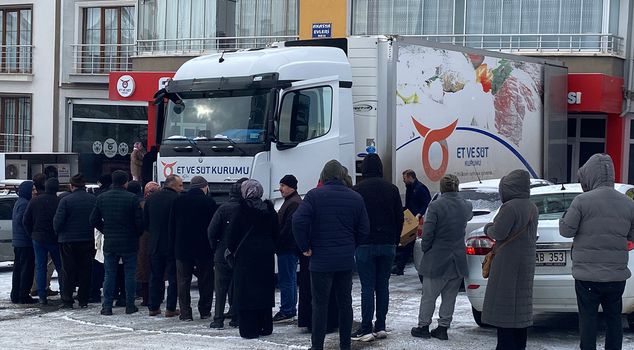
In Yozgat, hundreds of citizens are waiting for hours in line in front of the Meat and Milk Institution (ESK) store to buy approximately 9-10 kilograms of frozen minced meat and beef, despite the cold weather and snowfall. They start queuing in front of the store from 07:00 in the morning in the freezing cold of minus 4 degrees. From 09:00 onwards, the store's doors open and sales begin.
In front of ESK stores, where meat is sold at prices lower than the market, the queue that started before the month of Ramadan continues to grow. Citizens waiting in line in front of the ESK store in Yozgat, despite the cold weather and snowfall, hesitated to speak to the cameras, while some reacted to the filming. The ESK store in Yozgat opens at 07:30 due to Ramadan. Sales begin at 09:00 after approximately 4 tons of frozen meat are unloaded from the refrigerated truck.
MEAT RUNS OUT BY NOON
3-3.5 kilograms of minced meat and 4-4.5 kilograms of beef are provided per person. The meat runs out by noon. The store, which is open until 18:00 during Ramadan, sells products such as chicken, salami, butter, and cheddar cheese. While a kilogram of minced meat is sold for 900 lira in butchers and 1,000 lira in supermarkets, it is sold for 400 lira in ESK, and beef steak, which is sold for 1,000 lira in butchers and 1,375 lira in supermarkets, is sold for 540 lira in ESK.
Butchers in Yozgat stated that 17% of the carcass meat they buy for 630 lira per kilogram is bone, and they try to keep prices as low as possible, saying they have no chance of competing with ESK. Yozgat Agricultural Chamber President İsmail Açıkgöz also stated that ESK applies subsidies to control the market and that meat prices are not expensive according to input costs, noting that the sector most affected by this situation is the livestock breeders and farmers.
"A ANIMAL EATS 250 LIRA A DAY"
Açıkgöz, the President of the Agricultural Chamber, pointed out that meat prices have been a topic in the media for the past month and said:
"Meat is sold for 500-550 lira. Butchers sell meat for 800 lira per kilogram. Supermarkets sell it for 1,300 lira. Here, meat and fish are subsidized. Even if they cost 600 lira, they sell it for 500 lira. They want to be on the consumer's side."
The farmer sells carcass meat for 630 lira. He has his animal slaughtered for 630 lira. Strangely, when it comes to supermarkets, it corresponds to 1,300 lira. Okay, maybe they are doing it boneless, or whatever, but while the meat price has risen, no one is on the side of the producer. No one sees the costs. An animal eats 250 lira a day. The producer buys feed for 800 lira, 850 lira. No one sees this. Normally, if we think of the producer, he should sell this meat for 750 lira to make a profit. But they appear on television; meat has become expensive, meat has become expensive. They sell meat they bought for 500 lira for 1,300 lira. No one says this. So, no one asks why they are making so much money. Meat has become expensive. But the producer did not raise the prices. How much did you buy it for, how much did you slaughter it for, how much are you selling it for? That needs to be seen. The bone on an animal is 13-15%. If they sell it boneless, that already covers the offal. But the money is made by the supermarkets and the slaughterers.
"MAYBE IT BENEFITS THE CONSUMER, BUT IT DESTROYS THE TRADESPEOPLE"
The one who suffers the most here is the producer. The producer really has no owner. How much does the producer buy? How much did he buy a tiny calf for? He fed it for 10 months, how much did it cost? Sometimes it happens that when you buy a small animal, you feed it for 2 years. No one sees what this animal eats for 2 years. The shepherd has now become 60,000 lira. No one sees that. Straw has become 8,000 lira, no one sees that. Feed has become 800 lira per bag, no one sees that. Feed has become expensive. No one is anyone's servant. As long as the producer does not earn, he will never do this job. Today, lamb meat is still sold for 480 lira, the carcass is 480 lira. You go to the supermarket, chops are 1,200 lira, 1,000 lira. They bought it for 480 lira and sell it for 1,000 lira. Authorities should follow these. They should pursue these. No one should pursue the producer. The producer is already strange and victimized. Therefore, if this is to be controlled, when control is taken, it should be pursued not the producer but the seller.
Açıkgöz, drawing attention to the fact that ESK's policy is not correct, said, "ESK is present in Yozgat, there is a factory. It harms Yozgat. Why does it harm Yozgat? There is one slaughter animal in the poor's house. This used to be slaughtered by butchers. Now they can't even slaughter it because they can't compete with ESK. ESK today boasts that it sells meat for 500 lira. Maybe it benefits the consumer, but it destroys the tradespeople and the producers. No one sees that," he stated.