06.02.2026 15:33
Prof. Dr. Hasan Sözbilir, Director of the Earthquake Research and Application Center (DAUM) at Dokuz Eylul University in Izmir, stated that there will be changes in the active fault map of Turkey and that the number of active faults will exceed 600.
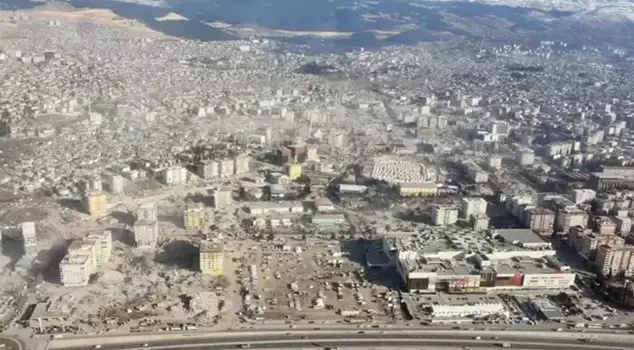
The Eastern, Southeastern, Mediterranean, Central Anatolia, and Black Sea regions of Turkey were shaken by earthquakes of magnitudes 7.7 and 7.6 centered in Kahramanmaraş on February 6, 2023, affecting 10 provinces. The earthquakes caused significant destruction, loss of life, and injuries. On the third anniversary of the earthquake, DEU DAUM Director Prof. Dr. Hasan Sözbilir stated, "On February 6, 2023, we experienced one of the largest earthquakes in the world. In a few seconds, the fault segments from Hatay to Adıyaman and Kahramanmaraş broke one after another. A rupture exceeding 350 kilometers occurred. There was an earthquake of magnitude 7.7. Nine hours later, before people could recover, a second earthquake occurred due to the rupture of a fault at least 150 kilometers further north. Therefore, considering the two earthquakes together, a rare seismic event occurred in the world. We are talking about a death toll exceeding 50,000. There was serious material damage and loss. We are still trying to heal our wounds after these major earthquakes. It has also been a significant lesson for us. The seismic activity in the last 25 years, starting with the 1999 earthquake, has thus reached its peak," he said.
'NEARLY 100,000 EARTHQUAKES OCCURRED'
Emphasizing that earthquake improvement plan studies are ongoing in the region, Prof. Dr. Sözbilir stated, "Efforts are being made to return people to normal life. These are carried out with contributions from both the state and the local population, as well as many people from across Turkey. In addition, many Turkish or foreign institutions, organizations, and individuals from abroad are helping the people in the earthquake zone. On the one hand, risk reduction efforts need to be implemented. Because the region is highly prone to earthquakes. Therefore, if another earthquake occurs, we will feel the risk at a high level again. Especially, there is stress accumulation in the faults adjacent to the broken faults. Currently, approximately 100,000 earthquakes have occurred in the region over the past three years. This is a very serious number. It means that the psychology of the people there cannot stabilize in some way. People cannot return to normal life. Even if they are of medium and small magnitudes, earthquakes are being felt," he expressed.
'POTENTIAL TO GENERATE EARTHQUAKES AROUND 7'
Prof. Dr. Hasan Sözbilir stated that significant aftershocks could also occur in the region, saying, "Aftershocks approaching around 6 can occur in the region. The main mechanism includes Kahramanmaraş, Hatay, and Gaziantep. One of the provinces most affected at the closest level is Adıyaman. However, there are also neighboring faults of the broken faults. We have significant faults on the Adana and Malatya sides. On the Adıyaman side, there are still unbroken segments in some fault branches associated with the East Anatolian Fault. Additionally, on the Göksun side, there is the Savrun Fault at the southwestern tip of the second earthquake. Many earthquakes have occurred on it, but no rupture has yet occurred. We may face a problem related to this in the future. There is a potential to generate earthquakes around 7. The rupture may take years. Currently, it is showing significant resistance. Besides, there is the Ecemiş Fault in the west. It is an important fault extending from Kayseri to Pozantı and Adana. It has also been dormant for a long time. Faults like the Erciyes Fault on the Kayseri side have not produced earthquakes in the long term. These major earthquakes are accumulating stress on these faults."
'IT IS VERY IMPORTANT TO ABANDON OLD STRUCTURES'
Evaluating the new structures built in the region after the earthquake, Prof. Dr. Sözbilir referred to the housing projects carried out by the Ministry of Environment, Urbanization, and Climate Change, stating, "Many buildings in several cities in the region suffered significant damage. The creation of a city from scratch is on the agenda. Since the new urbanization is being done with modern technology, the newly constructed buildings have no chance of collapsing. There is a very important project initiated by the state; within the scope of the housing project of the century, 500,000 houses. This is one of the largest projects initiated on a national scale in Turkey. This number can be increased to 1 million or 2 million houses. Because it is very important to abandon old structures. We need to raise the number a bit more," he said.
'WE WILL NEED TO GIVE TWICE THE IMPORTANCE WE HAVE GIVEN'
Prof. Dr. Hasan Sözbilir indicated that there will be changes in Turkey's active fault map, stating, "In Turkey, especially after 2023, after the major earthquake, the faults in Turkey have been reassessed from scratch. It is being updated to see if there are active faults that are not on our map. The new active fault map of Turkey will be announced by our government in the coming months. Accordingly, we can say that there is an increase in the number of active faults in Turkey. That is, the number of active faults, which was 485, will exceed 600. In this case, the earthquake risk in Turkey has increased. Different faults will emerge in our different provinces. A new regulation needs to be made regarding them. Therefore, we will need to give twice the importance to risk reduction efforts compared to what we are currently giving," he stated.