09.07.2026 18:01
"Minister of Energy and Natural Resources Alparslan Bayraktar announced that the flow of oil from Iraq to Ceyhan will continue. Minister Bayraktar said, 'As the Iraq-Türkiye pipeline agreement is set to end towards the end of this month, we have finalized an agreement that will cover the next 12 months and ensure the process continues without interruption.'"
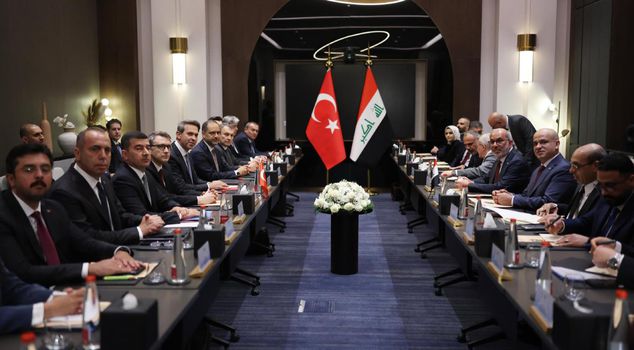
Minister Bayraktar held a press conference in Baghdad after his meetings with Iraqi Oil Minister Basim Muhammad Khudayir and Prime Minister Ali al-Zaidi.
FINAL STAGE REACHED: AGREEMENT WILL COVER 12 MONTHS
"We have been discussing a new agreement to ensure the continued flow of the Iraq-Turkey pipeline for a long time," said Minister Bayraktar. "As the Iraq-Turkey pipeline agreement is expiring towards the end of this month, we have brought a deal covering the next 12 months to its final stage to ensure the process continues without interruption. We aim to sign this agreement in the coming days and share it with the public."
Bayraktar also touched on oil flow through the Iraq-Turkey pipeline, stating, "Oil flow from Iraq to Ceyhan will continue."
Stating that Iraq-Turkey energy relations have broad potential, Bayraktar noted that they discussed this matter with Iraqi Prime Minister Ali al-Zaidi and Iraqi Oil Minister Basim Muhammad Khudayir and conveyed President Recep Tayyip Erdogan's message to them.
A HALF-CENTURY PROJECT
Bayraktar expressed that the Iraq-Turkey oil pipeline project is a half-century-old project ongoing since the 1970s and said that Turkey has kept this pipeline operational for a long time.
Minister Bayraktar noted the following:
"Some past incidents and instability in the region unfortunately prevented this pipeline from being used at full capacity. Now, the point we are jointly looking at is to fully utilize the capacity of this pipeline and even increase its capacity. It is actually an important alternative regarding extending the pipeline to Basra and delivering oil produced in Basra through this line to Ceyhan and then to global markets. The tensions between Iran and the US, and years of uncertainty in global markets due to conflict, necessitate two things: we need more connectivity and we must implement a very important diversification strategy. All of Iraq's oil exports go through the Strait of Hormuz, and a blockage there creates a handicap for Iraq. This applies not only to them but also to the global oil market."
"OUR GOAL IS TO USE EXISTING CAPACITY FULLY"
Speaking on capacity increase of the Iraq-Turkey oil pipeline, Minister Bayraktar stated, "What we aim for is to fully utilize the existing capacity, but the region's potential certainly requires including other producers, and if they have needs and interest, it might be possible to open this door to them as well. It might be possible to transform this (pipeline) into a 2.5 million barrel oil pipeline. Our advantage right now is the existing presence of this pipeline. This line exists, and we can realize 1.5 million barrels without needing a huge investment. We can increase its capacity much more with additional investments."
INVESTMENTS ON TURKEY'S SIDE COMPLETED
Bayraktar indicated that there is a need for connectivity with Iraq also in terms of electricity, stating that the power transmission line between the two countries could be operated at full capacity and with increased capacity through new transmission lines.
Emphasizing that they conveyed to Iraq the idea of bringing natural gas through Turkey to operate existing and potential new power plants there, Bayraktar noted that investments on Turkey's side have been completed.
Bayraktar said, "There is currently natural gas at Turkey's border. With natural gas pipelines we will build from Iraq's side, we might meet its natural gas needs from there for a few years, but later we want to jointly realize projects where we can use the same pipeline to bring other natural gas resources produced in Iraq or the Gulf to Turkey via reverse flow and through Turkey to Europe."