31.10.2026 11:00
The Energy Market Regulatory Authority (EPDK) has lowered the threshold for benefiting from the state-supported electricity tariff in households for 2027 from 4,000 kilowatt-hours to 3,000 kilowatt-hours annually. Under the current tariff, the limit corresponds to an average of 250 kilowatt-hours per month and a bill of approximately 826 liras. Approximately 6.5 million subscribers exceeding the limit will gradually switch to a cost-based tariff starting January 1, 2027.
The number of high-consumption electricity subscribers will rise from 2.5 million to 6.5 million with EPDK’s new decision. Households exceeding the limit will not be able to benefit from state support and will pay for electricity depending on market prices. According to Haberler.com’s calculation, if the market prices of recent days are maintained, the bills of these households could more than double.
LIMIT REDUCED FROM 5,000 TO 3,000 IN THREE YEARS
At EPDK’s Board meeting held yesterday, the consumption limits to be applied in 2027 were determined. For residential subscribers, the annual last-resort supply limit was applied as 5,000 kilowatt-hours in 2025 and 4,000 kilowatt-hours in 2026. With the new decision, the limit was reduced to 3,000 kilowatt-hours for 2027.
EPDK has been setting annual consumption limits by subscriber group since 2018 under the Last Resort Supply Tariff. Subscribers exceeding this limit are considered high-consumption and receive electricity under the last-resort supply tariff based on market prices instead of the state-supported national tariff.
6.5 MILLION SUBSCRIBERS WILL ENTER THE UPPER BRACKET
There are 44.2 million residential electricity subscribers in Turkey. According to EPDK’s data, with the new regulation approximately 6.5 million subscribers will enter the high-consumption consumer group. This number corresponds to 14.7 percent of all residential subscribers.
This year, the number of residential subscribers exceeding the limit was approximately 2.5 million, and 6 percent of homes were in the upper bracket. Thus, the number of subscribers in the upper bracket will increase approximately 2.6 times in one year.
HOW MUCH DOES A HOUSEHOLD AT THE LIMIT PAY TODAY?
The annual 3,000 kilowatt-hour limit corresponds to average monthly consumption of 250 kilowatt-hours. Under the national tariff, which has not changed since April 2026, a single-rate residential subscriber pays approximately 3.24 lira per kilowatt-hour including taxes for consumption up to 8 kilowatt-hours per day. For consumption exceeding this limit, the unit price rises to approximately 4.86 lira.
Accordingly, the bill for a household using 250 kilowatt-hours of electricity in a 30-day period is calculated as follows: 777 lira for the first 240 kilowatt-hours and 49 lira for the remaining 10 kilowatt-hours. The total bill is approximately 826 lira. This means an annual electricity bill of approximately 9,900 lira.
HOW MUCH WILL THE BILL INCREASE?
The amount subscribers who switch to the upper tariff will pay is not fixed. The last-resort supply tariff changes depending on the monthly market clearing price (PTF) and the renewable energy support cost (YEKDEM). This amount is multiplied by a coefficient of 1.05 for residential subscribers, and the distribution fee and taxes are added on top.
Two data points were used in the calculation. The first is the market price per megawatt-hour, which averaged 3,387 lira on October 26-30 according to EPİAŞ data. The second is the 526-lira YEKDEM cost projected by EPDK for October. With these data, a high-consumption residential subscriber should pay approximately 7.41 lira per kilowatt-hour including taxes.
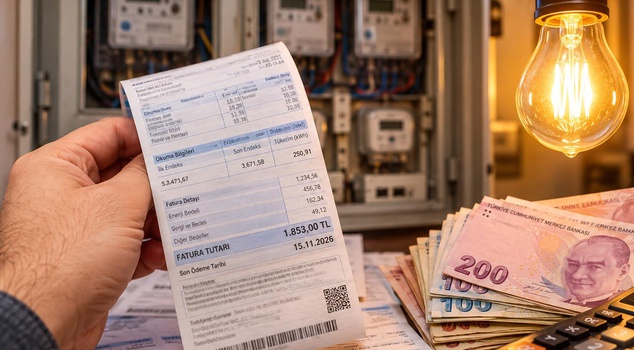
At this price, the same household’s monthly bill for 250 kilowatt-hours rises to approximately 1,853 lira. According to this calculation, the bill increases by approximately 1,027 lira, or 124 percent, to 2.2 times its previous amount. However, this calculation, based on a period when market prices remained high, may point to a lower difference in months when prices fall.
NOT A GENERAL INCREASE
EPDK announced that no price change was made to the national electricity tariff with the decision. The regulation only foresees removing subscribers who exceed the annual consumption limit from the state-supported tariff. Therefore, the decision does not mean a general electricity price increase covering all subscribers.
WHICH SUBSCRIBER WILL SWITCH TO THE UPPER TARIFF AND WHEN?
According to the schedule set by EPDK, the high-consumption tariff will not be applied immediately. Starting from the first day of the third month following the month in which the consumption limit is exceeded, the high-consumption tariff will be applied to subscribers who do not have a bilateral agreement with their supplier. The limit may be exceeded in 2027 or in the previous calendar year, 2026.
Accordingly, the transition schedule is as follows:
For subscribers whose 2026 consumption first exceeds 3,000 kilowatt-hours with the October bill, the upper-bracket tariff will be applied starting January 1, 2027.
For subscribers who first exceed 3,000 kilowatt-hours with the December bill, the upper-bracket tariff will be applied starting March 1, 2027.
For subscribers who do not exceed the limit in 2026 but exceed 3,000 kilowatt-hours with the June 2027 bill, the new tariff will be applied starting September 1, 2027.
For consumers who exceed the limit as of July 31, 2027, on meters capable of hourly reading, the unsupported tariff will be applied starting October 1, 2027.
WHO WILL NOT BE AFFECTED?
No change was made to the annual consumption limit for the agricultural activities subscriber group. The annual 15,000 kilowatt-hour limit applied to the industry, public and private services sector, and lighting subscriber groups was also maintained.
Mosques, places of worship, cemevleri, and associations in the residential subscriber group were excluded from the regulation. Families of martyrs, combat veterans and disabled veterans, village drinking water, and temporary accommodation centers belonging to AFAD were also not included in the limit. Consumers dependent on dialysis support units, respiratory devices, and similar life-support devices will also not be affected by the regulation.