31.10.2026 12:43
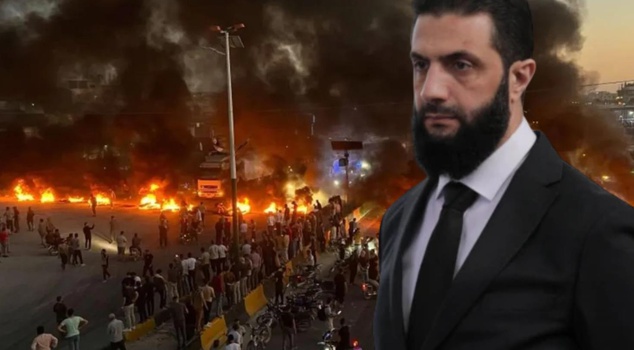
In Syria, the government's decision to raise fuel prices again sparked the largest protests seen since Ahmed al-Sharaa came to power two years ago. With the removal of subsidies, the price of bread rose 10-fold, while electricity costs increased several hundred-fold in some areas. According to the United Nations, 90 percent of Syrians live in poverty. Following the backlash, the price increase decision was canceled.
After the overthrow of the Assad regime, Syrians who hoped the economy would quickly recover are grappling with a deepening cost-of-living crisis. As the price of almost everything, from bills to basic necessities, has risen, many families say they have had to skip meals.
FUEL PRICE HIKE ROCKS THE STREETS
Last month, protests began in squares and streets across Syria. Demonstrators reacting to the government’s decision to raise fuel prices again burned tires, blocked roads and chanted slogans. These protests were recorded as the largest expression of discontent since Syrian President Ahmed al-Sharaa came to power two years ago.
Speaking on Syrian television, one citizen said he supported the authorities but had reached a point where he could not buy bread. Another citizen said, “To be honest, we have started to fear what kind of new decision will be made every morning.”
“THIS WILL CAUSE AN EXPLOSION”
Many saw the unexpected increase in fuel prices as a sign that the government was out of touch with the people. Addressing al-Sharaa, one protester said, “We don’t want roundabouts. They build a new roundabout every day. The people were with you, and they still are, but this will cause an explosion.” Days later, as new calls for demonstrations were made, the price increase decision was canceled.
The hike was the latest in a series of measures that Syrians cite as the cause of their growing cost-of-living crisis. The overthrow of Bashar al-Assad by opposition forces led by al-Sharaa ended the Assad family’s 50-year rule and a civil war lasting more than 13 years. But after this process, life became even harder financially for many Syrians.
BREAD UP 10-FOLD, ELECTRICITY UP HUNDREDS-FOLD
Since coming to power, the government has removed long-standing subsidies as part of austerity policies. The price of bread, Syria’s staple food, has increased 10-fold. Fuel prices have risen to the same level as the international average. This has put pressure on farmers and made transportation expensive. In some areas, the cost of electricity has risen several hundred-fold.
In response, authorities raised the salaries of public employees and retirees. But as prices continued to rise, the effect of the additional payments disappeared.
“WE CAN’T AFFORD TO BUY CHICKEN OR MEAT”
Speaking to the BBC in an open-air market in a suburb of Damascus, Fatima Saleh Eid (50), who works as a cleaner to support her family, said, “We have suffered a lot.” Eid’s husband recently found work at a ceramics factory after being unemployed for a year. In some streets, men can be seen gathering in the hope of finding day labor, but often waiting in vain.
Eid said, “We eat less now. We can’t afford to buy chicken or meat. We eat only vegetables, but even that is expensive. God willing, everything will get cheaper.”
Citizens gathered in the market also described similar hardships. An elderly man said he had stopped eating meat. A young man in his twenties said his family could no longer afford his father’s heart medication. A young woman said she and her four children could only eat a proper meal every two days.
90 PERCENT LIVING IN POVERTY
Retired Marwan Bashur (68) said he receives about $90 a month, the minimum public-sector wage, and said, “This is absolutely not enough.” Last year, the United Nations Development Programme announced that 90 percent of Syrians were living in poverty.
Bashur said, “Sometimes I borrow money, and sometimes I sell things from my home. An old pot or plates we never used, things that were given to us as gifts. I even had to sell furniture.” Bashur, who previously relied on support from aid organizations, said he had lost that support as organizations reduced their services due to funding cuts.
GOVERNMENT LINKED HIKE TO WAR
Syria has also been affected by the US-Iran war. The government argues that the fuel price increase that sparked protests was partly caused by pressure in energy markets due to the war.
Retired Nabil al-Ramheyn (63), none of whose four adult children can find work, said, “We now eat only one meal a day. This is very tragic. It is not just me. The entire population is like this. We are all hungry. We are suffocating under rising prices.”
“I AM AFRAID OF THE ELECTRICITY BILL”
Al-Ramheyn, who lives in a poor neighborhood with narrow streets and modest buildings, said, “I am afraid of the electricity bill. We have reduced the lighting in the house and turn off the refrigerator for about five hours a day.” It was learned that the family’s last electricity bill amounted to about a third of their income and has not yet been paid.
EXPERT: PART OF THE CRISIS IS THE GOVERNMENT’S FAULT
Syrian writer Dr. Haid Haid, a researcher at the London-based think tank Chatham House, said that “a significant portion” of the population is worse off than before Assad’s overthrow. Haid argued that the economic crisis is “one of the most dangerous issues” for the government and that part of it is the government’s own fault.
Haid said, “Part of the crisis is related to a lack of financial resources and the legacy left by the old regime. But it is also a direct result of new policies that are taking Syria toward a liberal and free-market economy and that do not take into account their impact on people.” A spokesperson for Syria’s Ministry of Economy and Industry said no one was available for an interview.
SANCTIONS LIFTED, RECOVERY DID NOT COME
During al-Sharaa’s era, sanctions imposed on the Assad regime were lifted, and the United States removed Syria from its list of countries supporting terrorism. Al-Sharaa, who continues to consolidate his power, took back the resource-rich northeast from the Kurdish-led SDF earlier this year. The Druze, meanwhile, control areas in the south where they want to establish an autonomous administration, and Israel maintains occupation of some parts of the southwest.
However, a real economic recovery has not yet occurred. After a war that killed half a million people and displaced half the population, much of the country remains in ruins. Many families who cannot pay rent live in partially destroyed buildings.
The World Bank estimates the reconstruction cost at 216 billion dollars and states that Syria’s reconstruction will not be possible without foreign aid and investment.
“IF THEY DON’T CHANGE, I FEAR CHAOS WILL BREAK OUT”
Syrian economist Samir Aita, President of the Paris-based Arab Economists’ Circle, said that the crisis is “a combination of the policies implemented, together with the government’s inability to manage expectations and its creation of unrealistic hopes.” Aita said, “This is not sustainable. If they don’t change, I fear chaos will break out.”
Some Syrians, exhausted after years of conflict, however, remain hopeful. Taxi driver Abu Mahmoud said, “They took over the country in a bankrupt state, so people need to be patient. Everything doesn’t happen overnight.”
.