19.10.2026 10:32
In the rainfall that caused floods and inundations in Istanbul, approximately 40 percent of the annual rainfall fell in Beykoz and 30 percent in Sarıyer in a single day. Prof. Dr. Ceyhun Özçelik, noting that the rainfall that should be received until the first weeks of January was received in one day, said that urgent arrangements should be made on the most affected Ayazağa and Kağıthane Stream line.
Evaluating the floods and inundations that occurred in ISTANBUL, Prof. Dr. Ceyhun Özçelik said, 'In Beykoz, we received about 40 percent of the rainfall the city should get in 1 year, and in Sarıyer, 30 percent of it, in 1 day. This means that, statistically, we received in 1 day the rainfall we should get until the first weeks of January.'
THE RAIN THAT WOULD FALL UNTIL JANUARY FELL IN 1 DAY
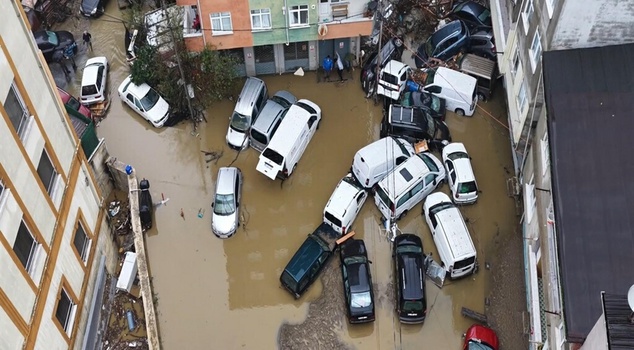
Faculty Member of the Department of Civil Engineering, Faculty of Engineering and Architecture, Istanbul Nişantaşı University, Prof. Dr. Ceyhun Özçelik evaluated the rainfall that caused floods and inundations in Istanbul and made statements regarding the latest situation in the region. Prof. Dr. Özçelik said, 'As a result of the rainfall that intensified in Istanbul on October 14, we were faced with floods and inundations at almost every point of the city. In Beykoz, we received about 40 percent of the rainfall the city should get in 1 year, and in Sarıyer, 30 percent of it, in 1 day. Statistically, we received in 1 day the rainfall we should get until the first weeks of January. Hoping that the amount of rainfall will be low does not make things easier for us in terms of flood protection in the streams. On the other hand, our citizens staying at home means that we are quite lacking in terms of flood management and that we cannot overcome the problems in urban infrastructure. At this point, it is necessary to distinguish between floods and inundations. Rehabilitation of dry stream beds and making the excess rainfall coming from there protected against flood effects will provide us with great protection in terms of floods. However, in order to be able to speak of inundations formed as a result of inadequacies in urban infrastructure, our urban infrastructure needs to be made protected. Otherwise, it produces a result in which our citizens stay at home and we are inadequate in terms of water resources management.'
THE MOST AFFECTED PLACES ARE AYAZAĞA AND KAĞITHANE STREAM
Prof. Dr. Ceyhun Özçelik continued his words as follows:
'If we take these measures and identify at which points we will be exposed to inundations and at which point the flood in the stream beds will be effective, it produces a result in which our citizens can also develop protection measures at those points and we can overcome the flood effects in the mildest way by taking only local measures in that region. The point where flood effects are seen most is Ayazağa and, continuing from there, Kağıthane Stream. Along a line extending from Vadi İstanbul on the upper right and up to the Ayazağa point above it, Kağıthane Stream has been exposed to flood effects as a result of both the problems in the stream bed and the covering of the stream bed. In order for this place to be resolved as soon as possible, it is necessary to open the covering over the dry stream bed at Ayazağa Square and rehabilitate the stream bed at its source, and in the Vadi İstanbul and Sadabat section below, to make arrangements by preparing an environment where surface runoff waters can flow into the stream bed. Otherwise, in the coming periods, we will face flood and inundation effects even during short-term heavy rainfall.'