23.02.2026 17:41
The fragmented parliamentary picture that emerged after the general elections held in the Netherlands on October 29 dragged the country into months of coalition negotiations. After the elections, in which 27 parties competed and 15 parties entered the House of Representatives, no party was able to secure a governing majority on its own, while three parties reached an agreement to form a minority government after discussions lasting over 110 days. Thus, the new cabinet took office with an oath ceremony held in The Hague 117 days after the election.
After the general elections held in the Netherlands on October 29, the coalition negotiations that lasted for months yielded results. Parties that could not obtain enough votes to govern alone reached an agreement on a minority government formula after negotiations lasting more than 110 days. The new cabinet officially took office with an oath ceremony held in The Hague.
MINORITY GOVERNMENT OFFICIALLY IN OFFICE
The Democrats 66 (D66), who did not reach a simple majority in the 150-seat House of Representatives, formed the government together with the People's Party for Freedom and Democracy (VVD) and the Christian Democratic Appeal (CDA). The coalition formed by the three parties fell 10 seats short of the parliamentary majority with a total of 66 seats.
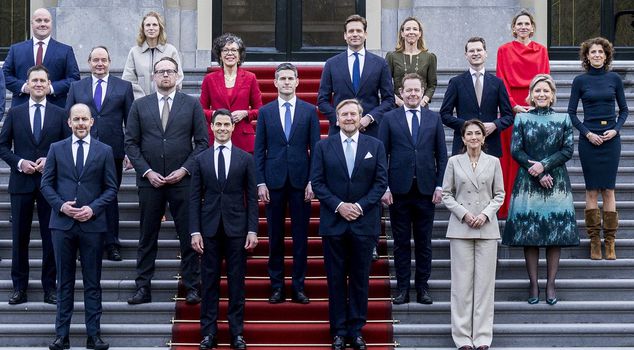
At the ceremony held in the Huis ten Bosch Palace in The Hague, 18 ministers and 10 state secretaries took their oaths in the presence of King Willem-Alexander. Thus, the third government established in the country within the last four years officially began its term.
THE YOUNGEST PRIME MINISTER IN DUTCH HISTORY
The 38-year-old leader of D66, Rob Jetten, became the youngest prime minister in the country's history with the start of the new minority government. The cabinet formed under Jetten's leadership began its term during a period when political balances are delicate.
According to the distribution in the cabinet, there are 10 members from D66, 9 from VVD, and 8 from CDA in the administration. Additionally, a neutral state secretary was appointed.
27 PARTIES PARTICIPATED IN THE ELECTION
In the elections held on October 29, where 27 parties participated and 15 parties entered the parliament, both D66 and the Freedom Party (PVV) won 26 seats each. VVD secured 22 seats, the Green Left - Labour Party alliance obtained 20, and CDA gained 18 members of parliament.
The resulting picture brought along lengthy coalition negotiations due to the fragmented parliamentary structure.
PRIORITIES OF THE NEW GOVERNMENT
The policy program announced by the Dutch government includes priority issues such as accelerating decision-making processes in public administration, increasing housing construction, accelerating energy transition, tightening immigration policies, and implementing comprehensive reforms in the social security system.