18.06.2026 06:30
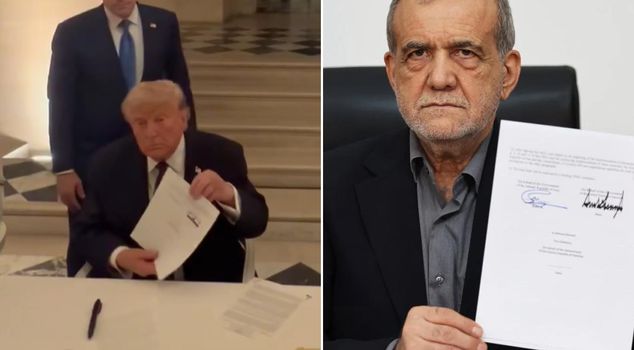
The historic agreement reached between the US and Iran has officially come into effect. The deal was signed digitally by US President Donald Trump and Iranian President Masoud Pezeshkian. The White House shared footage of Trump signing the agreement in France as part of the G7 Summit, while Iran announced that the agreement had been finalized. Pakistan stated that the "Islamabad Agreement" would pave the way for regional peace and thanked the countries that contributed to the process.
The memorandum of understanding, reached after weeks of diplomatic contacts between the U.S. and Iran, has officially entered into force. While parties confirmed that the agreement was signed digitally by the heads of state, the White House shared footage of U.S. President Donald Trump signing the deal with the public. Pakistani Prime Minister Shehbaz Sharif announced that the document, called the "Islamabad Memorandum of Understanding," is a historic turning point for regional peace.
WHITE HOUSE RELEASES FOOTAGE OF TRUMP'S SIGNING
As the repercussions of the agreement between the U.S. and Iran continue, the White House released images of U.S. President Donald Trump signing the deal.
Trump, who was in France for the G7 Leaders' Summit, was seen signing the agreement during a dinner with French President Emmanuel Macron at the Palace of Versailles. In the footage, it was noted that guests in the hall, including Macron, applauded the development.
MACRON: A CORRECT AND IMPORTANT STEP
French President Emmanuel Macron also shared one of the images on his social media account, emphasizing the importance of the agreement.
In his statement, Macron said, "President Trump signed the agreement reached between Iran and the U.S. this evening at Versailles. This agreement will pave the way for lasting peace and ensure the reopening of the Strait of Hormuz. This is a correct and important step and will soon allow for a decrease in energy prices."
IRAN: THE AGREEMENT IS NOW FINALIZED
Following the details of the memorandum being reflected to the public, notable statements also came from Iran.
Iranian Foreign Ministry Spokesman Ismail Baghai announced that Iranian President Masoud Pezeshkian and U.S. President Donald Trump signed the agreement digitally, declaring that the memorandum has officially entered into force.
Baghai said, "The text of the memorandum of understanding between Iran and the U.S. is now formally finalized because both parties have signed it."
"NO SIGNING CEREMONY IN SWITZERLAND"
Stating that it was decided to sign the memorandum digitally, Baghai announced that the planned official signing ceremony in Switzerland would not take place.
Noting that the direct signing by heads of state adds special importance to the agreement, Baghai said, "Since the memorandum was signed by the heads of state of both countries, the cost of violating it will be higher. Based on our past experiences, we preferred it to be this way."
"LEBANON WAS AS IMPORTANT TO US AS IRAN"
Stating that the agreement reflects Iran's fundamental principles, Baghai said that all topics are clearly included in the text.
Baghai said, "For us, a ceasefire in Lebanon and the end of the war was as important as Iran, and it continues to be important. In the first part of the memorandum, Lebanon's name appears three times. Respect for Lebanon's territorial integrity and national sovereignty is included."
"OUR JOB IS NOW HARDER"
The Iranian spokesman emphasized that an important step has been taken to end the war, but the subsequent process is more critical. Baghai said, "The fact that we have signed an agreement to end the war at this stage does not mean we have forgotten the past. Implementing international agreements is always harder than preparing them, especially when parties are not committed to their obligations. From now on, we must all be careful to act in a way that forces the other party to comply with its commitments."
60-DAY PERIOD FOR THE NUCLEAR FILE
Baghai stated that after the memorandum enters into force, the parties will begin a new negotiation process on the nuclear program and sanctions.
The Iranian official assessed, "We will negotiate on the nuclear issue and sanctions within 60 days of the memorandum's entry into force. If negotiations conclude earlier, that would be better. However, considering the complexity of the issue, the 60-day period is reasonable and will be extended if necessary."
AXIOS, AFP, AND REUTERS ALSO CONFIRMED
U.S.-based news site Axios also confirmed that the memorandum was signed by Donald Trump.
In the report citing senior officials, it was stated that Trump signed the agreement during a dinner with French President Emmanuel Macron as part of the G7 Leaders' Summit, and the agreement entered into force.
A U.S. official speaking to AFP confirmed the development, while sources informing Reuters also reported that the text was finalized after being signed by Trump and Iranian President Masoud Pezeshkian.
PAKISTAN: ISLAMABAD MEMORANDUM OF UNDERSTANDING IN EFFECT
Pakistani Prime Minister Shehbaz Sharif also announced that the U.S. and Iran signed the "Islamabad Memorandum of Understanding" electronically.
In a post on his X account, Sharif stated that the agreement was signed electronically by the leaders of both countries, indicating that the will for a diplomatic solution was demonstrated at the highest level.
Sharif said, "The signing of this agreement at the highest level of the relevant governments shows both parties' commitment to resolving the conflict through diplomatic means. The Islamabad Memorandum of Understanding will take effect immediately, and as a first step, Iran will immediately reopen the Strait of Hormuz, while the U.S. will immediately lift the naval blockade."
Sharif also announced that Pakistan, with the support of Qatar, will hold an official ceremony in Switzerland on June 19, 2026, to initiate technical-level talks.
THANKS TO TURKEY, QATAR, SAUDI ARABIA, AND EGYPT
In his statement, Sharif thanked U.S. President Donald Trump and expressed appreciation for Iranian leader Mojtaba Khamenei and President Masoud Pezeshkian.
Praising the efforts of Iranian Parliament and Negotiation Team Head Mohammad Bagher Kalibaf and Foreign Minister Abbas Araghchi, Sharif highlighted Qatar's mediating role.
The Pakistani Prime Minister also thanked the leaders of Turkey, Saudi Arabia, and Egypt for their contributions to the process, expressing hope that the memorandum would serve as a foundation for lasting peace, mutual respect, and shared prosperity in the region.