01.03.2026 19:31
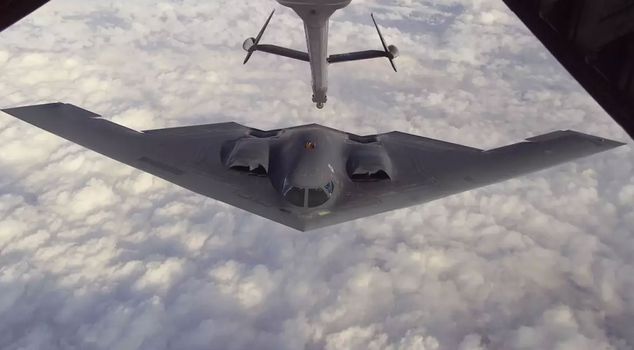
As the attacks by the US and Israel on Iran continue, the Washington administration has deployed B-2 Spirit bombers, known as the "invisible" asset. The US Department of Defense announced that the stockpile of ballistic missiles located in Iran's underground shelters was targeted, and that four B-2 Spirit bombers were involved in the operation. On June 22, the US also struck Iran's nuclear facilities with missiles launched from B-2 Spirit aircraft.
Israel and the United States launched a military attack on Iran on February 28 while negotiations were ongoing between the Tehran and Washington administrations. In response, Iran attacked targets it identified in several regional countries, including Qatar, the United Arab Emirates, and Bahrain, where U.S. bases are located, in addition to Israel.
In the U.S.-Israel attacks, Iranian leader Ali Khamenei and many high-ranking officials were killed. The Iranian Red Crescent announced that 201 people lost their lives and 747 were injured in the bombings targeting the country.
THE U.S. "INVISIBLE" CARD IN PLAY
While the attacks between the two sides continued, the U.S. began deploying the world's most advanced bomber, the B-2 Spirit, known as the "invisible" card. The U.S. Department of Defense announced that ballistic missiles located in Iran's underground shelters were targeted and that four B-2 Spirit bombers were also involved in the operation.
HAD BOMBED IRAN'S NUCLEAR FACILITIES
The U.S. had struck Iran's nuclear facilities, which were targeted on June 22, with missiles approximately 6 meters long and capable of causing damage dozens of meters underground, launched from the aforementioned B-2 stealth bombers. Among the targeted facilities was the Fordo Nuclear Facility, considered the center of Iran's nuclear activities.
FEATURES OF THE B-2 SPIRIT BOMBER
The B-2 Spirit, a strategic bomber of the United States Air Force, holds a significant place in the military aviation sector due to its stealth technology and high cost. Developed by Northrop Grumman, the aircraft entered service in the late 1980s.
The technical specifications of the B-2 are remarkable. It has a wingspan of 52.4 meters, a length of 21 meters, and a height of 5.18 meters. Unlike traditional fuselage-wing designs, the aircraft uses an integrated wing structure. This design aims to reduce radar cross-section.
HAS TECHNOLOGY TO AVOID RADAR DETECTION SYSTEMS
The aircraft's stealth capability is based on a multi-component system. The geometric design prevents the reflection of radar waves. Special materials absorb electromagnetic energy. The engine inlets and outlets are positioned to minimize radar reflection.
The surface coatings consist of carbon fiber composites and radar-absorbing materials. This coating technology works on the principle of converting radar waves into heat. For thermal signature reduction, exhaust gases are mixed with cold air.
Four General Electric F118-GE-100 turbofan engines provide a total thrust of 31,388 kilograms. Each engine produces 7,847 kilograms of power. The maximum speed is reported to be 1,010 kilometers, with a cruising speed of 900 kilometers.
The operational range is 11,100 kilometers. With aerial refueling, this distance can become unlimited. The maximum service ceiling is 15,200 meters. The takeoff distance is recorded as 2,600 meters, and the landing distance as 1,600 meters.
WEAPON SYSTEM CAPACITY
Two internal weapon bays offer a payload capacity of 22,700 kilograms. Conventional and nuclear weapon options are available. It can carry 16 B83 nuclear bombs or 80 Mark 82 general-purpose bombs. There is also the option to use 80 JDAM precision-guided munitions. It has the capability to carry 16 AGM-158 JASSM cruise missiles. The GBU-57 MOP bunker penetrator is also among the weapon options.
ONLY 21 UNITS EXIST IN THE U.S.
The total cost of the B-2 program reached 78 billion dollars. The unit cost was calculated at 2.1 billion dollars. Research and development accounted for 46 billion dollars, while production cost 24 billion dollars. Program management incurred a cost of 8 billion dollars. The hourly operational cost is 135,000 dollars. The annual maintenance cost is 3.4 million dollars per aircraft. Each B-2 requires 15 technician personnel. Initially, 132 units were planned for production, but only 21 were completed.