26.08.2026 17:11
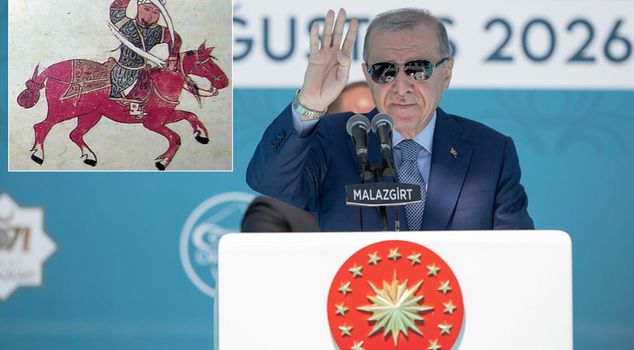
President Recep Tayyip Erdogan, in his speech on the anniversary of the Malazgirt Victory, delivered a message of irrevocable determination, saying, "We have tied our horse's tail for the goal of the Century of Türkiye and a terrorism-free Türkiye." This historical tradition, rooted in Sultan Alp Arslan's 1071 Malazgirt and the Orkhon Inscriptions, symbolizes in Turkish war culture the refusal to turn back, the willingness to risk death, and the resolve to fight to the end.
President Recep Tayyip Erdogan made a big impact with the phrase "We tied our horse's tail" used in his speech at the anniversary ceremonies of the Malazgirt Victory. After this statement, where Erdogan emphasized determination, the deep-rooted tradition of Turkish military history became a matter of curiosity.
Addressing the public at the commemoration ceremonies held in Malazgirt district of Mus, President Recep Tayyip Erdogan gave critical messages containing historical symbols regarding the Turkey Century and the goals of the fight against terrorism.
"WE TIED OUR HORSE'S TAIL"
In his speech, President Erdogan, referring to the ancient war rituals of Turkish culture, used the following statements: "As a nation, we have a very old tradition. When we go on an expedition, when we set out on a path, when we undertake a task, we tie our horse's tail. We do this to express that no matter what happens, we will not return and we will go to the end. Likewise, we tied our horse's tail to build the Turkey Century. We tied our horse's tail to achieve our goals of a Turkey free of terrorism and a region free of terrorism. We tied our horse's tail to make the geography we are in a land of peace and tranquility once again, and to pull out the daggers struck at our eternal brotherhood, such as terrorism."
WHAT DOES "TYING A HORSE'S TAIL" MEAN IN HISTORY?
The tradition, which came to the forefront following Erdogan's statements, stands out as one of the most important symbolic and practical applications of Turkish war culture.
- Technical Reason: It was done to prevent the horse's tail hairs from getting caught in bushes or restricting the horse's movement on the battlefield.
- Symbolic Meaning: It meant "not returning from the struggle", "risking death", and a vow of determination. In ancient Turkish sources, this situation was called "kuyruk tügmek" or "at çermetmek".
IT EXTENDS FROM SULTAN ALP ARSLAN TO THE ORKHON INSCRIPTIONS
Historical sources show that this symbolic practice was personally applied at turning points in Turkish history:
- Sultan Alp Arslan and Malazgirt (1071): Before the historic Battle of Malazgirt in 1071, Sultan Alp Arslan wore his white garment, for which he said "If I die, let it be my shroud," then tied his horse's tail with his own hands and gave the same order to his army.
- Dīwān Lughāt al-Turk (1074): In his work, Mahmud al-Kashgari included the phrase "Alp er atın çermetti. Yiğit adam atının kuyruğunu bağladı" (The brave man tied his horse's tail) and defined it as a sign of valor and heroism.
- Orkhon Inscriptions: The lines in the Bilge Tonyukuk Inscription, "I did not let armed enemies roam among the Turkish people, I did not make their horses with knotted tails run," prove that the tradition is a military operation symbol dating back to pre-Islamic Turkish states.