05.08.2024 16:02
Approximately 47 tombs, dating back nearly a thousand years, were discovered during excavations in the ancient city of Nysa in Aydın. Professor Dr. Öztaner, the head of the excavation, stated, "The majority of the tombs being those of infants and children indicates the possibility of epidemic diseases and a difficult life in the city during the 11th century. We are continuing our research to identify this epidemic disease."
Approximately a thousand-year-old 47 tombs were found in the ancient city of Nysa in Aydın.
The excavations in the ancient city, located between two valleys at the foot of the Aydın Mountains in the Sultanhisar district, are continuing under the leadership of Prof. Dr. Serdar Hakan Öztaner, a faculty member at Ankara University Faculty of Language, History and Geography. The ancient city, which has the Akharaka Temple and one of the best-preserved libraries in Anatolia, attracts attention with its theater, stadium, and assembly structure.
Prof. Dr. Öztaner, the excavation director of Nysa Ancient City, said that the famous geographer Strabo wrote in his work that he received education in Nysa and that Nysa is also known as the educational and cultural city of the Roman period with its libraries and theaters. Öztaner stated that they are continuing the restoration works as well as the excavations and said that they have started an exciting season. Öztaner stated that they are continuing to work on Nysa's grid-planned street and street system and reported that they have reached a street that provides a connection to the main trade route on the route of Ephesus, Magnesia, and Tralleis, and they are very excited.
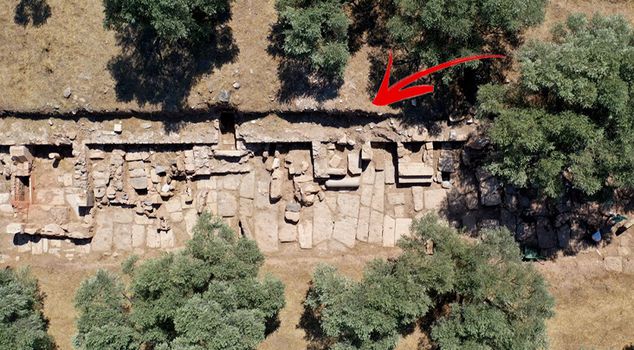
Öztaner stated that they determined the period of use of the street and said, "We found the main north-south street of the city that provides a connection to the main trade route that reaches Magnesia, Trallies, and the present day, starting from Ephesus." Öztaner, stating that the street was used until the 7th century and remained underground after earthquakes, said that they found 47 tombs in the upper fill soil of the street.
MOSTLY BABY AND CHILD GRAVES
Öztaner, stating that the burials date back to the 11th century, said the following:
"We found 47 late period tombs on the street line. The fact that baby and child graves are in the majority among the tombs shows that there may have been epidemic diseases in the city in the 11th century and that life was difficult. We continue our research to determine this epidemic disease. It is understood that there were poorer and more irregular settlements in the last period of the city and the city appears to have been abandoned due to the use of the center as a cemetery."
Öztaner explained that one of the tombs was a chamber tomb and said the following:
"When we opened this tomb, we found a woven piece attached to a coin. It was determined by anthropologists that it was made of linen and that the owner of that tomb was a woman. She had reached her forties and her teeth had become serrated due to weaving. These were exciting for us, of course. It was also important that the fabric was preserved along with the corrosion of the coin. We determined that the tombs date back to the 11th century from the date of the coin."
"IF YOU HAD COME FROM EPHESUS, YOU WOULD HAVE ENTERED THE CITY THROUGH THIS STREET"
Öztaner emphasized the importance of the found street and said, "The importance of this street is that it connects Nysa with the main road passing through the south. Therefore, if you had come from Ephesus, you would have entered the city through this street. Until when? Until that devastating earthquake in the 7th century." he said.
Öztaner added that the length of the street, which dates back 2,000 years, exceeds 1 kilometer and that they are currently working on a 100-meter section.