24.07.2026 15:01
With the establishment of the YENI Party under the leadership of Ozgur Ozel, the number of political parties with groups in the Turkish Grand National Assembly has risen to seven, and new arrangements will be made in the assembly. A new seating order will be formed in the General Assembly of the Parliament, and the number of members in the Presidential Council and commissions will change according to the parties. It is anticipated that the YENI Party will have one group chairman and three deputy group chairmen, while the CHP, which fell from the main opposition after 24 years, will have one group chairman and two deputy group chairmen.
After the 'absolute nullity' decision against CHP and subsequent developments, 91 of the 135 CHP deputies left the party to establish the NEW Party under the leadership of Özgür Özel. With the formation of the NEW Party, the seat distribution in Parliament was reshaped.
A FIRST FOR CHP IN 24 YEARS
The number of political parties with groups in the Turkish Grand National Assembly rose to 7, and the main opposition party became the NEW Party. According to parties with parliamentary groups, the seat distribution was as follows: AK Party 277, NEW Party 91, DEM Party 56, MHP 46, CHP 44, İYİ Party 29, and New Path Party 20. With this picture, the Republican People's Party fell from its position as the main opposition party for the first time in 24 years. Turkey's new main opposition party became the New Party. Although not yet official, it is anticipated that the NEW Party will have one group chair and three deputy group chairs, while CHP will have one group chair and two deputy group chairs.
OFFICES WILL CHANGE
According to information obtained, in the Turkish Grand National Assembly, a new order will be established through correspondence between the party and the Presidency of the Assembly, as required by the procedure for the establishment of the NEW Party. In this context, new arrangements will be made in Parliament, especially regarding the allocation of space for the NEW Party and CHP. Özgür Özel had been continuing his work in the office at the CHP Group Chairmanship in Parliament as the CHP Group Chair after the absolute nullity decision and his eviction from the party. It is expected that the NEW Party will continue in the current 'CHP Group Chairmanship' location, and for the CHP Group, whose number of deputies has dropped to 44 in Parliament, space will be allocated through reorganization of offices. According to the new situation, the names and office signage in the group chairmanships will be changed.
SEATING ORDER IN THE GENERAL ASSEMBLY WILL CHANGE
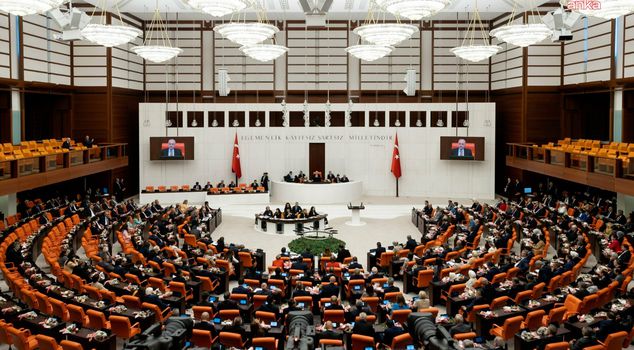
The seating arrangement in the Parliamentary General Assembly will be shaped according to the new situation. The NEW Party, as the main opposition party, will take a place next to the AK Party Group. Based on the number of deputies, the seating order in the General Assembly will be: AK Party, New Party, DEM Party, MHP, CHP, İYİ Party, and New Path Party.
Changes will also be made to the Parliamentary Presidency Council. According to the Assembly's Rules of Procedure, the Presidency Council consists of one Speaker, four Deputy Speakers, seven clerk members, and three administrative officers. The percentage ratios of political party groups within the total number of party groups and the number of positions in the Presidency Council allocated to each political party group will be determined based on these ratios.
Before the establishment of the NEW Party, Tekin Bingöl was serving as the Deputy Speaker of the Turkish Grand National Assembly on behalf of CHP. The other Deputy Speakers of the Assembly are Bekir Bozdağ from the AK Party, Pervin Buldan from the DEM Party, and Celal Adan from the MHP. With Tekin Bingöl's resignation from CHP, one of the Deputy Speaker positions will be assumed by the NEW Party.
COMMITTEES WILL ALSO BE RESHAPED
The number of members in committees will also be reshaped according to the new situation. There are a total of 16 specialized committees in Parliament. The number of members allocated to political party groups in the committees will be determined. Political party groups will announce their candidates, and these candidates will be voted on in the General Assembly.