02.09.2026 17:01
Germany has lifted its partial restrictions on arms exports to Israel, which continues to commit genocide in Gaza, and approved shipments of military equipment worth approximately 800 million euros in the first half of 2025. This amount has already exceeded the total for the entire year of 2025, and the opposition has accused the government of 'double standards.'
The German government has approved the shipment of military equipment worth approximately 800 million euros to Israel, following the removal of partial arms export restrictions that had been imposed on the country, which is accused of committing genocide in Gaza.
WORTH A TOTAL OF 800 MILLION EUROS
According to a report by Der Spiegel magazine, in a response by Germany's Ministry of Economics and Energy to a parliamentary question submitted by the opposition Left Party (Die Linke), it was stated that following the lifting of export restrictions on November 24, 2025, licenses were issued to German defense industry manufacturers during the January-June period of this year for the supply of military equipment totaling 800 million euros to Israel.
It was noted that the total export permits granted to Israel in the first six months of this year exceeded the amount for the year 2025. Large-scale projects in the defense industry were the main factor behind this rise.
GERMAN SUBMARINE SETS SAIL FOR ISRAEL
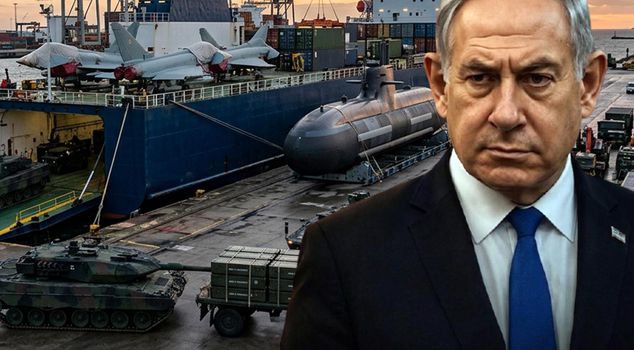
It was reported that approximately 67 percent of the budget of 735.8 million euros approved in the second quarter of the year belonged to a project in the maritime sector. In this context, it was stated that the submarine named "INS Drakon," built by the German shipbuilding company ThyssenKrupp Marine Systems (TKMS) and equipped with an air-independent propulsion system, departed from the shipyard in Kiel and set sail for Israel.
It was recorded that 21 percent of the permits covered joint projects carried out between German and Israeli companies in line with the strategic interests of the German Armed Forces (Bundeswehr). It was also reported that the remaining export approvals consisted of military equipment such as light weapons, ammunition, explosives, and unmanned aerial vehicles.
LIFTING OF TEMPORARY EMBARGO ACCELERATED SHIPMENTS
Chancellor Friedrich Merz had suspended the export of weapons that could be used in the region on August 8, 2025, following Israel's decision to expand its attacks in Gaza. However, this decision was repealed on November 24, 2025, approximately 3.5 months later.
The magazine's report included the assessment that the removal of the temporary restrictions previously applied was influential in the increase in arms exports to Israel.
OPPOSITION'S "DOUBLE STANDARD" REACTION
The government's continued arms shipments to Israel at an increased rate has also brought about political debates in the country. Lea Reisner, the Left Party's spokesperson for International Relations, who strongly reacted to the decision, accused the Berlin administration of implementing "unlimited double standards."
Reisner, recalling that Israel's far-right National Security Minister Itamar Ben-Gvir's statements targeting civilians in Gaza were condemned by the German government, criticized the fact that despite these condemnations, military support continued to increase behind the scenes.
The Left Party reiterated its call for the federal government to immediately and completely halt arms exports to Israel.
Germany's sales of weapons and military equipment to Tel Aviv amounted to 327 million euros in 2023, 161.1 million euros in 2024, and 260 million euros in 2025. The country's sales of weapons and military equipment to Israel in 2023 had increased tenfold compared to the previous year.
While the German government has long been a "loyal" supporter of Israel, German political leaders defend this support by referring to the country's historical responsibility towards Israel arising from its Nazi past and the Holocaust.
In the country, arms export permits are decided through a joint assessment by the Ministry of Economics and Climate Protection, the Ministry of Foreign Affairs, and the Federal Office for Economic Affairs and Export Control.
In strategic and sensitive situations, however, the final decision is made by the Federal Security Council, which includes the Chancellor and relevant ministers.
The Berlin administration does not share information regarding indirect shipments made through third countries.