14.03.2026 22:12
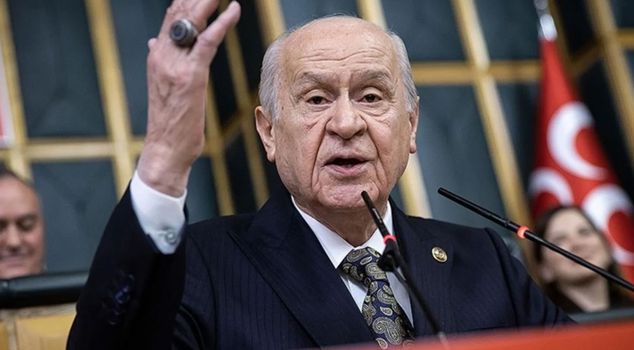
Speaking at the iftar program organized by his party, MHP Chairman Devlet Bahçeli made striking comments regarding Israel's intense attacks on Lebanon, following its decision to expand its ground occupation. Emphasizing that more comprehensive options to strengthen Lebanon should be openly discussed, Bahçeli stated, "If Lebanon collapses, it will not be just one country that falls; a new belt of instability will emerge in the Eastern Mediterranean. If Beirut falls, it will not be just one city that is wounded; the geopolitical balance of the region will be shaken."
The Chairman of the Nationalist Movement Party (MHP), Devlet Bahçeli, made evaluations regarding the agenda at the iftar program organized with the participation of mayors.
Here are the key points from MHP leader Bahçeli's speeches:
"IN SHORT, THE WORLD HAS REACHED A RADICAL BREAKTHROUGH THRESHOLD THAT CANNOT BE EXPLAINED WITH OLD CONCEPTS; IT CANNOT BE GOVERNED WITH OLD MEMORIZATIONS"
While maps may seem to remain in place, the balance of power behind the maps is being reestablished by deep circles. Although states are defined and referred to by the same borders, security belts are narrowing in some places, expanding in others, and breaking in some areas.
In short, the world has reached a radical breakthrough threshold that cannot be explained with old concepts; it cannot be governed with old memorized patterns. This break is not merely the sum of a few regional tensions; it is a historical threshold where power balances are being re-evaluated across a wide line extending from the Middle East to Eurasia and then to the Pacific, where the internal resilience of states is being tested, and a new geopolitical order is slowly taking shape.
The issue facing Turkey is precisely this. Will it be a spectator waiting on the edge of this tumultuous era, or will it become a country that determines its direction with state wisdom, fortifies its internal front, and becomes one of the founding actors of the regional equation?
As we live through the days that history will record in the future, we must seek the answer to this question and clearly outline the direction Turkey should take.
"TODAY, WE ARE INDEED IN SUCH A THRESHOLD"
History sometimes progresses slowly; states and societies spend long periods without realizing the change. Sometimes, however, the tensions accumulated over centuries are compressed into a few years, a few months, or even a few weeks, and the world suddenly enters a fast-paced time. Today, we are indeed in such a threshold.
The humanitarian drama in Gaza, the deepening fracture in the Lebanese theater, the increasingly uncontrollable state of war centered in Iran, the fragility on the ground in Syria and Iraq, the impact of the Ukraine-Russia war shaking the European security architecture, the instability line extending from Afghanistan to Pakistan, and the macro and micro strategic competition in the China-India arena; none of these are disconnected and coincidental events. On the contrary, they are different fronts of a major reckoning where power balances are being re-evaluated across a wide belt extending from Eurasia to the Middle East, security belts are being redrawn, and the global order is gaining a new geometry.
"THESE ARE NOT COINCIDENTAL EVENTS"
For this reason, it is not sufficient to read events only through the images reflected on the screen, the daily hot news language, or the superficial chronology of military retaliations. At the heart of the issue lies the struggle to control energy lines and trade corridors, the reallocation of spheres of influence, competition conducted through proxy networks, the strategic activation of sectarian and ethnic fault lines, and ultimately the evolution of the global power architecture towards a new arrangement.
The warning expressed by Mustafa Kemal Pasha gains additional value in this tumultuous period we are experiencing: "Do not rush to make a decision; but once you have made a decision, do not hesitate."
In state administration, the issue is not just knowing the truth; it is about being able to articulate the truth at the right time, taking the right measures without delay, sensing danger before it arrives at the door, and being able to evaluate opportunities without wasting them. State wisdom is not a spectator that interprets events after they have occurred; it is the will that weighs what will happen in advance, calculates probabilities, and determines the direction accordingly.
Timeless courage often turns into recklessness; delayed measures produce weakness, not power. In contrast, an early grasp of a risk opens up space for states, allows nations to breathe, and provides the ability to manage crises.
"STATE WISDOM IS NOT A SPECTATOR"
The line that Turkey needs today is precisely this: a cool-headed state line that does not succumb to anger, does not get swept away by rhetoric, and does not yield to complacency; one that centers on reason, experience, and national interest. The broad fault line of the Middle East has been reactivated. The fire that started in Gaza has jumped to Lebanon, cast a shadow over Syria, touched Iraq, and finally produced a tremor that extends to the heart of Iran. The struggle taking place here is not merely a battle for military objectives. It also tests the environmental depth of states, deterrence rings, regional influence networks, and their ability to hold on in the global hierarchy. It must be clearly seen that the struggle conducted over proxy lines in the Middle East for many years has now transitioned to a more direct phase directed from the periphery to the center. This situation creates new risks for every actor in the region; the same reality holds true for Turkey.
"THE STRUGGLE HAS TRANSITIONED TO A MORE DIRECT PHASE"
Moreover, this picture is not a development disconnected from history. Approximately a century ago, the regional status quo established by England and partially France after the First World War was built on borders drawn with a ruler and externally centered security architectures. That order persisted in various forms for many years. Today, however, the status quo of the same geography is being reshaped through the strategic approach of the United States and a new security design that places Israel at the center. Thus, the fate of the ancient geography of the Middle East is once again faced with an externally centered design initiative. This initiative risks not only political maps but also the historical truth, memory, and legitimate expectations of the societies living in these lands. Today, one of the main thresholds where this great geopolitical arrangement is knotted is the Iranian theater. Iran is not an ordinary country, nor can a potential tremor it experiences be seen as an ordinary internal disturbance.
A disintegration that emerges in a structure like Iran, which has large, historical, multi-layered, and strong state reflexes, does not merely produce a regime issue; it also results in cross-border security pressures, irregular population movements, sectarian fluctuations, the expansion of smuggling economic networks, the proliferation of proxy armed structures, and the emergence of new geopolitical vacuums.
In other words, an uncontrolled weakening or disintegration in Iran will not remain merely an internal issue for Tehran; it will carry the potential to produce a new wave of instability that spreads to neighboring countries.
"THE PICTURE TURKEY FACES IS DIRECTLY RELATED TO NATIONAL SECURITY, BORDER SAFETY, AND REGIONAL STABILITY"
The issue is precisely this. The matter before Turkey is not a border crisis observed from afar. The picture Turkey faces is directly related to national security, border safety, and regional stability. The experience in Syria has taught us, at a heavy cost, that areas where state authority weakens quickly turn into fields for various armed groups, proxy elements, irregular migration movements, smuggling networks, and external interventions.
Today, developments centered around Iran should also be read with the same attention. The moment a state vacuum occurs in a region, reason, conscience, discernment, and compassion do not settle there; first, weapons settle, then intelligence settles, and afterward, proxy wars settle. Subsequently, the peoples of that geography are crushed under the calculations of others.
"WHEN A STATE VACUUM OCCURS, WEAPONS SETTLE FIRST"
The issue of Lebanon must be discussed here as well. Because Lebanon is a reduced map of the Middle East; at the same time, it is an enlarged contradiction. There is religion, there is sect, there is external intervention, there is a historical fracture, there is an armed structure, there is a weak state, and there are strong foreign calculations.
The fate of Beirut has shown us this repeatedly: As the state weakens, communities grow; as communities grow, external influence becomes easier, and as external influence settles, national sovereignty erodes. As long as this vicious cycle is not broken, even if a country protects its borders, it cannot fully protect its independence.
When looking at Lebanon, it is not enough to see only the current, hot conflict of today. The line extending from the last century of the Ottoman Empire to the mandate years, from the civil war to the 2006 crisis, shows us the same lesson: The moment the internal balance is disrupted, external intervention does not delay.
The moment external intervention settles, the country's own decision-making power diminishes. When decision-making power diminishes, armed structures take precedence over the state. Today, the picture seen again in the Lebanese arena is just that. The burning is not just a front; it is also the erosion of the idea of the state.
"AS THE STATE WEAKENS, COMMUNITIES GROW"
For this reason, the issue of Lebanon should not remain merely an emotional solidarity matter for Turkey; it should also be a historical lesson carrying heavy lessons about security, sovereignty, and regional order. Every incident that happens to Lebanon reminds Turkey of this reality: If the state weakens, geography speaks, softness speaks, sect speaks, weapons speak, foreign capitals speak. If the state stands firm, the nation breathes, borders find safety, and the desire for external intervention is curbed.
The current picture shows this: Israel sees the Palestinian territory as a practically liquidated area and is clearly accelerating its search to expand its security strategy northward. Whether the justification is Hezbollah, Iran, or security; the emerging strategic orientation does not change.
Whatever the excuse, the search for re-establishing regional power balances through a new security belt centered on Israel is becoming increasingly visible.
At this point, the following question must be asked clearly: If the Palestinian territory has been effectively narrowed and fragmented, where is the next pressure line? The answer to this question is not difficult to see.
The Lebanese arena is increasingly becoming a target. This situation signifies a serious geopolitical fracture not only for Lebanon but for the entire Eastern Mediterranean.
"IF BEIRUT FALLS, IT WON'T JUST BE A CITY THAT IS WOUNDED; THE GEOPOLITICAL BALANCE OF THE REGION WILL BE SHAKEN"
Because Lebanon is not just a small country. Lebanon is also one of the key points of the Eastern Mediterranean. Beirut is not just a capital; it is a great gateway where trade, culture, and geopolitics intersect throughout history.
This city and this country, which is the pearl of the Eastern Mediterranean, constitute one of the most sensitive links of regional balances. For this reason, the issue of Lebanon can no longer be addressed solely within the narrow framework of current conflicts. More courageous and comprehensive options that will strengthen Lebanon's state capacity, reinforce its sovereignty, and provide lasting stability in the Eastern Mediterranean need to be openly discussed.
Strengthening Lebanon internally, establishing regional stability mechanisms, and evaluating new political and economic cooperation opportunities with neighboring geographies, if necessary, is an urgent need that can no longer be postponed.
Because the truth is this: If Lebanon, our neighbor by sea, collapses, it will not just be one country that collapses; a new instability belt will emerge in the Eastern Mediterranean. If Beirut falls, it won't just be a city that is wounded; the geopolitical balance of the region will be shaken.
For this reason, the issue of Lebanon is not just Lebanon's issue; it is also a strategic matter directly related to the future of the region and Turkey's security.
"TURKEY'S STRATEGIC DIRECTION IS NOT A DRIFT; IT IS A BALANCE POLICY THAT ESTABLISHES ORDER"
At this point, it is vital to determine what kind of political and strategic line Turkey should follow. Because the issue is not just a regional crisis; it is also a historical threshold where Turkey's geopolitical position, security architecture, and strategic mind are being tested.
Our line is clear. Turkey cannot be dragged into a position of a country swept away by the current of the crisis.
Turkey cannot become an actor that serves the growth of the fire; rather, it must strengthen its position as a central country that limits the fire, balances tensions, calms polarization, and rebuilds regional intelligence. Turkey's strategic direction is not a drift; it is a balance policy that establishes order. This approach is the natural result of a state mind that preserves Turkey's geopolitical weight and ensures its place among the architects of regional stability.
Strategic calm does not mean a shameful wait; it is the power to read the spirit of the time correctly and to put the right weight on the field at the right moment. Composure is not hesitation or slackness; it is a concentration of power that is purified from the murkiness of anger, calculated, and directed towards the target.
Great powers do not falter with rhetoric in times of crisis; they calculate strength, time, and direction simultaneously. They are not swayed by the allure of noisy slogans; they act with the calmness of strategy. They are not trapped by the narrow horizon of instant reactions; they focus on long-term direction.
Because the structure we call the state is not a management that survives with reflexes that save the day. The state stands with a historical intellect that can read the flow of time, sense danger before it escalates, and put all its weight on the field at the right moment. This is exactly what Turkey needs today. Turkey has not become a line of surrender that is integrated into someone else's scenario. It has not been the center of chaotic reactions that do not understand calculations. Turkey's line is a rational state line that fortifies its own security, strengthens its own economy, expands its own geopolitical space, and solidifies its own internal front.
Because countries that falter in the midst of regional storms do not leave a mark on the stage of history; states that determine direction not only overcome crises but also become architects of new balances.
Turkey also has the will and historical capacity to be exactly such a state.
"GREAT POWERS DO NOT FALTER WITH RHETORIC IN TIMES OF CRISIS"
For this very reason, Turkey's task ahead is heavy. It is imperative to quickly escape from the shallow and daily polemics of domestic politics. A political line that cannot produce a lasting work even at a local level in the name of the opposition; a narrow competition between an incompetent figure on one side and a greedy figure on the other, along with a so-called leader who has settled into the role of their supporter and spokesperson, must not be allowed to determine Turkey's strategic atmosphere.
The seriousness of the state cannot walk in the shadow of personal ambitions; the fate of the nation cannot be confined to the narrow corridor of daily political calculations. In moments of geopolitical rupture, wasting time is not only a political flaw; it also produces a heavy strategic cost that narrows the state's maneuvering space.
What Turkey needs in such a period is a strong will rather than noisy polemics; it is a state-level intellect and resilience beyond shallow opposition and competition.
Therefore, a recovery and consolidation at the state level is essential. Minimum common denominators in security, energy, and foreign policy must be rapidly fortified.
If Turkey's internal front is strong, external pressures lose their meaning. If internal resilience is strengthened, regional crises cease to be threats for Turkey and turn into manageable risks.
Because the structure we call the state is not a management mechanism established to save the day. The state is a historical intellect that can read the flow of time; that can sense danger before it escalates, see opportunities before they arise, and keep the fate of the nation above daily calculations.
This intellect sometimes knows how to be patient, sometimes knows how to speak, and sometimes knows how to put all its weight on the field at the right moment. The state intellect of the Republic of Turkey is a continuation of this tradition. This intellect is neither swayed by the noise of rhetoric nor trapped in the narrow horizon of fear.
This intellect is the common will of a nation that does not lose its compass in stormy times. And that will is telling Turkey today: Keep the internal front strong, keep the state intellect alive, and be one of the countries that determine direction in the midst of great storms.
"KEEP THE INTERNAL FRONT STRONG, KEEP THE STATE INTELLECT ALIVE"
From here, I want to clearly address the opposition: While the fire ring around Turkey narrows, a political line that is still preoccupied with municipal backroom dealings, personal ambitions, media glitz, and daily polemics becomes a burden on the country.
Incompetent and greedy cadres who cannot present projects to the state, cannot set horizons for the nation, and cannot act with historical consciousness in moments of regional rupture cannot have the capability to bring Turkey safely out of great storms. It is easy to make noise. It is easy to shine on social media. It is easy to gather crowds with crude sentences. What is difficult is to read the state. What is difficult is to carry the weight of geography. What is difficult is to show a calm and constructive line in times of crisis.
Some of the opposition do not seem to have a horizon that can grasp the nature of the great geopolitical challenge facing Turkey. While the oceans swell, they consider playing in shallow waters with mud in a so-called FREE state of mind as a skill.
Because they cannot read the horizon, they belittle; because they cannot grasp, they simplify; because they cannot comprehend, they confine the issue to the narrow frame of daily polemics.
Surrounding this shallowness are the noisy comments of ear intellectuals, tavern know-it-alls, and some individuals whose names are not even worth mentioning. There is much noise, little understanding; many words, scant comprehension.
However, the subject being discussed here is not any party competition, any election calculation, or a polemic topic consumed on screens. The subject being discussed here is the security and geopolitical threshold that will shape the next century of the Republic of Turkey.
The impact of a severe rupture that may arise in the Iranian sphere is not merely an event concerning Tehran; it produces a shockwave that can extend to Turkey's eastern borders, security architecture, migration movements, economic balances, and internal stability.
Such an issue cannot be handled with slogans. Such an issue cannot be carried with incompetence. Such an issue cannot be left in the shadow of personal ambitions.
The state intellect does not produce polemics in such times; it determines direction. It does not make noise; it puts weight. Because nations that pass through historical thresholds do not advance with the noise of shallow competitions, but with the resilience of a deep state intellect.
That is why the historical accuracy of the national unity and brotherhood project is becoming much clearer today. The external front cannot be protected without fortifying the internal front. Border security cannot be permanently established without strengthening brotherhood.
The state's resistance capacity against external pressures cannot reach maximum levels without deepening social consensus. Every attempt to weaken Turkey with ethnic fault lines, sectarian tensions, political polarization, and cultural separations is directly a matter of national security.
Unity at home produces power. Brotherhood at home produces deterrence. Disintegration at home whets appetites abroad. This truth is clearer today than ever.
The value of the People's Alliance is understood precisely here. The People's Alliance is not a simple electoral partnership; it is a historical unity of will that fortifies the bond between the state and the nation in Turkey's difficult times, strengthens the coordination between security and politics, and fortifies the internal front.
Considering the regional threats that Turkey faces, the stance put forth by the People's Alliance represents solidarity instead of fragmentation, determination instead of looseness, seriousness of the state instead of hesitation, and a sense of direction instead of aimlessness.
The value of the People's Alliance is better understood not on election days, but in such moments of destiny.
"TURKEY IS A STATE THAT DETERMINES DIRECTION IN THE MIDST OF CRISES"
The state mind does not read events with the heat of a single day and pass judgment. It incorporates the weight of tomorrow into today and the memory of history into tomorrow. For this reason, Turkey's current test is not merely about the hot tension along the Iran-Israel-US axis.
The main issue is where Turkey will stand in the new regional architecture that will be established following this tension. If Turkey remains passive, it will be subjected to the outcomes of the equations set by others.
If Turkey acts actively and constructively, it will fortify its own security belt, its own geoeconomic area, and its own diplomatic weight.
Our understanding is clear. Turkey must be a conscience for the oppressed, and a country of safety and peace for its own citizens.
I thank you all very much. Until today, with your practices, you have been the essence, face, truth, and sincerity of local governance in Turkish politics. May God be pleased with all of you. I congratulate you all and wish you success.
Thank you, be well, and may you be entrusted to God."