04.07.2026 13:21
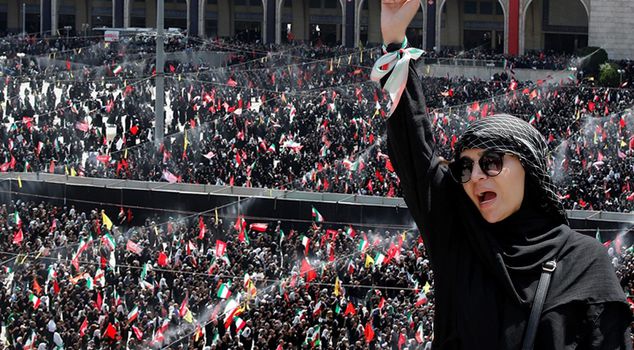
Tens of thousands of people attended the funeral ceremony in Tehran for Iran's former leader Ayatollah Ali Khamenei, who died in a US and Israeli attack. The mourning crowds, which will continue for days, experienced moments of sorrow.
Following the attack launched by the US and Israel on February 28, protocol visits were made yesterday for the body of Iran's religious leader Ali Khamenei, who lost his life in the attack; today it was opened for public viewing in Tehran. As the Iranian administration begins a week-long funeral ceremony for Khamenei, it was reported that the body will be buried in Mashhad after ceremonies in Shiite holy cities in Iran and Iraq.
STARTED AT 06:00 IN THE MORNING
A farewell ceremony was held for Ali Khamenei at Imam Khomeini Grand Mosque in Tehran. Thousands of people from various cities in Iran and abroad attended the ceremony. The ceremony, which started at 06:00 local time, is expected to continue until 20:00.
ANTI-US AND ANTI-ISRAEL SLOGANS
With the sight of Khamenei's coffin placed in the ceremony area, the attending public experienced moments of sorrow. Anti-US and anti-Israel slogans were also shouted during the ceremony.
FUNERAL PRAYER TOMORROW
Iranians filled the area shouting "Ya Hossein" and reciting laments while beating their chests. Some Iranians attended the ceremony, where recitations from the Holy Quran took place, in local attire. The funeral prayer for Khamenei will be held tomorrow at Imam Khomeini Grand Mosque.
TO BE BURIED ON JULY 9
The public ceremony for Khamenei and his family members will continue tomorrow. On July 6 and 7, the funeral will be taken to the city of Qom after passing through other areas of Tehran. Khamenei's body will then be taken to the cities of Najaf and Karbala in Iraq on July 8 for display. After Iraq, Khamenei's body will be brought back to Iran and buried at the Imam Reza shrine in Mashhad on July 9.
TRUMP: WE GAVE IRAN A WEEK
Meanwhile, US President Donald Trump stated in his remarks that Iran "really wanted" to reach an agreement, saying he "gave the Tehran administration a week off" as part of the state ceremony for Ali Khamenei.
WHO IS ALI KHAMENEI?
Ayatollah Ali Khamenei was born in the city of Mashhad on April 19, 1939.
After receiving religious education in Mashhad and Qom, Khamenei joined the movement initiated by Ayatollah Khomeini against the Shah in Qom in 1962. He was arrested and sent into exile at various intervals.
One of the founders of the Islamic Republic Party in 1978, Khamenei served as Deputy Minister of Defense of the Islamic Republic of Iran in July 1979 after the revolution.
On November 24, 1979, he was appointed Chief of the Islamic Revolutionary Guard Corps, and in the same year, he was appointed as the Imam of Friday prayers in Tehran. In 1980, he was appointed by Imam Khomeini as a representative to the Supreme Defense Council of Iran. That same year, he was elected to the Iranian parliament as a deputy from Tehran.
On June 27, 1981, he was seriously injured in a bomb attack allegedly carried out by the People's Mujahedin group at the Abu Zar Mosque in Tehran. In the elections held in October 1981, he was elected as the 3rd President of the country after the revolution. He became President for a second time by winning the presidential elections in 1985.
After Khomeini's death, Khamenei was elected as the Leader (Guide), the highest position in the country, in 1989 with the support of Hashemi Rafsanjani by the Assembly of Experts, which is responsible for selecting and overseeing the country's leader.
Throughout his rule, Khamenei stood out with his anti-Western stance and tried to establish good relations with Russia and China.
While the President, who comes to power through elections in Iran, has limited powers, the leadership position represented by Ali Khamenei, with its constitutional powers above all state organs, had the final say on domestic and foreign policy issues.
The Guide, possessing authority over all state organs including the President, played a decisive role in internal security and foreign policy as the Commander-in-Chief of the Iranian Armed Forces.
Especially in recent years, Khamenei became a target of anti-government activists during street protests stemming from governance issues and economic problems.
Iran's religious leader Ayatollah Ali Khamenei died in the attack launched by the US and Israel on February 28.