06.03.2026 17:50
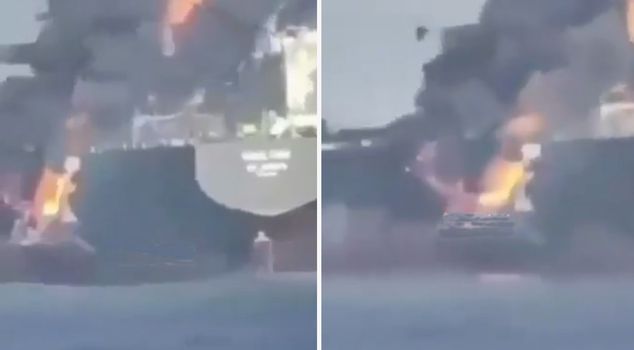
After the US-Israel declared war, Iran announced that it would close the Strait of Hormuz and target every ship attempting to pass through. Iran followed through on its statement. Iranian state television broadcasted the moments when a ship was hit by a drone in the Strait of Hormuz.
The Iranian state television shared moments of a ship being hit by a drone in the Strait of Hormuz.
DRONE ATTACK ON THE SHIP IN THE STRAIT OF HORMUZ
Iran has turned its threat to close the Strait of Hormuz into action following escalating tensions with the US and Israel.
The Iranian state television shared footage of a commercial ship attempting to pass through the strait being hit by an unmanned aerial vehicle (UAV). The footage clearly shows an explosion occurring on the targeted ship and a fire breaking out.
Concerns have increased in global oil prices following the attack. The Iranian Revolutionary Guards announced that any ship that ignores warnings will continue to be targeted.
IRAN HAD CLOSED THE STRAIT OF HORMUZ
Major General Ibrahim Jabbari, advisor to the Commander of the Iranian Revolutionary Guards Army, stated that they had closed the Strait of Hormuz to crossings and would attack ships attempting to pass.
Speaking on Iranian state television, Jabbari said they would not allow crossings through the Strait of Hormuz in response to US-Israeli attacks.
Major General Jabbari stated: "The Strait of Hormuz is closed. We will attack and set fire to every ship attempting to pass. Ships attempting to pass will be burned by our heroes in the Revolutionary Guards Navy and Ground Forces."
“Do not come to this region. The price of oil has reached 82 dollars, and the world is definitely expecting it to reach at least 200 dollars. We will also attack oil pipelines and will not allow a single drop of oil to leave the region.”
THE IMPORTANCE OF THE STRAIT OF HORMUZ
The Strait of Hormuz is considered the most critical and sensitive "jugular vein" of global energy security; approximately one-third of the oil transported by sea worldwide and a significant portion of liquefied natural gas (LNG) passes through this narrow waterway. This strait, located between Oman and Iran, has a narrowest point of about 33 kilometers and serves as a challenging gateway connecting major oil producers in the Persian Gulf to the open seas.
During periods of escalating regional tensions, the mere possibility of closing the strait causes panic waves in global energy markets and leads to rapid price increases, making control and navigation security over Hormuz a geopolitical issue that directly affects not only the countries in the region but the entire world economy.