07.03.2026 09:53
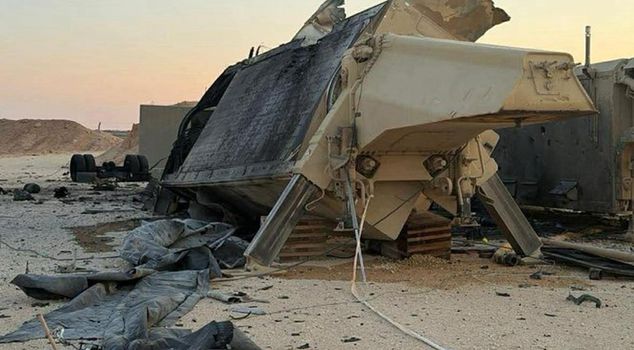
It has been revealed that the AN/TPY-2 radar located at the Muwaffaq Salti Air Base in Jordan was damaged in the Iranian attacks. The radar, which is a critical component of the THAAD missile defense system, is used to detect ballistic missiles from long range. Satellite images showed that Iran specifically targeted the U.S. radar and communication infrastructure in its attacks.
As the Iran war transcends regional conflict, findings that Tehran targeted not only runways or hangars but also systems at the heart of the U.S. missile defense network have drawn attention. According to CNN's analysis, the AN/TPY-2 radar belonging to the American THAAD battery located at the Muwaffaq Salti Air Base in Jordan was hit in the early days of the war, and satellite images from March 2 indicated that the system may have been largely incapacitated.
The same analysis reported that two large craters were observed near the radar, the system was found divided into five separate 40-foot trailers, and it was assessed that all these elements were either destroyed or severely damaged. CNN noted that the radar and THAAD battery had been at Muwaffaq Salti since at least mid-February, and that the base was a heavily used center for the U.S.
IT WAS OF CRITICAL IMPORTANCE
The struck AN/TPY-2 radar is seen as one of the most critical components of the THAAD, or Terminal High Altitude Area Defense system. According to RTX, this radar detects, classifies, and tracks ballistic missiles; it can perform long-range missile detection in forward-based mode and provides direct radar support to the THAAD system in terminal mode. The company explicitly describes the AN/TPY-2 as the "eyes" of THAAD.
The CSIS Missile Threat project also states that the AN/TPY-2 is a long-range, high-resolution X-band missile defense radar that not only detects threats but can also relay target information to other U.S. missile defense systems. Therefore, damage to the system weakens not just a single battery but a broader regional defense network.
SATELLITE IMAGES EMERGED
According to CNN's analysis of satellite images, facilities with similar radar infrastructure were also struck in Saudi Arabia and the United Arab Emirates. The report noted that fire and severe burn marks were observed at the radar site near Prince Sultan Air Base in Saudi Arabia, and that structures housing THAAD battery radars near Ruwais and Sader in the UAE were damaged. It could not be confirmed whether the radars at these two locations were operational at the time of the attack due to the lack of high-resolution images.
In an analysis based on satellite images and verified videos from the New York Times, it was reported that Iranian attacks caused damage to communication and radar systems or nearby elements at least seven U.S. military facilities in the Middle East over the weekend and on Monday. The report highlighted that Iran particularly targeted the communication and sensing infrastructure connecting U.S. bases to the outside world. CNN also reported separately that Iranian attacks targeted communication, radar, and intelligence equipment at U.S. bases, suggesting that the aim could be to isolate American forces from the outside world and weaken the air defense network. The same report indicated that damage was also detected at the Umm Dahal early warning radar system in Qatar.
THEY STRUCK AT THE HEART OF THE THAAD BATTERY
THAAD is a high-level air and missile defense system used primarily for high-altitude interception of ballistic missiles. According to CNN, the U.S. operates eight THAAD batteries; the United Arab Emirates has two, and Saudi Arabia has one THAAD battery. It was noted that the system struck in Jordan was stationed at the Muwaffaq Salti Base, over 500 miles away from Iran.
N.R. Jenzen-Jones, Director of ARES and munitions expert, told CNN that the AN/TPY-2 radar is the "essential heart" of the THAAD battery, enabling the launch of intercepting missiles and contributing to the networked air defense picture. Jenzen-Jones emphasized that the loss of such a radar is operationally extremely significant, and that a replacement may need to be shifted from another region, which would take time.
ITS VALUE IS HALF A BILLION DOLLARS
The report also included information that the cost of an AN/TPY-2 radar is approaching half a billion dollars according to the 2025 Missile Defense Agency budget. This indicates that the struck system holds very high value not only tactically but also economically.
The Pentagon Press Office stated in response to CNN's inquiry that they would not comment on the status of certain capabilities in the region for operational security reasons. For this reason, the U.S. did not confirm whether the radar in Jordan was officially destroyed. However, open-source satellite images and independent analyses reveal that the system has suffered heavy damage. The Wall Street Journal also reported that the U.S. is trying to quickly replace the damaged THAAD radar in Jordan. According to the newspaper, the radar was a crucial link in the U.S.'s broader regional air defense network.
The emphasis on radar, communication, and early warning infrastructure in Iran's attacks shows that the conflict is not merely about reciprocal missile strikes. The choice of targets is interpreted as Tehran's attempt to weaken the U.S.'s "seeing," "monitoring," and "coordinating" capabilities in the region. Especially since systems like THAAD and AN/TPY-2 are at the center of the early detection and interception chain against ballistic missile threats, damage to these elements can directly affect the U.S.'s defense flexibility.