10.04.2026 07:30
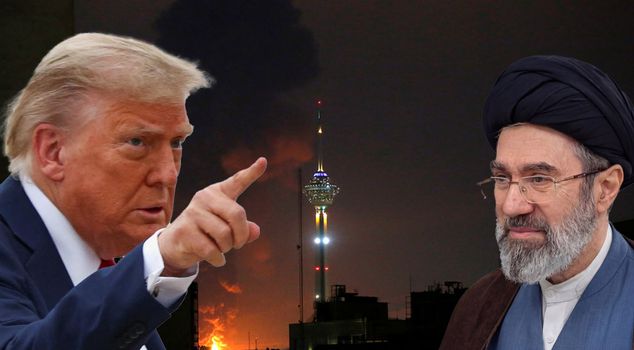
Ahead of critical talks between the US and Iran set to take place in Islamabad, Pakistan, Trump and Hamaney faced off. US President Donald Trump stated that there were reports of Iran demanding fees from ships passing through the Strait of Hormuz, saying, "This is contrary to our agreement." Mojtaba Hamaney, on the other hand, said that a new phase regarding the operation of the Strait of Hormuz would be initiated.
The fragile structure of the ceasefire established between the US and Iran, which lasted for 40 days, became evident from the very first days. While tensions in the region continued, statements came in succession from Iran, the US, and Israel. It was announced that the Iranian delegation would go to Pakistan for negotiations scheduled for Saturday, while Israeli Prime Minister Benjamin Netanyahu instructed to start direct negotiations with Lebanon. Mojtaba Khamenei spoke for the first time after the ceasefire.
HARSH MESSAGES FROM KHAMENEI
The Iranian leader Mojtaba Khamenei used striking expressions in his first statement after the ceasefire.
In his message, Khamenei stated, “Iran is not seeking war, but we will not give up our rights,” emphasizing that attacks against Iran will not go unanswered, and said, “We are determined to take revenge for the previous leader Ali Khamenei and our martyrs.”
Khamenei also called on the Iranian people to continue being in the streets, stating that this would affect the course of the negotiations. “We see all resistance fronts as a whole,” he said.
He also added that a new phase regarding the operation of the Strait of Hormuz would be initiated.
TENSION RISING OVER LEBANON
Iranian President Masoud Pezeshkian also harshly criticized Israel's attacks on Lebanon in a statement made via the social media platform X.
Pezeshkian described the attacks as “a clear violation of the ceasefire agreement and a dangerous sign of non-compliance and deception regarding potential agreements,” expressing that this situation could render the negotiations meaningless.
The Iranian President stated, “We will remain vigilant, and Iran will never abandon its Lebanese brothers.”
TRUMP'S STATEMENT ON THE STRAIT OF HORMUZ
US President Donald Trump issued a warning to Iran regarding the Strait of Hormuz.
Trump said, “I hope Iran is not charging fees for tankers passing through the Strait of Hormuz. If it is, it must stop immediately,” and stated that the flow of oil would resume shortly.
In a later statement, Trump said, “Iran is doing a very bad job of allowing oil to pass through the Strait of Hormuz. In fact, some might say this is dishonorable. This is not the agreement we made.”
NETANYAHU: DIRECT NEGOTIATIONS WITH LEBANON
Israeli Prime Minister Benjamin Netanyahu announced that he had instructed for direct talks with Lebanon.
Netanyahu said, “The negotiations will focus on the disarmament of Hezbollah and the establishment of peaceful relations between Israel and Lebanon.”
According to a report from Axios, a US media outlet, direct negotiations between the two countries are expected to begin next week in Washington.
CEASEFIRE TURNED BACK FROM A CRITICAL THRESHOLD
The Iranian Deputy Foreign Minister announced that the Iranian delegation would participate in the talks to be held in Islamabad, the capital of Pakistan.
The same official stated that Israel's attacks on Lebanon should be stopped by the US, emphasizing that lasting peace in the region should also include Lebanon.
He expressed that Iran was preparing to respond to the ceasefire violation on the night of April 8, but Pakistan intervened and prevented the crisis.
On the other hand, an Iranian source reported that a maximum of 15 ships would be allowed to pass through the Strait of Hormuz daily under the ceasefire.
TENSION ON THE NATO FRONT
According to diplomats speaking to Reuters, NATO Secretary General Mark Rutte conveyed that US President Donald Trump expects concrete commitments from allies for the security of the Strait of Hormuz.
German Chancellor Friedrich Merz also emphasized the need to continue negotiations with Iran in a meeting with Trump.
NATO spokesperson stated that the US is expecting concrete steps for freedom of navigation in the region.
Rutte also stated that NATO is not a unilateral alliance, noting that some allies have been slow to support the US. “Right now, almost all allies are doing what the US wants,” he said.
Rutte also expressed that Iran not having nuclear weapons is positive for global security.
SPAIN'S REACTION TO ISRAEL
Spanish Foreign Minister Jose Manuel Albares accused Israel of violating international law due to its attacks on Lebanon.
Albares said, “We have seen Israel drop hundreds of bombs on Lebanon, disregarding the ceasefire and violating international law.”
It was also announced that Spain would reopen its embassy in Tehran to contribute to peace in the region.
NEGOTIATIONS WILL START TOMORROW
After the attacks initiated by the US and Israel against Iran, all eyes are turned to the critical negotiations to be held in Islamabad, the capital of Pakistan. The meetings, expected to start on Saturday, are seen as a decisive threshold for ending the regional war.
Before the talks, which will take place with the initiatives of Pakistani Prime Minister Shahbaz Sharif, a two-week temporary ceasefire had been established between the parties. However, Israel's continued attacks on Lebanon led to a serious disruption of the ceasefire even before it began.
According to diplomatic sources, the negotiations will be conducted indirectly, not directly. The parties will be in separate rooms, and Pakistani officials will manage the process by relaying messages. It is stated that the talks may not be limited to a few days and could even last for weeks.
The US delegation will be led by Vice President JD Vance, while the Islamic Republic of Iran will be represented by Parliament Speaker Mohammad Baqir Qalibaf and Foreign Minister Abbas Araghchi.