22.05.2026 15:50
At the Zero Waste Workshop Final Conference held in Diyarbakır, strategic goals for the city's environmental and climate transformation were announced. While the target of "Diyarbakır Zero Waste Year" was set for 2027, comprehensive projects on recycling, water management, energy efficiency, and environmental awareness were shared with the public.
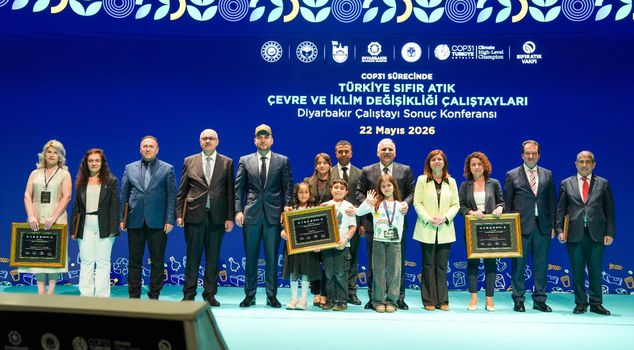
An important organization regarding environment, climate change, and zero waste was realized in Diyarbakır. The results of the Diyarbakır Zero Waste Workshop, held within the scope of the "Turkey Zero Waste, Environment, and Climate Change Workshops in the COP31 Process" organized by the Zero Waste Foundation under the theme "From Local to National: Waste and Waste," were announced to the public. At the concluding conference held at Dicle University, strategic goals that will shape Diyarbakır's environmental policies were announced.
The Diyarbakır Governorship, Dicle University, Diyarbakır Metropolitan Municipality, various public institutions, and non-governmental organizations supported the organization carried out by the Zero Waste Foundation under the auspices of Emine Erdoğan. During the workshop, the city's environmental problems, waste management, water resources, and solution proposals related to climate change were discussed.
“ZERO WASTE YEAR” TARGET ANNOUNCED FOR DIYARBAKIR
Speaking at the conference, Diyarbakır Provincial Director of Environment, Urbanization, and Climate Change Ufuk Nurullah Bilgin shared the “Zero Waste Target Document” prepared for the city with the public. Among the announced targets, the declaration of 2027 as “Diyarbakır Zero Waste Year” drew attention.
The prepared roadmap plans to establish a single-center management model where municipalities, universities, public institutions, and non-governmental organizations will act together. Other goals include converting organic waste from public markets into compost, expanding smart trash containers in parks and public spaces, collecting waste oils on a district basis, and increasing green areas in the city.
During the workshop, proposals were also presented for the development of Dicle University in line with the zero waste philosophy, with an “eco-campus” approach that is highly energy-efficient and self-sufficient.
“WE WANT TO BRING REAL PROBLEMS TO THE COP31 AGENDA”
Zero Waste Foundation President and COP31 High-Level Climate Champion Samed Ağırbaş stated that the main purpose of the workshop is to identify problems in cities on-site and produce solutions. Ağırbaş noted that the series of workshops conducted across Turkey aims to create a common mind on environment and climate change.
“For the first time at COP31, we want to bring real problems from the field to the United Nations agenda,” Ağırbaş said, emphasizing that water stress, climate change, and environmental crises pose serious risks worldwide.
Stating that representatives from many countries around the world will come together in Istanbul within the scope of the Zero Waste Forum, Ağırbaş drew attention to the importance of international cooperation against the environmental crisis.
DIYARBAKIR'S ENVIRONMENTAL AND CLIMATE TRANSFORMATION DISCUSSED
Diyarbakır Governor Murat Zorluoğlu also stated in his speech that environmental problems have become a common issue for the entire world and emphasized the great importance of protecting natural resources for future generations.
Governor Zorluoğlu noted that there has been a significant increase in recycling rates thanks to the Zero Waste Movement, and that recovered waste contributes billions of liras to the economy.
Diyarbakır Metropolitan Municipality Mayor Serra Bucak, on the other hand, stated that the climate crisis is no longer a problem of the future but of today, and expressed that pressure on water resources, drought, and the increasing waste load pose serious risks for cities.
SOLUTION PROPOSALS DEVELOPED AT 14 THEMATIC TABLES
Within the scope of the Diyarbakır Zero Waste Workshop, technical studies were conducted at 14 different thematic tables. Experts developed solution proposals on topics such as water management, energy transformation, organic waste, plastic use, industrial waste, environmental financing, and social awareness.
As a result of the studies, historical and cultural diversity, fertile agricultural lands, and a strong transportation network stood out among Diyarbakır's strengths, while unplanned construction, inadequate recycling infrastructure, increasing energy consumption, and risks related to climate change were listed as main problem areas.
Officials stated that efforts in the city will continue under the coordination of the established “Zero Waste Provincial Advisory Board,” and projects aimed at increasing environmental awareness will be expanded.