07.05.2025 13:33
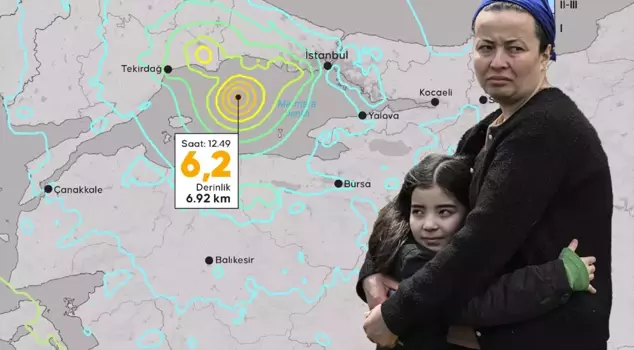
In the preliminary report on the 6.2 magnitude earthquake in Silivri, Istanbul, prepared by academics from Istanbul Technical University (ITU), it was noted that the earthquake and the subsequent aftershocks did not lead to a significant release of energy. It was determined that 88% of the energy accumulated since 1766 remains, while 12% has been released.
Under the coordination of ITU Faculty of Mining Dean Prof. Dr. Mustafa Kumral, a preliminary report titled "April 23, 2025 Central Marmara Ridge Earthquake (Mw 6.2: 12:49 - 26 km South of Silivri)" was prepared by the Disaster Management Application and Research Center (MATAM) Group, which includes Prof. Dr. Cenk Yaltırak, Prof. Dr. Seda Yolsal Çevikbilen, Assoc. Prof. Dr. Tuna Eken, Prof. Dr. Hülya Kurt, Assoc. Prof. Dr. Beyza Taşkın, and Dr. Murat Şahin.
According to the report, the earthquake that occurred at a depth of 13 kilometers in the Central Marmara Ridge, located in the middle of the Sea of Marmara, lasted approximately 13 seconds at 12:49 on April 23, 2025. The earthquake took place about 5 kilometers south of the 5.8 magnitude Silivri earthquake that occurred on September 26, 2019, and as of April 25, over 291 aftershocks were recorded in the region.
The report states that the aftershocks concentrated in an area approximately 40 kilometers long and 12 kilometers wide, north of the main fault. These tremors clustered particularly in the Kumburgaz Basin and the secondary fault lines in the northern block. Some aftershocks reached depths of up to 30 kilometers.
It was noted that the region where the earthquake occurred is located between the Eastern Ridge North Segment (Kumburgaz Fault), which last produced an earthquake in May 1766, and the Silivri Ridge South Boundary Fault, emphasizing that there is a correlation between the stress change observed in the region after the Silivri earthquakes in 2019 and the location of the earthquake in 2025.
12% OF SEISMIC STRESS HAS BEEN RELEASED
Calculations indicate that approximately 12% of the accumulated seismic stress since 1766 was released with this earthquake.
According to the report, it was determined that the main shock occurred with a displacement of 30 centimeters over an area of approximately 20x12 kilometers. National and international observation organizations reported that the earthquake exhibited a right-lateral strike-slip faulting character.
The preliminary report prepared by the academics also included findings regarding the acceleration values of the earthquake. In a table that included all provinces and districts in the Marmara Region where the earthquake was felt, the highest acceleration value was measured in Küçükçekmece, Istanbul. Following Küçükçekmece were Eyüp, Marmara Ereğlisi, and Avcılar.
The highest ground acceleration measured within a radius of 200 kilometers from the epicenter was recorded at 0.2 g in Küçükçekmece, Istanbul, located approximately 50 kilometers from the epicenter, in the north-south direction. Other high acceleration values were measured at 0.16 g in Sazlıbosna Dam, 0.1 g on the coast of Marmara Ereğlisi, and 0.1 g in Arnavutköy.
The report stated that the acceleration values are related not only to distance but also to ground characteristics, topography, and geological structure, and that the compatibility between the measured values and the existing attenuation relationships remained below 65%, indicating a need for new generation dynamic attenuation models.
In the analyses regarding the Kumburgaz Fault, it was emphasized that only 0.3 meters of the 3.7 meters of slip accumulated in the region since 1766 was released with this earthquake.
The preliminary report noted that the distribution of the main shock and aftershocks remained limited to a narrow area on the fault plane, while the stress concentrated towards the Central Marmara Basin.
"IT OCCURRED ONLY IN A 20 KILOMETER SECTION OF THE KUMBURGAZ SEGMENT"
MATAM Director Prof. Dr. Cenk Yaltırak told AA correspondent that the recent earthquake occurred only in a 20-kilometer section of the Kumburgaz segment within the Sea of Marmara.
Stating that the entire Kumburgaz segment is 80 kilometers long, Yaltırak said, "Only a small portion of the fault experienced a movement of about 30 centimeters. However, there is a 3.7-meter accumulation of stress in the same region. This does not indicate a major earthquake, but it is also incorrect to say 'Stress has been released.' The larger part of the fault is still intact."
Yaltırak explained that multiple ruptures have become increasingly understandable based on historical examples, stating, "As seen in the 1999 Izmit earthquake, we experienced a series of earthquakes caused by the simultaneous rupture of three separate faults, not just one earthquake. The initial magnitude measurements were 7.4, but moment calculations reached 7.5. Moreover, Düzce did not rupture that day; it ruptured a month later. If it had ruptured on the same day, the destruction we would have experienced today would have been much greater."
Yaltırak noted that such sequential ruptures were also observed in the February 2023 Kahramanmaraş earthquakes, emphasizing that major earthquakes in Anatolia are not singular but chain reactions, which increases the magnitude of the earthquake, meaning that a scenario where different segments rupture consecutively should be considered the "worst-case scenario."
"OUR DUTY IS TO IDENTIFY THE GREATEST RISK"
Prof. Dr. Yaltırak pointed out that the frequently mentioned earthquake scenario of magnitude 7.8 for Marmara was not created to instill fear but was based on real engineering calculations.
Emphasizing that they did not fabricate the 7.8 magnitude earthquake, Yaltırak stated, "This number was calculated through scientifically conducted doctoral studies, moment calculations, and fault lengths. In other words, there is serious academic effort and the work of hundreds of experts behind this figure. As engineers, our duty is to define the greatest risk that society may face."
Highlighting the importance of taking precautions against earthquakes, Yaltırak said, "Imagine a bucket with four eyes. If this bucket is full, all four pieces can empty at once. What happens if they all empty and we do not take precautions accordingly? If one segment ruptures, it becomes 7.1; if another ruptures, it becomes 7.4; if three rupture, it becomes 7.6; if four rupture, it becomes 7.8. If you design your cities based on 7.1, you will die if it is 7.8, but if you prepare for 7.8, nothing will happen if it is 7.1. It is that simple. Society needs to understand this."
"PEOPLE BELIEVE THOSE WHO COMFORT THEM"
Yaltırak pointed out that society acts with misconceptions about earthquakes and emphasized that they are trying to provide accurate information.
Prof. Dr. Yaltırak concluded his remarks as follows:
"But people listen to what they want to hear. This is a state of distancing from science. People believe those who comfort them rather than those who speak the truth, but the reality is that nature has no mercy. The earthquake reminds itself as it is forgotten. I cannot say, 'There will not be a 6.5 magnitude earthquake in Marmara tomorrow.' If it happens, I will not have known. This is not a prediction; it is a matter of risk management. Our duty is to identify the greatest risk and plan urban transformation against it, to produce disaster scenarios."
Elbette, mevcut HTML içeriğini bozmadan metni İngilizce'ye çevirebilirim. Ancak, çevirmemi istediğiniz metni belirtmediniz. Lütfen çevirmemi istediğiniz HTML içeriğini paylaşın, böylece size yardımcı olabilirim.