03.03.2026 06:22
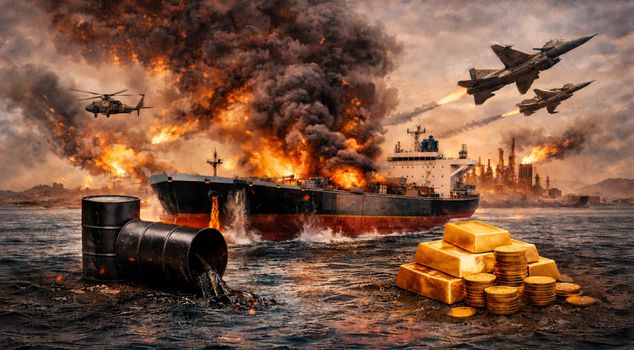
The attacks by the US and Israel on Iran and Iran's retaliations have raised concerns about global trade and oil supply due to the closure of the Strait of Hormuz. Rising geopolitical risks have pushed defense and energy stocks higher, while leading to sharp declines in the airline, tourism, and banking sectors. US and European stock markets have fluctuated, and the BIST 100 finished the day down 2.71%.
The attacks by the US and Israel on Iran and the retaliations from Iran have increased the risks of prolonged conflict in the Middle East while causing fluctuations in global markets.
Israel and the US launched a military attack on Iran on February 28 while negotiations were ongoing between Tehran and Washington. Iran responded with attacks on targets it identified in several regional countries, including Qatar, the United Arab Emirates, and Bahrain, where US bases are located, in addition to Israel.
HIGH-RANKING NAMES KILLED IN US-ISRAEL ATTACKS
In the US-Israel attacks, many high-ranking officials were killed, including Iranian leader Ali Khamenei. Evaluating how long the attacks on Iran would last, US President Donald Trump stated, "We are currently ahead of our predictions in terms of timing. We had estimated it would last four to five weeks, but we have the capacity to continue longer than that. We will do this."
HORMUZ STRAIT TENSION
Major General Ibrahim Jabbari, advisor to the Commander of the Islamic Revolutionary Guard Corps, stated that they have closed the Hormuz Strait to crossings in response to the attacks from the US and Israel and that they would attack ships attempting to pass. The closure of the Hormuz Strait has raised concerns that global trade, especially oil, could be disrupted.
FLUCTUATIONS IN GLOBAL MARKETS
The rising tension in the region has led to an increased perception of risk in the markets and significant fluctuations in global markets. Geopolitical tensions have boosted the shares of companies in sectors such as defense and energy, while sectors like airlines and tourism experienced selling pressure.
US MARKETS OPENED WITH A DECLINE, RECOVERED
The New York Stock Exchange started Monday with a decline due to concerns about conflicts in the Middle East. US markets, which exhibited a volatile course during the day, completed the first trading day of the week with a mixed trend as investors viewed the declines as buying opportunities.
At the close, the Dow Jones index fell by 0.15% to 48,904.78 points. The S&P 500 index increased by 0.04% to 6,881.62 points, and the Nasdaq index rose by 0.36% to 22,748.86 points. The VIX Index, known as the "fear index" in the markets and indicating volatility in the S&P 500, rose above 25 during the day, reaching a three-month high before declining to 21.5.
AMERICAN AIRLINE COMPANIES DECLINED
Among the sectors most affected by the rising tension in the Middle East were airline companies that suspended their flights in the region. Shares of American airline companies Delta fell by 2.2%, United Airlines by 2.9%, and American Airlines by 4.2%.
INCREASE IN DEFENSE AND ENERGY SHARES
Shares of defense industry companies saw an increase. Shares of American defense company Lockheed Martin rose by 3.3%, RTX shares by 4.7%, Northrop Grumman shares by 6%, and shares of Kratos Defense & Security Solutions increased by 5.3%. With the momentum in oil prices, shares of energy companies also rose, with Exxon Mobil shares increasing by 1.1%, Chevron shares by 1.5%, ConocoPhillips shares by 4.2%, and Occidental Petroleum shares by 2.1%.
EUROPEAN MARKETS DECLINED
European markets struggled throughout the day to recover their losses. At the close, the benchmark index Stoxx Europe 600 lost 1.65% to 623.36 points. In the UK, the FTSE 100 index decreased by 1.2% to 10,780.11, in Italy, the FTSE MIB 30 index fell by 1.97% to 46,280.4, in France, the CAC 40 index dropped by 2.17% to 8,394.32, and in Germany, the DAX 40 index lost 2.42% to close at 24,672.4 points.
TOURISM AND AVIATION UNDER PRESSURE IN EUROPE
The fear of the war spreading hit the travel and tourism sector the hardest in Europe. The tourism company TUI, which showed the weakest performance in the MDAX index, lost 9.9% in value, while shares of Germany's flagship airline Lufthansa fell by 5.2%. Lufthansa announced that it had suspended flights to the Middle East starting from Saturday due to the risks in the region.
JPMorgan analyst Harry Gowers pointed out in his analysis that the Iran-centered conflicts directly threaten the profitability of airline companies. Gowers emphasized that flight cancellations, operational disruptions, rising oil prices, and falling demand have reduced investor appetite.
MIXED TREND IN EUROPEAN DEFENSE INDUSTRY SHARES
The military activity in the region initially gave a strong momentum to defense industry shares. German defense technology manufacturer Hensoldt gained 4.9%, and gearbox manufacturer Renk increased by 3.6%. Shares of British BAE Systems rose by 6.1%, and Italian Leonardo shares increased by 2.5%. On the other hand, Rheinmetall shares gave back their gains during the day, closing with a decline of about 2.2%, falling below the market average.
FREIGHT ACTIVITY IN LOGISTICS AND SHIPPING
With the suspension of crossings in the Hormuz Strait, the expectation of an increase in freight prices and a contraction in capacity has boosted demand for European shipping companies. Shares of container shipping giant Hapag-Lloyd rose by 6.35%. Similarly, shares of Danish shipping giant Maersk increased by 7.61%. Both companies announced that they had indefinitely suspended crossings in the Hormuz Strait for security reasons. Analysts described the reaction of European investors as "cautious and measured." In the markets, it was stated that the expectation that the conflict would be short-lived is still maintained.
BIST 100 DECLINED BY 2.71%
In Borsa Istanbul, the BIST 100 index completed the day with a loss of 2.71%, closing at 13,346.43 points. The BIST 100 index, which started the day with a decrease of 5.32% at 12,987.42 points, later recovered some of its losses. Among the main sector indices, the technology index rose by 4.4%, while the services index fell by 2.7%, the industrial index by 2.6%, and the financial index by 4.7%.
Among the sub-sector indices, only trade with 0.09% and chemical petroleum plastic with 0.02% gained. The biggest loss was in banking, which fell by 7.43%. There were also declines of over 5% in the transportation and tourism indices. Despite the decline in the BIST 100 index, shares of technology companies such as Altınay Defense rose by 8.3%, ASELSAN shares by 5.6%, shares of Gen İlaç included in the trade index by 4.9%, shares of chemical petroleum plastic company Petkim by 3.2%, and shares of Tüpraş by 2.9%.
Shares of transportation companies such as Turkish Airlines fell by 6%, Pegasus shares by 5.8%, Çelebi Ground Services shares by 5.7%, and banking companies such as Türkiye İş Bankası (C) shares by 6.7%, Akbank shares by 8.2%, Şekerbank shares by 8.2%, Garanti BBVA shares by 8.6%, and Yapı ve Kredi Bankası shares by 8.7%.
In the heart of the city, there is a beautiful park where people come to relax and enjoy nature. The trees are lush and green, providing shade on sunny days. Children play on the swings, while couples stroll hand in hand along the winding paths. The sound of laughter fills the air, creating a joyful atmosphere. Every spring, the flowers bloom in vibrant colors, attracting visitors from all around. It is a perfect place to escape the hustle and bustle of everyday life.