27.08.2026 17:20
With the official dissolution of the SDF, which has controlled northeastern Syria since 2015, and the integration of its military forces into the Syrian army, a new era has begun for the Kurds in the region. With the end of the autonomous structure, the future of Syrian Kurds in the process shifting from arms to the political arena will be determined by how constitutional guarantees promised by the new administration—such as citizenship rights, Kurdish-language education, and representation in the native language—will be realized on the ground.
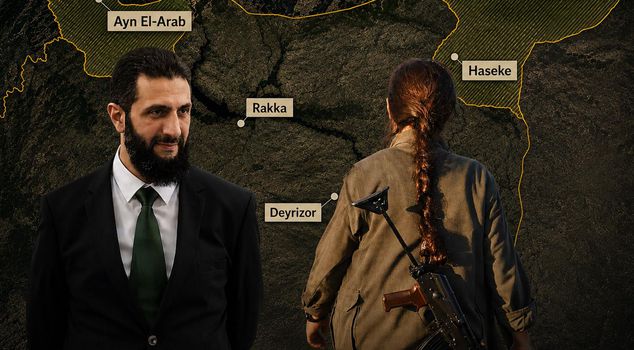
Mazloum Abdi, the leader of the Syrian Democratic Forces (SDF), announced on August 25 that the structure that had controlled the country's northeast since 2015 was officially dissolved. The YPG/SDF elements, which Turkey describes as an extension of the terrorist organization PKK, joined the official Syrian army, while all civilian and administrative institutions in the region were transferred to the central government.
THE CARDS HAVE BEEN REDEALT
In the historic process that led to the redealing of cards in Syria, the autonomous administration in the region that Kurds call "Rojava" has effectively and legally come to an end. With this development, welcomed with satisfaction on the Ankara and Washington line, the negotiation process regarding the roles of Syrian Kurds in the new government, their constitutional guarantees, and citizenship rights has accelerated.
MINISTER FIDAN: A GRATIFYING EVENT
Ankara viewed the SDF, whose backbone was formed by the People's Protection Units (YPG) since its inception, as a direct threat to border security. Turkey, which limited the organization's dominance with cross-border operations carried out between 2016 and 2019, also played a key role in the process of the group's dissolution and integration into the central government in the post-Bashar al-Assad period. Evaluating the development, Foreign Minister Hakan Fidan described the dissolution of the SDF as "a gratifying event" and stated: "The statement made in Damascus is positive in its text, but if it is as stated in practice, it is extremely positive."
"TURKEY GOT WHAT IT WANTED IN SYRIA"
Asli Aydıntaşbaş, Director of the Turkey Project at the Brookings Institution, stated, "I think Turkey got what it wanted in Syria. There is a new structure that addresses its own security concerns. This development, by encouraging the integration of Kurds with the Damascus regime, has led to the formation of a new Syria that proceeds almost in parallel with the process in Turkey." Retired Consul General Gülru Gezer also emphasized that the terrorist structures under the KCK umbrella have entered a process of dissolution across the region.
FORCES WITHIN THE STRUCTURE JOIN THE SYRIAN ARMY AND INTERIOR MINISTRY
According to the dissolution agreement, the integration of more than 5,000 soldiers within the SDF into four Syrian army brigades stationed in the Hasakah region was ensured. It was also decided that the Women's Protection Units (YPJ), the women's wing of the YPG, would join the security forces affiliated with the Ministry of Interior and take on counter-terrorism duties in the northeast of the country. On the political front, an agreement was reached for SDF General Commander Mazloum Abdi to serve as an advisor to Syrian President Ahmed al-Sharaa, and for another prominent Kurdish politician, İlham Ahmed, to serve as a member of parliament in the Syrian Parliament.
DEBATES, RIGHTS, AND THE KURDISH LANGUAGE EDUCATION STEP
Within the framework of the agreement reached between the parties, it is aimed to "preserve the special structure" of regions with a high Kurdish population. With a decree issued by Syrian leader Ahmed al-Sharaa, Syrian Kurds were recognized as an "integral part" of the country's people, Nowruz was declared an official holiday, and Kurdish gained the status of a "national language."
Additionally, the Syrian official news agency SANA reported that Kurdish will be added to the school curriculum starting from the 2026-2027 academic year and will be taught as a 2-hour elective course per week. Despite this, the Kurdish side continues to insist that Kurdish should be included in the constitution as an "official language" and "language of education," beyond being an elective course.
Field experts, drawing attention to security risks in the Druze and Alawite regions, emphasize that the integration process in the northeast needs to be managed with sensitivity in its social and political dimensions.*Heybar Othman from BBC Arabic contributed to this report. Related news