29.10.2026 17:06
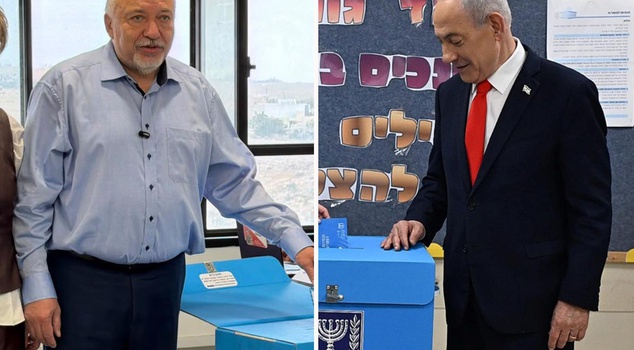
As Israelis head to the polls, Prime Minister Benjamin Netanyahu's rival, Yisrael Beiteinu Party Chairman Avigdor Liberman, made a statement. Liberman said, "We are ahead of Netanyahu by a large margin. Netanyahu is in a panic because he knows he will lose."
As the people of Israel head to the polls, Yisrael Beiteinu Party Chairman Avigdor Liberman made striking statements regarding the election process. Stating that he trusted the result that would emerge from the ballot boxes, Liberman claimed that they were leading the race against his rival, Prime Minister Benjamin Netanyahu, by a clear margin.
"WE ARE FAR AHEAD OF NETANYAHU"
Claiming that Netanyahu was afraid of the election results, Liberman said, "We are far ahead of Netanyahu. Netanyahu is in a panic because he knows he will lose."
7.3 MILLION VOTERS AT THE POLLS IN ISRAEL
Approximately 7.3 million voters in Israel are at the polls today to determine the new members of the 120-seat Knesset. The election is the first general election held in the country since the October 7, 2023 attacks, which are also regarded as the start of the Gaza war.
THE PREVIOUS RECORD WAS BROKEN IN 1988
According to data from Israel's Central Elections Committee, turnout as of 2:00 p.m. local time was recorded at 44.9 percent. This rate was the highest turnout seen since 1973 at the same stage of elections. The previous record at the same time slot was set in 1988 and was 2.7 points below today's level.
NETANYAHU KEEPS ISSUING CALLS
Following the high turnout, Netanyahu addressed his supporters on his social media account, saying, "Emergency. Left-wing activists are flooding the polls, while right-wing activists are indifferent. Time to wake up. Go out, get others out to vote too, vote Likud."
ALLEGATION OF "INTERFERENCE IN THE ELECTIONS"
In a statement after casting his vote in West Jerusalem, Netanyahu alleged that there was an attempt to interfere in the elections, claiming that police had detained three people carrying money in their bags for the purpose of bribing voters.
STRONG INTEREST FROM ARAB VOTERS IN THE POLLS
Behind the unease in Netanyahu's camp and the provocative rhetoric aimed at mobilizing the right-wing base lie the intense interest Arab voters have shown in the polls, especially in the Negev, and the goal of toppling the far-right coalition.
While 61 of the 120 seats are needed for a majority in parliament, no party has so far been able to reach that number on its own. Recent public opinion polls also showed that neither of the two main blocs would be able to secure a majority. The polls are expected to close at 10:00 p.m. local time.
WHO IS RUNNING IN THE ELECTION?
More than 30 parties and lists are competing in the election to pass the 3.25 percent electoral threshold and send members to the 120-seat parliament. There are two main blocs competing to form the next government: First, the coalition led by Netanyahu's Likud party, joined by several far-right and ultra-Orthodox parties. Second, the main opposition coalition consisting of the Yashar Party of 66-year-old Gadi Eisenkot, who served as Chief of Staff from 2015 to 2019, the Democrats, the Yisrael Beiteinu Party, and the Together Alliance. According to the latest poll results, Prime Minister Netanyahu and former Chief of Staff Eisenkot are running neck and neck in the race for prime minister.
While 61 of the 120 seats are needed for a majority in parliament, no party has so far been able to reach that number on its own. Recent public opinion polls also showed that neither of the two main blocs would be able to secure a majority.
PREDICTIONS
The Yashar Party led by former Chief of Staff Eisenkot is expected to win 22 to 24 seats, while Likud, led by Israel's longest-serving prime minister, Benjamin Netanyahu, is expected to win 21 to 23 seats. The Together Alliance led by former Prime Ministers Naftali Bennett and Yair Lapid is projected to win 13 to 14 seats, and the Democrats led by former Deputy Chief of Staff Yair Golan are projected to win 8 to 9 seats. The Joint List, consisting of three Arab-led parties (Hadash, Balad, and Ta'al), is expected to win 9 to 10 seats. Yisrael Beiteinu, led by Avigdor Liberman, is expected to win 8 seats.
United Torah Judaism, which includes the two largest Ashkenazi Haredi parties, is projected to win 8 seats. The Shas Party, which represents the Sephardi Haredi community and is led by Aryeh Deri, is expected to win 7 to 8 seats, while Otzma Yehudit, led by far-right National Security Minister Itamar Ben-Gvir, is also expected to win 7 to 8 seats.
Religious Zionism-Zehut, led by far-right Finance Minister Bezalel Smotrich and Moshe Feiglin, is projected to win 5 to 6 seats. The Ra'am party, led by Mansur Abbas, is expected to win 5 to 6 seats.
After the election, parties have 28 days to form a coalition that reaches 61 seats, and this period can be extended by another 14 days.