24.04.2026 14:06
Ace, a robot produced by the AI research unit of a Japanese company, has begun demonstrating super-expert-level performance in a physical sport. Ace made history by defeating top-tier human players.
With the dizzying pace of technology, robots and artificial intelligence are no longer just mechanical arms in factories; they have become partners and competitors penetrating every aspect of our lives. As their data processing capabilities and physical skills improve day by day, this digital revolution has begun to bring deep uncertainty not only to business life but also to sports.
Today, even professional jobs requiring creativity and analysis are being delegated to algorithms, creating serious unease for modern humans who are starting to ask, "Will there be a place for me in the future?"
ACHIEVED WITH HIGH-SPEED PERCEPTION AND ARTIFICIAL INTELLIGENCE
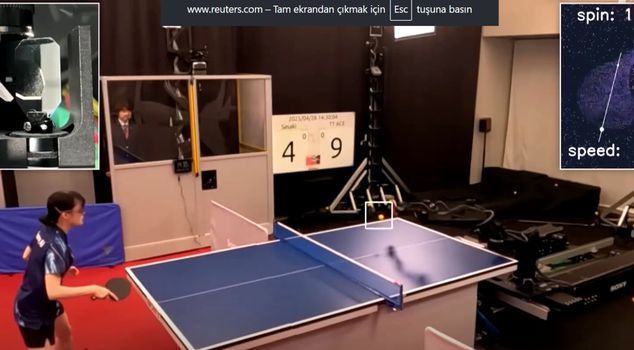
Most recently, an autonomous robot table tennis player named Ace, produced by Japanese company Sony, marked a turning point in artificial intelligence and robotics by competing against top human players in Tokyo, sometimes beating them.
Ace has gone down in history as the first robot to perform at an expert level in a competitive physical sport requiring quick decisions and precise execution. According to experts, Ace achieved this using high-speed perception, AI-based control, and state-of-the-art robotic systems.
A ROBOT SUCCEEDED IN TABLE TENNIS FOR THE FIRST TIME
Experts note that various table tennis-playing robots have been produced since 1983, but until now, they could not compete with highly skilled human opponents. Ace changed this with its performance against elite and professional human players in matches conducted under the rules of the International Table Tennis Federation (the sport's governing body) and officiated by licensed referees.
PERCEIVES WITH HUMAN-LIKE SPEED AND PRECISION, ACTS PLANNED
Peter Dürr, Director of Sony AI Zurich and leader of Sony AI's Ace project, said, "Unlike previous AI systems, physical and real-time sports like table tennis remain a major open challenge because they require fast, precise, and competitive interactions near obstacles and at the limits of human reaction time."
Emphasizing that the project's goal is not just to compete in table tennis, Dürr stated, "We also want to gain insights into how robots can perceive, plan, and move with human-like speed and precision in dynamic environments."
Dürr, lead author of the study published in the journal Nature detailing Ace's achievements, said Ace's success stemmed from its perception system and learning-based control algorithm.
Noting that similar techniques can be applied to other areas requiring fast, real-time control and human interaction, Dürr shared, "For example, manufacturing and service robots, as well as applications in sports, entertainment, and safety-critical physical domains."
In the matches detailed in the research, Ace won 3 out of 5 matches against elite players in April 2025, while losing 2 matches against professional players, the highest skill level in the sport. Sony AI stated that Ace has since beaten professional players.