28.02.2026 16:50
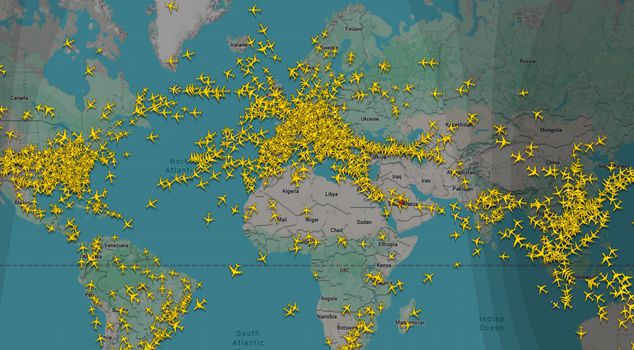
After Israel's operation against Iran, many countries in the Middle East closed their airspace, and international flights were canceled or redirected to alternative routes. Global flight maps show that air traffic along the Iran, Iraq, Syria, and Israel corridor has nearly come to a halt, while the crisis has directly impacted global aviation.
After Israel launched a military operation against Iran, air traffic in the Middle East came to a standstill. Images reflected in global flight tracking maps revealed that civil flights in the airspaces of Iran, Iraq, Syria, and Israel were almost completely halted. In contrast, intense air traffic continued along the European and Mediterranean routes.
GLOBAL AVIATION AFFECTED
According to experts, the developments are directly affecting not only regional but also global aviation, as the Middle East is a critical transit corridor for international flights.
AIRSPACES CLOSED ONE BY ONE
Following the attacks, Iran and Iraq were the first to decide to close their airspace, and shortly after, countries like Qatar, the United Arab Emirates, and Israel took similar steps. These developments seriously disrupted civil aviation operations in the region.
CONSECUTIVE CANCELLATIONS FROM AIRLINES
International flights were either completely canceled or redirected to alternative routes. The closure of the shortest routes used on the Europe-Asia line, in particular, led to longer flight times and increased costs. Following the security risks, Turkish Airlines (THY) announced that it had canceled flights to many destinations in the Middle East.
According to the announcement:
- Flights to Iran, Iraq, Syria, Lebanon, and Jordan were suspended until March 2
- Flights to Qatar, Kuwait, Bahrain, the United Arab Emirates, and Oman were canceled for February 28
Similarly, Pegasus, AJet, and many international airlines also suspended their flights to the region.
European-based airlines also opted to change their routes or completely cancel flights, with reports of some planes changing direction mid-air and returning.
MAP REVEALED THE TRUTH: EMPTY AIR CORRIDOR
Real-time maps obtained from flight tracking systems clearly showed the impact of the crisis. In the shared images, while heavy traffic continued in European airspace;
- It was observed that there were almost no flights in the Iran, Iraq, Syria, and Israel corridor
- In the Gulf region, flights were limited and scattered.