06.07.2026 16:40
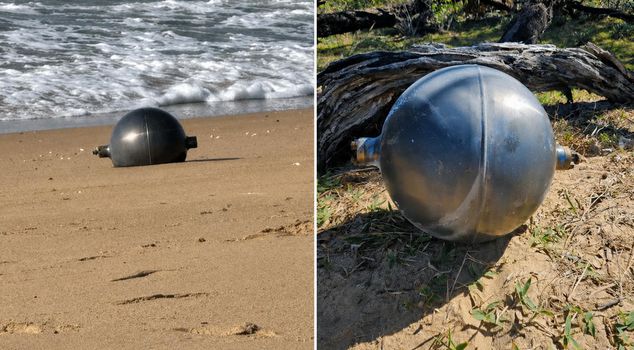
The beaches of Forrest Beach in northern Australia witnessed an unusual discovery over the weekend. Six mysterious metal spheres found in a row along the shoreline alarmed police and fire crews due to suspected chemical hazards. A 50-meter safety corridor was established in the area, while the secret of the intriguing objects was revealed in an official statement by the Australian Space Agency. The agency announced that the objects were debris from a foreign rocket that had returned to Earth from orbit.
Six mysterious metal spheres washed ashore on Forrest Beach in Queensland, Australia, sparking widespread curiosity and prompting authorities to take the highest level of action. Police and fire crews established a 50-meter safety cordon around the objects found by the public over the weekend north of Townsville, suspected of containing hazardous chemicals.
FIRST OFFICIAL STATEMENT FROM THE AUSTRALIAN SPACE AGENCY
The Australian Space Agency, which launched an investigation into the mysterious "space spheres," shared key clues about the origin of the objects. The statement read:
"Our agency has identified the likely source. The location and characteristics of the objects are consistent with debris from a foreign rocket body that recently re-entered the atmosphere from orbit. The objects appear to be pressure vessels from a space launch vehicle."
The Agency reported that discussions with international authorities are ongoing to officially confirm which country the rocket belongs to.
WHAT ARE "SPACE SPHERES" AND WHY AREN'T THEY BURNED?
Associate Professor Alice Gorman, a space archaeologist and space debris expert at Flinders University, stated that these objects are pressure vessels used to store fuel before it is pumped into the engine during rocket launches.
Since these vessels are made of titanium alloy, they can withstand the extremely high temperatures of atmospheric re-entry and reach the ground without melting. They are among the most common types of space debris falling to Earth.
Experts emphasize that this debris fall does not necessarily indicate a malfunction or problem during the rocket launch, but could be a standard return process.
INTERNATIONAL LAW AND PROPERTY PROCESS
Gorman reminded that space debris falling to Earth is evaluated under the 1967 United Nations Outer Space Treaty, of which Australia is a signatory. According to this treaty:
The launching state always retains ownership of any material sent into space.
Australia will begin negotiations with the launching country and ask whether the country wants the debris returned.
In 2023, when a piece of an old Indian rocket washed up on the coast of Western Australia, the Indian government did not request the material back.
LIFE-SAVING WARNING FROM AUTHORITIES: NEVER TOUCH!
Queensland authorities have declared the existing objects found along the coastline safe, but warned that more debris may be present in the area. The space agency warned citizens:
"Never touch, move, or collect any suspected space debris. Assume it is dangerous until an official warning states otherwise. Move away immediately and contact emergency services."
INTERESTING HISTORICAL NOTES
When NASA's first space station, Skylab, entered the atmosphere over Western Australia in 1979, loud sonic booms were heard on the ground, and the station's fuel tanks crashed to the ground completely intact.
THE ONLY KNOWN CASE IN HISTORY
According to expert Alice Gorman, only one person has ever been recorded as being hit by falling space debris. In 1997, American Lottie Williams was struck on the shoulder by a fiberglass piece from a Delta II rocket while walking in a park in Tulsa, but luckily escaped without injury.