23.03.2026 15:58
The three-year research conducted by Prof. Dr. Şenol Hakan Kutoğlu and his team has been published in an international scientific journal. The study, which also utilized radar satellite data, indicated that there is a movement of the earth in different directions between the east and west of Anatolia, and therefore, there is a strain zone extending from Ereğli on the Black Sea to Ankara and down to Antalya. Prof. Dr. Kutoğlu stated, "It is also possible that Anatolia could split in two after millions of years."
Zonguldak Bülent Ecevit University Geomatics Engineering Faculty Member Prof. Dr. Şenol Hakan Kutoğlu, along with Research Assistant Elif Akgün from Fırat University and Associate Professor Dr. Mustafa Softa from Dokuz Eylul University, published their article titled 'Delineating the Central Anatolia Transition Zone (CATZ): Constraints from Integrated Geodetic (GNSS/InSAR) and Seismic Data' in an international scientific journal, which took nearly 3 years of peer review.
ANATOLIA CAN BE DIVIDED
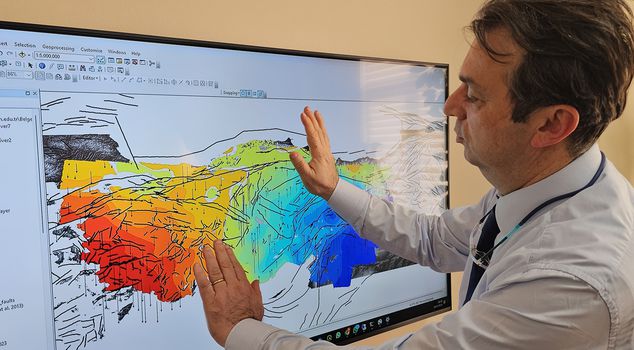
In the study prepared by utilizing radar satellite data, it was stated that there is a movement of the ground in different directions between the east and west of Anatolia, and therefore, there is a strain zone extending from Karadeniz Ereğli to Ankara and down to Antalya.
According to this, it was noted that if this movement continues in different directions, the east and west of Anatolia will separate from each other millions of years later.
"THE EAST OF ANKARA MOVES NORTH, THE WEST MOVES SOUTH"
Kutoğlu stated that it is a known fact that Turkey is moving westward, and continued:
"When we deepened our analyses, we observed the following; the part of Ankara that is east is moving north, while the west of Ankara is moving south. As a result, a transition zone, which we call the 0 line, is formed, shown in white on the map. This transition zone is also a strain line.
In our analyses, it appears that there have been small and large earthquakes in some regions along this strain line from the past to the present. However, if we extend this geological process a bit further, it is possible to predict that millions of years later, due to the strain here, the east and west of Turkey will separate and move away from each other due to this opposite directional movement, provided that this movement continues.
As we move up from the south towards Antalya, we see that this strain line bends as it approaches the North Anatolian Fault (NAF). The reason for this is that the NAF moves laterally to the right at an average speed of 3 centimeters per year, bending this line. When we look at the extent of this bending, we estimate that it may have occurred over 4.5 million years."
FIRST TIME REVEALED WITH THIS STUDY
Kutoğlu explained that the strain zone extending to Zonguldak Ereğli merges with the North Anatolian Fault (NAF) to form an 'S' shaped line, and noted:
"In the north, we see that the transition zone ends in Karadeniz Ereğli. When we look here, we have shown that the protrusion of Ereğli Cape, similar to the 'S' shaped line formed in the NAF, may have also occurred over 4.5 million years. If this movement continues, the situation of this protrusion entering the Black Sea will also continue. The division of Anatolia into two over millions of years could also be possible. This was revealed for the first time with this study. We published this together with Elif Akgün and our colleague Mustafa Softa from Dokuz Eylul University in a reputable international journal."
"EAST ANATOLIA FAULT MAY MERGE WITH NORTH ANATOLIAN FAULT"
Kutoğlu expressed that the East Anatolia Fault also comes from the north at a certain angle, but its downward bending seems to be a result of the same movement, and continued:
"To the south of Antalya, the African continent is moving north at a speed of 6 millimeters per year. In contrast, the Arabian plate is moving at a speed of 1.8 centimeters. Therefore, the Arabian plate is moving 1.2 centimeters faster than the African plate. Over millions of years, this 1.2 centimeters accumulates to reach kilometers. As a result, the East Anatolia Fault must have been a vertical line going down from Bingöl millions of years ago, but this 1.2 centimeters of movement difference has reached dozens of kilometers over millions of years, resulting in its current appearance.
As this movement continues, the northern part of the East Anatolia Fault will gradually close, and it is likely that it will adhere to the North Anatolian Fault line. Consequently, we think that the remaining part of the East Anatolia Fault from the Hatay region will form a vertical line upwards."
"STRAIN ZONE IN THE NEAR FUTURE"
Kutoğlu stated that they do not think the strain line will pose a major threat in the near future, and said:
"When we examine the seismic events along this line, we see that small earthquakes of magnitudes 3 and 4 have occurred over time. However, this energy accumulation may lead to the breaking of much longer lines over millions of years. In fact, if this strain continues, it may be possible for Anatolia to split in two millions of years later. There is no major earthquake threat in the near future, but these may occur in the geological process. Because in the middle region, there are strain accumulations at speeds of a few millimeters per year along the white line."