20.01.2026 19:11
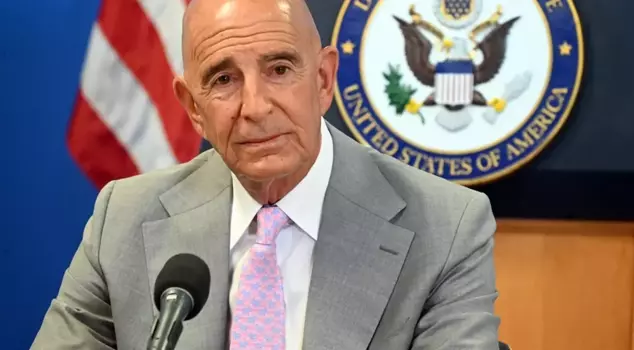
A historic statement came from Tom Barrack, the U.S. Special Representative for Syria. Barrack stated that there is now a state in Syria and said that the YPG has lost its significance in the fight against ISIS. Barrack said, "The YPG is no longer our primary partner; they need to integrate into Damascus. The main goal of the YPG to be the primary anti-ISIS force on the ground has largely come to an end."
A period has closed in Syria. In a statement, the U.S. Special Representative for Syria, Tom Barrack, said that the YPG has completely lost its status as the primary partner in the fight against the ISIS terrorist organization in Syria, as it is now a state in Syria. Barrack called on the YPG to integrate into Damascus.
STATEMENT ON YPG FROM THE U.S. SPECIAL REPRESENTATIVE FOR SYRIA
In his statement, Tom Barrack said: "The greatest opportunity for the Kurds in Syria right now lies in the transition period after Assad, under the leadership of the new government led by President Ahmed Shara.
This moment offers a path for full integration into a united Syrian state, combining long-denied citizenship rights, cultural protections, and political participation that many Kurds have faced under the Bashar Assad regime, which has long been confronted with statelessness, language restrictions, and systematic discrimination.
"OUR PARTNERSHIP WITH SDF WAS FOR THE FIGHT AGAINST ISIS"
Historically, the U.S. military presence in northeastern Syria was primarily justified as a partnership in the fight against ISIS. The SDF, led by the Kurds, proved to be the most effective ground partner in defeating ISIS's regional caliphate and holding thousands of ISIS fighters and their family members in prisons and camps like Al-Hol and Al-Shaddadi until 2019.
"THE SITUATION IN SYRIA HAS FUNDAMENTALLY CHANGED"
At that time, there was no functioning central Syrian state to establish a partnership; the Assad regime was weakened, in a controversial position, and was not a viable partner against ISIS due to its alliances with Iran and Russia. Today, the situation has fundamentally changed.
"THE SDF'S GOAL AS AN ANTI-ISIS FORCE HAS ENDED"
Syria now has a recognized central government that has joined the Global Coalition to Defeat ISIS (as the 90th member by the end of 2025), signaling a shift towards the West and cooperation with the U.S. in counter-terrorism.
This situation changes the rationale for the U.S.-SDF partnership: With Damascus now willing and ready to take on security responsibilities, including control of ISIS detention facilities and camps, the primary goal of the SDF to be the main anti-ISIS force on the ground has largely come to an end.
Recent developments show that the U.S. is actively facilitating this transition rather than extending a separate SDF role: We have held extensive talks with the Syrian Government and SDF leadership to secure an integration agreement signed on January 18 and to establish a clear path for timely, peaceful implementation.
"THE U.S. HAS NO INTEREST IN LONG-TERM MILITARY PRESENCE"
The agreement envisions the integration of SDF fighters into the national army (in the form of individual participation, which is among the most controversial issues), the transfer of key infrastructures (oil fields, dams, border crossings), and the handover of control of ISIS prisons and camps to Damascus.
The U.S. has no interest in a long-term military presence; its priority is to defeat the remnants of ISIS without supporting separatism or federalism, to promote reconciliation, and to advance national unity.
This situation opens a unique window for the Kurds: Integration into the new Syrian state; full citizenship rights (including those who were previously stateless), recognition as an integral part of Syria, constitutional protections for the Kurdish language and culture (such as Kurdish education, celebrating Nowruz as a national holiday), and participation in governance offer possibilities far beyond the semi-autonomy that the SDF has had amid the chaos of civil war.
CALL FOR "INTEGRATION INTO DAMASCUS" TO SDF
While risks (such as fragile ceasefires, occasional clashes, concerns about hardliners, or the desire of some actors to bring past grievances back to the agenda) continue, the United States is pressuring for guarantees on Kurdish rights and cooperation in the fight against ISIS.
The alternative of long-term separation could invite instability or a resurgence of ISIS. This integration, supported by U.S. diplomacy, represents the strongest chance yet for the Kurds to gain permanent rights and security within a recognized Syrian nation-state.
In Syria, the United States has focused on: Ensuring the security of prison facilities currently protected by the SDF, where ISIS prisoners are held; facilitating talks between the SDF and the Syrian Government to allow for the peaceful integration of the SDF and political participation of the Kurdish population in Syria in full citizenship.