24.12.2025 14:00
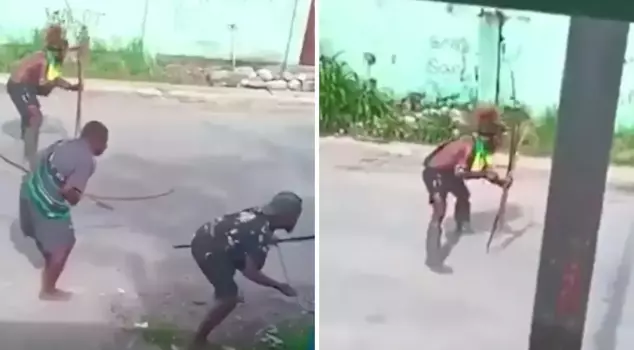
In Papua New Guinea, two rival tribes clashed with bows and arrows on a busy street. It was reported that the tribes resorted to traditional weapons that have been used for centuries, as carrying weapons in public is prohibited in the country. During the conflict, the warriors drew arrows from their backs and aimed at targets from close range.
In Papua New Guinea, two rival tribes clashed with bows and arrows in a busy street, right in front of everyone. The situation quickly turned into complete chaos.
Footage shows dozens of men advancing towards each other along a narrow path. Groups armed with arrows, bows, and machetes move as if they are in a battlefield. Some individuals quickly drop to the ground to avoid arrows, while others leap over arrows that have embedded themselves at their feet.
During the conflict, warriors draw arrows from their backs and aim at close range. As arrows whiz past their heads, some manage to dodge at the last moment. They then re-enter the fray. One of the most striking aspects of the events is the complete absence of firearms.
Since carrying weapons in the streets is banned in the country, tribes resort to traditional weapons that have been used for centuries. Bows and arrows remain one of the most common symbols of tribal conflicts in Papua New Guinea.
It has not yet been disclosed whether there were any injuries or fatalities in this incident.
In Papua New Guinea, tribes frequently come into conflict over land disputes, compensation fights, and behaviors considered insults. In recent years, election periods have further heightened these tensions. Tribes unite around local candidates and political groups, escalating the conflicts.
In the past, such disputes were controlled by traditional rules. The person who initiated the conflict was considered the "owner of the fight" and was responsible for both starting and ending the conflict. Tribal elders would intervene and set rules to prevent harm to civilians and neutral buildings.
However, according to local authorities, these traditions are now largely ignored. Young warriors are said to initiate attacks without heeding the warnings of the elders, leading to violence spiraling out of control.
Although bows and arrows are still used symbolically, the situation is much more dangerous, especially in the mountainous regions of the country. The introduction of automatic weapons and mercenaries has turned small conflicts into large-scale massacres.
Last year, police discovered 64 bodies left by the roadside in the remote mountainous areas of the country. Authorities described this incident as one of the most horrific points of inter-tribal violence. The deceased are believed to have been killed in an ambush set by a rival group in the early morning hours.
In footage shared by the police, dismembered and stripped bodies were seen loaded into truck beds or left by the roadside. Some victims were found to have had their limbs severed.
Police Chief David Manning described the events as "shameful barbarism" and announced that strict security measures had been implemented in the area. He also stated that police would be permitted to use deadly force if civilians or security forces were threatened.
Deputy Police Chief Samson Kua mentioned that conflicts are still ongoing in the surrounding valleys and that new bodies are being recovered from wooded areas. Investigations indicate that the attackers have access to heavy weapons such as AK-47s, M16s, AR-15s, and shotguns.
Tribal wars in the mountainous regions of Papua New Guinea have now become a part of daily life. Many believe that preventing this violence is becoming increasingly difficult with each passing day.