08.06.2026 14:00
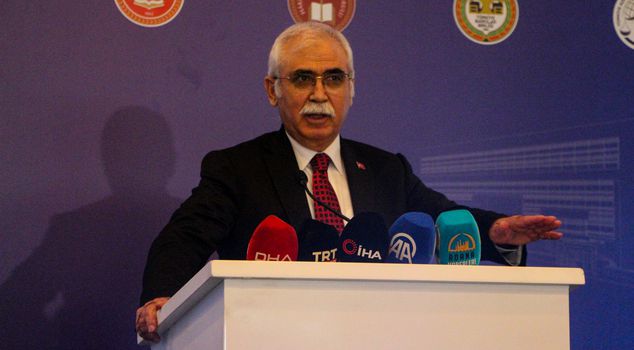
The President of the Constitutional Court, Kadir Özkaya, stated that 739,417 individual applications have been made to the Court since September 23, 2012, 86 percent of which have been concluded, resulting in 87,000 violation rulings. Speaking at the project closing ceremony in Adana, Özkaya emphasized that individual applications play a significant role in the development of a rights-oriented legal culture.
Constitutional Court President Kadir Özkaya said, "The individual application mechanism is undoubtedly one of the most important reforms in Turkish legal history. Since individual applications began to be accepted on September 23, 2012, a total of 739,417 applications have been made to the Constitutional Court. Of these applications, 637,274 have been concluded, thus approximately 86 percent of the applications have been decided."
At a hotel in the city, the Project Closing Ceremony and Adana Regional Meeting were held under the 'European Union-Council of Europe Joint Project on Supporting the Effective Implementation of Constitutional Court Decisions in the Field of Fundamental Rights'. The event was attended by Constitutional Court President Kadir Özkaya, President of the Court of Cassation Civil General Assembly Adem Albayrak, Deputy President of the Council of Judges and Prosecutors Fuzuli Aydoğdu, Adana Governor Mustafa Yavuz, President of the Human Rights and Equality Institution of Turkey Vasip Şahin, President of the Turkish Justice Academy Metin Yıldırım, Adana Chief Public Prosecutor Altuğ Kürşat Şahin, President of the Adana Criminal Justice Commission Ferhat Karakuş, President of the Adana Regional Court of Justice Mehmet Yüksek, Chief Public Prosecutor of the Adana Regional Court of Justice Bestami Tezcan, Head of the Governance Section of the European Union Delegation to Turkey Jean Barbe, and Head of the Council of Europe Ankara Program Office William Massolin.
'ADANA HAS BEEN ONE OF THE MOST IMPORTANT CITIES OF SOLIDARITY'
Speaking at the event, Governor Mustafa Yavuz stated that the city has hosted many civilizations throughout its history, saying, "Adana is one of the cities that has left a mark on the memory of nations throughout history. Our Adana, carrying its stance overlooking the Taurus Mountains in its horizon, has hosted different civilizations throughout history. This ancient city has been one of the important cities of solidarity from past to present. These lands have brought together the tradition of the state and the sense of justice of our nation on the same ground for centuries. Justice is the foundation of the state. I believe such programs will contribute to strengthening the trust of our citizens in justice."
'THE INDIVIDUAL LEGAL SYSTEM LED TO A FUNDAMENTAL CHANGE'
President of the Court of Cassation Civil General Assembly Adem Albayrak also noted that individual application has led to a very fundamental change in the Turkish legal system, stating, "Individual application is a contemporary and important gain brought to our country to better protect fundamental rights and freedoms and raise their standards. The high number of individual applications coming before the Turkish Constitutional Court brings together the importance of the matter, its execution, and the difficulties. This excess is such that when we look at the figures in European countries that implement it well, it is 10-12 times higher. The Turkish Constitutional Court receives more individual applications than even the European Court of Human Rights, which receives applications from 47 countries. We have no doubt about the high number of applications. We see that the Constitutional Court is engaging in an intensive and noticeable effort to deal with this increasing workload and conclude these applications as quickly as possible."
'THE STRENGTH OF THE RULE OF LAW STEMS FROM THE EFFECTIVE APPLICATION OF NORMS'
Constitutional Court President Kadir Özkaya said, "As is known, the true strength of the rule of law stems not only from the existence of norms, but from the effective application of these norms. Similarly, the real meaning of constitutional guarantees emerges not only in court decisions, but in the reflection of those decisions on social life, judicial practices, and the functioning of public authority. Essentially, the ultimate aim of constitutional jurisdiction is not merely to determine violations. More importantly, it is to create a constitutional awareness and practice culture that will prevent the recurrence of violations."
'739 THOUSAND APPLICATIONS HAVE BEEN MADE SINCE 2012'
Stating that individual application is the most important reform in terms of legal history, Özkaya said, "The individual application mechanism is undoubtedly one of the most important reforms in Turkish legal history. The point reached today by the individual application system clearly demonstrates how important results our work and institutional cooperation have achieved. When current data is examined, it is seen that a total of 739,417 applications have been made to the Constitutional Court since individual applications began to be accepted on September 23, 2012. Of these applications, 637,274 have been concluded, thus approximately 86 percent of the applications have been decided. The number of pending applications is 102,143. While these figures reveal the trust our citizens place in the Constitutional Court and the individual application mechanism on one hand, they also show the magnitude of the workload faced by our court on the other."
'INCLUDING THE RIGHT TO A FAIR TRIAL, 87 THOUSAND VIOLATION DECISIONS WERE MADE'
Stating that the Constitutional Court has issued 87 thousand violation decisions to date, Özkaya continued as follows:
"The fact that the Constitutional Court has issued approximately 87 thousand violation decisions, including the right to a fair trial within a reasonable time, demonstrates how important a role individual application plays in the development of a rights-based legal culture. The main purpose of individual application is to ensure stronger protection of the fundamental rights and freedoms of the individual at the national level. Additionally, individual application serves as an effective domestic legal remedy that allows disputes related to human rights to be resolved within the national legal system before being brought to international bodies. Indeed, with the implementation of individual application, many disputes concerning fundamental rights and freedoms have been resolved within our national legal system, thus reducing applications to the European Court of Human Rights and significantly strengthening the effectiveness of domestic legal mechanisms in protecting human rights. The success of the application cannot be measured solely by the decisions of the Constitutional Court. What is truly important is the effective reflection of these decisions on first instance courts, regional courts of justice, regional administrative courts, administrative practices, and social life. Particularly, the roadmap prepared for more effective implementation of Constitutional Court decisions by first instance courts has identified problem areas in the implementation of decisions and has provided highly valuable recommendations for strengthening implementation processes."
After the opening speeches, a panel titled 'Objective and Subjective Impact of Individual Application Violation Decisions' was held.