08.12.2025 10:51
With a tip from a citizen in Kayseri, rock paintings depicting human figures, believed to date back to the Neolithic Age, have been uncovered. Prof. Dr. Osman Özsoy, the representative of ÇEKÜL in Kayseri, stated, "This may push the history of Kayseri even further back. It will be a discovery or finding that will be positioned within the Neolithic Age."
In Kayseri, rock paintings depicting human figures, believed to date back to the Neolithic Age, were discovered following a citizen's tip-off.
DISCOVERED BY A HIKER
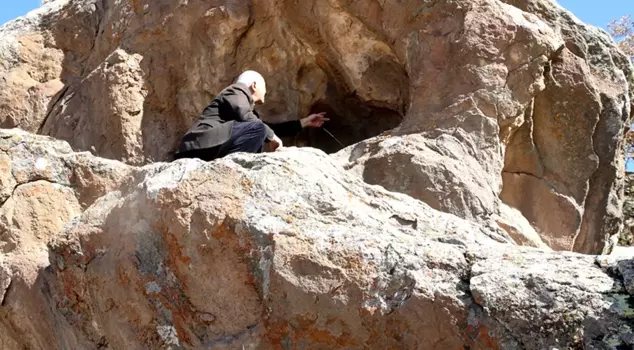
A citizen hiking in a mountainous area of the city reported the images he noticed on the rocks, thinking they might be valuable. Initial examinations in the region assessed that the images belong to the Neolithic Age.
UNPRECEDENTED EXAMPLE
Prof. Dr. Osman Özsoy, the Kayseri Representative of the Foundation for the Protection and Promotion of Environmental and Cultural Values (ÇEKÜL), told AA correspondent that they have been conducting an underground inventory study in Kayseri for about 11 years, but they have never encountered such examples before.
"KAYSERİ WILL PUSH HISTORY BACK FURTHER"
Emphasizing the significance of these images for Kayseri, Özsoy stated:
"This may push Kayseri's history even further back. It will be a discovery or finding that will be positioned within the Neolithic Age. There are examples in many parts of Anatolia. Hakkari, Van, Mersin, Antalya, and Çatalhöyük are among the most famous. In the west, there is Latmos between Balıkesir, Aydın, and Muğla, near Lake Bafa. The most prominent and studied ones are Çatalhöyük and Latmos. When we look at the images in Latmos, they are very similar to ours. The dominant color in our images is brown. Similar colors are also prominent in Latmos. There are figures related to women, men, families, nature, and the environment. There has been considerable research on these. The colors in Kayseri's images are also similar. When compared with studies in the literature, it is evident that there are figures of women and men. There are figures resembling the letter 'T'. Whether they are women, men, or families, they will require a lot of study."
Özsoy explained that it is not clear whether the images were carved or painted on the walls, stating that detailed research needs to be completed regarding these matters.
He pointed out that necessary research should be conducted to determine whether there are other figures in the area, saying, "Currently, in all the cave paintings we can identify, especially in Anatolia, hematite minerals and clay are mixed to obtain a type of paint, which is used to create various figures on the walls. These points are not clear at this stage, and we will have to explain them in the future."
"IT WILL RESONATE ON THE INTERNATIONAL STAGE"
Özsoy explained that many factors are considered in dating, continuing:
"Dating can be done based on whether it is paint or carving, what the figures represent, and their similarities. When the full reports are written or when experts start working on this, it will likely resonate on the international stage as well. Experts will derive a dating based on the form, the style of paint used, and the shape of the figures, but it seems possible to date it to prehistoric times. If we say Latmos, we can say it is contemporary with Latmos. Perhaps it is contemporary with Hakkari or even Göbeklitepe. Ideally, it would be great if it were contemporary with Göbeklitepe. While we cannot say anything definitive, if we consider that the Neolithic Age began around 10,000 BC, it would be somewhere in the gap until the invention of writing. Roughly speaking, if we say around 6,000 years, we would not be wrong."
Özsoy suggested that the images may have been drawn by an artist or a family member living in the region.
"A GREAT GAIN"
Özsoy emphasized the important role of sensitive individuals in the emergence of such values, stating:
"Thanks to the citizen's tip-off and raising awareness about this issue, the event has reached this stage. Therefore, the attention, foresight, or awareness of these individuals has led to significant progress in other areas as well. We will likely see the same with us. We will receive good news from these people. It is significant for Kayseri. It pushes Kayseri's history further back, and the emergence of rock paintings, which have never been seen before, is a great gain."
Özsoy added that they are curious whether the image of Erciyes, which influenced civilizations such as the Seljuks, Ottomans, and Romans, has been processed in this way on the wall.