23.04.2026 12:10
Minister of Culture and Tourism Mehmet Nuri Ersoy announced that a 2-meter-long white marble statue of Athena was unearthed in the stage building of the Western Theater as part of excavation and restoration works in the ancient city of Laodicea.
Excavation and restoration work at Laodikeia Ancient City, one of Denizli's important cultural heritages, continues to bring the artistic and cultural accumulation of the ancient period to the present day. The studies carried out especially in the stage building of the Western Theater provide significant data to the archaeology world with new findings.
Minister of Culture and Tourism Mehmet Nuri Ersoy made a post on his social media account regarding the work carried out in the ancient city. Announcing the new discovery in the Western Theater, Ersoy emphasized the importance of the ongoing excavation and restoration work in the region. Minister Ersoy said, "We have made another important discovery in Laodikeia. A new find has come to light in the ancient city. Our work in the Laodikeia Western Theater continues to reveal traces of the past. In the stage building, we uncovered a white marble statue of Athena, approximately 2 meters tall. This structure, which hosted the epics of Homer, reveals that it was also a center of cultural expression in ancient times, while the work, reflecting the classical style of the Augustan period, draws attention with its high artistic quality. With our 'Heritage for the Future' vision, we continue to preserve and carry this unique heritage into the future."
FOUND AMONG RUBBLE
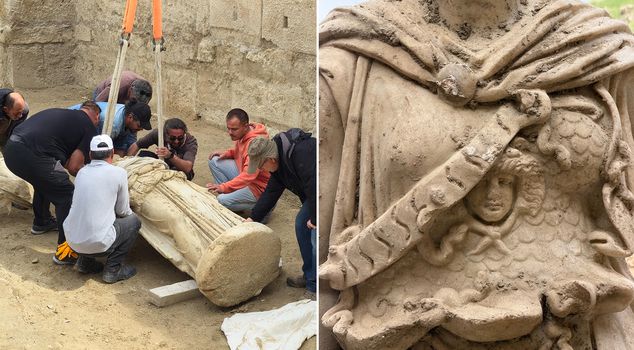
According to the statement made by the ministry; within the scope of the excavation and restoration work carried out in the stage building of the Laodikeia Western Theater, a statue of Athena, left face down in rubble fill, was reached on the outer wall of the stage building called 'Postscaenium'. While the head of the approximately 2-meter-long statue has not yet been identified, it is noteworthy that it is made of white marble.
STAGE BUILDING ADORNED WITH STATUES
In the stage building of the Western Theater, dating back to the 2nd century BC, there are 16 columns on each floor within a three-story architectural layout. Statues depicting gods and goddesses, as well as rulers and scenes related to the Homeric epics, were placed between these columns. Statue groups including scenes such as the Land of the Laestrygonians encountered by Odysseus on his return journey to Ithaca, the cave of the giant Polyphemus, and the sea monster Scylla revealed that the structure was used not only for theatrical performances but also for the transmission of cultural narratives. During the work carried out in 2024-2025, many statues related to these narratives were brought to light.
UNIQUE TYPOLOGY AND HIGH ARTISTIC CRAFTSMANSHIP
In the statue of Athena depicted standing on a round base, details such as a finely woven sleeveless peplos garment, a chlamys (cloak) around the neck, and an aegis (shield) with a Gorgon head and snakes on the chest draw attention. While the folds of the dress and the natural processing of the fabric reveal high artistic quality, the uniqueness of the typology with a cloak around the neck increases the importance of the work. It has been determined that the back of the statue was left roughly finished because it was placed between columns, and it is assessed that the work was produced by a master sculptor.
REFLECTS THE AUGUSTAN CLASSICAL STYLE
When evaluated in terms of artistic style, the Athena statue is stated to reflect the first classical style of the Augustan period (27 BC – 14 AD). In Laodikeia, an important textile center in ancient times, it is noted that Athena's weaving aspect rather than her warrior identity is emphasized, and inscriptions document that festivals were organized in honor of the goddess. Additionally, it is stated that restoration work in the stage building of the Western Theater has been carried out uninterruptedly since the beginning of 2026.