01.05.2026 00:49
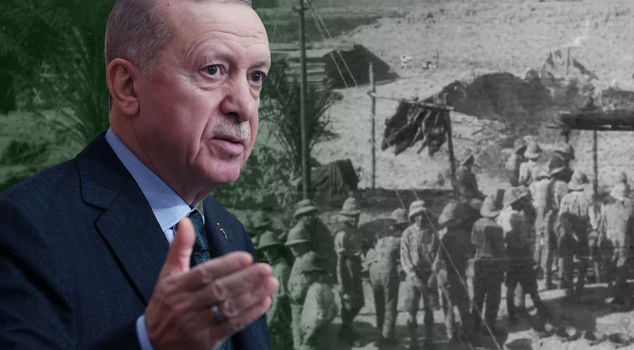
President Erdoğan, referring to the narrative that 'the Arabs stabbed us in the back,' stated: 'Today we are commemorating the 110th anniversary of the Kut al-Amarah victory, one of the proud moments of our history. This victory is a magnificent one, together with Gallipoli. Another aspect of this victory is that it is one of the clearest examples exposing the lie that 'the Arabs stabbed us in the back during World War I,' which is being agitated again by certain circles.'
Speaking at his party's weekly group meeting in the Turkish Parliament, President Erdoğan stated that the narrative constantly voiced by a certain segment, "The Arabs stabbed us in the back," does not reflect the truth.
"THE MOST CLEAR EXAMPLE THAT EXPOSES THAT LIE..."
Starting his speech by saying, "Today we are commemorating the 110th anniversary of the Kut al-Amara victory, one of the proud moments of our history," Erdoğan said, "This victory, along with Gallipoli, is a magnificent triumph. Another aspect of this victory is that it is one of the most obvious examples exposing the lie, now being stirred up again by certain circles, that 'The Arabs stabbed us in the back during World War I.' The people of Kut acted as part of the Ottoman army, supported the siege, and gave many martyrs. This victory reminds us once again of the strategic importance of the Turkish-Kurdish-Arab alliance."
"WE MUST EXALT BROTHERHOOD"
Continuing his statement with an emphasis on unity and togetherness, Erdoğan said, "Our strongest line of resistance against those trying to flood our region with blood is our unity. Our origins may differ, our lifestyles, our worldviews, our political views may differ... All of these are not elements that divide us but values that reflect our human and intellectual richness. In this painful period, we must set aside our differences in origin and sect and exalt brotherhood together. We must also speak the language of brotherhood beyond our borders and strongly convey our peace messages. We are waging this struggle with all our teams."
SO WHAT IS THE KUT AL-AMARA VICTORY?
The Victory of Kut al-Amara, which for many years did not find enough place in historical narratives, has been addressed in a limited way in educational curricula. In secondary education history books, this process, often mentioned together with the British capture of Baghdad, left the great defeat at Kut mostly in the background. In recent years, steps have been taken to recall this victory.
THE BRITISH IRAQ CAMPAIGN
At the beginning of World War I, after the United Kingdom declared war on the Ottoman Empire, it landed in Iraq from the Shatt al-Arab region. The aim was to control oil fields and capture Baghdad. Due to the limited Ottoman forces in the region, British troops advanced rapidly and reached Qurna.
Ottoman forces, under the command of Major Süleyman Askerî, resisted with volunteers and tribal forces. However, the defeat at Shu'ayyiba, followed by Süleyman Askerî's suicide, revealed the difficulties on the front.
SUPPORT FROM ARAB AND KURDISH TRIBES
Although some Arab tribes cooperated with the British during their advance, many Arab and Kurdish tribes sided with the Ottoman army. Besides Arab tribes such as Zubayd, Dulaym, Shammar, Anaza, and Muntefiq, Kurdish tribes like Talabani, Zengene, and Barzanji also fought on the Ottoman side.
During this period, fatwas issued by both Sunni and Shia scholars in favor of fighting alongside the Ottoman State revealed not only the military but also the religious and social dimensions of the struggle.
THE SIEGE OF KUT AL-AMARA
In 1915, the British suffered a heavy defeat at the Battle of Salman Pak and withdrew to Kut al-Amara. The Ottoman army, under the command of Halil Pasha, laid siege to the region. Throughout the siege, which lasted about five months, the British tried to receive external support, but Ottoman forces repeatedly repelled relief forces.
While aerial supply attempts proved insufficient, the capture of the Julnar ship, the last relief effort, by Ottoman forces changed the course of the siege.
THE BRITISH SURRENDERED
Struggling due to starvation and shortages, the British army eventually had to surrender. On April 29, 1916, Ottoman forces under the command of Halil Pasha entered Kut al-Amara and achieved a great victory. Among the surrendered British forces were 6 generals, 476 officers, and over 13,000 soldiers.
This defeat was considered a major turning point in British military history. Indeed, in some sources, Kut al-Amara is described as one of the heaviest defeats of the United Kingdom.