11.05.2026 16:20
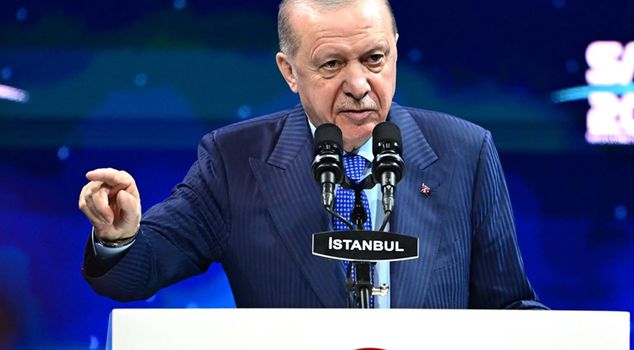
President Recep Tayyip Erdogan delivered a message on a new constitution at the ceremony held for the 158th anniversary of the Council of State and Administrative Judiciary Day. Erdogan said, "Apart from our founding constitutions, the fact that the last two constitutions were unfortunately products of coups and unlawful interventions plays a big role in this. Eliminating this democratic disgrace is a debt of honor for Turkish politics."
President Erdoğan, during the ceremony held at the Council of State building, congratulated the anniversary of the establishment of the Council of State, a 150-year-old institution rooted in Turkish legal history, and the Administrative Justice Day of the entire judicial community. In his speech, Erdoğan expressed his gratitude to all legal professionals who contributed to the institution's legacy, remembering those who passed away with mercy and wishing health to retirees and success to those still serving in the judiciary.
"I send my respects from here to our lawyers who oversee, guide citizens in their pursuit of rights, and contribute to the manifestation of justice," Erdoğan stated, continuing as follows;
I also thank the justice personnel, whose names are often forgotten in such ceremonies but who bear the burden of administrative justice, for their labor and effort; I sincerely congratulate all of them on Administrative Justice Day. The most general definition of the rule of law is that the state, with all its institutions and bodies, remains within the law and comes to life through law. At the forefront of the institutional guarantees that turn this definition from potential to actual, from ideal to reality, is the existence of an independent and impartial judiciary that functions fairly and effectively.
"ADMINISTRATIVE JUSTICE IS A SAFE HARBOR"
Administrative justice, within the judiciary—one of the three fundamental pillars of the state—is a safe harbor where citizens can seek their rights against public actions. The Council of State is the final stop on this path, both at first instance and on appeal. When it was established exactly 158 years ago under the name Şura-yı Devlet, the Imperial Address read on behalf of Sultan Abdulaziz emphasized the principles of legal security, fair and equal administration; it was promised that the law would be protected for everyone, regardless of class distinctions in society. First as Şura-yı Devlet, and then as the Council of State in Republican Turkey, it has followed this commitment and rendered significant services for the establishment and consolidation of the principle of the rule of law. Over time, the Council of State's administrative and advisory role weakened, while its judicial oversight function came to the forefront. Through its legality review, the Council of State's guidance to both administrative authorities and lower courts still maintains its importance.
Of course, a point needs to be emphasized here. Look, today we cannot fully define law without considering the inherent rights and freedoms of human beings. Because law derives its essence and legitimacy from these universal values. Rights and freedoms are, in a sense, a set of rules that determine the protected sphere of an individual and ensure personal security. Therefore, it is impossible to meet collective security needs without responding to individual security needs. Moreover, this is not a newly learned lesson for us.
"THE ESSENCE OF OUR LAW: LET THE HUMAN LIVE SO THAT THE STATE LIVES"
With the advice of Sheikh Edebali, which forms the foundation of our state philosophy—'Let the human live so that the state lives'—we have been aware of this truth for centuries. Another point we are aware of is that the relationship between the state and the citizen is not, by nature, a relationship between equals. Administrative law and administrative justice applying the rules of this branch of law serve as a balancing element in this very relationship between the state and the citizen. Unlike ordinary courts, in administrative justice, one party to the dispute is always the state, the public administration. Hence, the fair and effective functioning of administrative justice holds special importance for the separation of powers and judicial independence, and this functioning is a very critical indicator of the standards of the rule of law.
Very dear friends; the late Professor Dr. İlhan Özay, who passed away about six years ago, opened a new window for us with the concept of 'Administration in the Daylight.' The symbolization of the state with the sun and the description of its fundamental characteristics in relation to daylight is essentially an elegant and wise expression of the rule of law. In its modern sense, the rule of law, like the sun positioned directly at noon, spreads its light to every corner, equally warming and illuminating everyone.
"THE ADMINISTRATOR IS NOT THE MASTER OF THE NATION, BUT ITS SERVANT"
It is for this very reason that the ancients said, 'May God not let the state decline.' What is feared to decline is undoubtedly not the abstract existence of the state but its just and egalitarian character. In a rule of law order nurtured on the principles of justice and equality, there is no fear for anyone, no hopelessness, no helplessness. In this order, the public administration cannot look down on the citizen; it speaks at eye level. In this order, the privileged and the elite are not outside the scope of the law; there is absolute equality before the law. The administrator is not the master of the citizen but the servant of the citizen. In this order, what matters is the nation, the consent of the nation, and the satisfaction of the citizen.
"THE IDEAL OF GOOD GOVERNMENT GAINED STRENGTH AND POSITION"
By God's grace, we have reached a level of maturity from times when a segment of society felt alienated in their own homeland to a point where politics and public administration communicate with citizens at eye level. We put an end to all kinds of privilege and discrimination. We tore down the barbed wire fences drawn between the People and the Republic. Especially with the Presidential Government System, we ensured that the nation's will is directly decisive in state administration. The ideal of good government has gained strength and position, particularly through legal and structural reforms implemented over the last 23 years.
With institutions such as the right to petition and access to information, and the ombudsman, the door to democratic oversight of the administration has been opened. Additional guarantees for our citizens have been provided through boards and regulations such as the Ombudsman Institution, the Human Rights and Equality Institution of Turkey, the Ethics Board for Public Officials, and the Law on the Protection of Personal Data. You are already well aware of the steps we have taken to strengthen the administrative judiciary. We increased the number of courts from 126 to 245, a 68 percent rise. We raised the number of provinces with administrative courts to 72 and those with tax courts to 39.
"OUR REFORM WILL IS AS VIBRANT AND STRONG AS ON THE FIRST DAY"
We made the biggest innovation in the system by introducing the appellate review process 10 years ago. The transition from a two-tiered judicial system to a three-tiered one strengthened the Council of State's role as a cassation court and significantly reduced its workload. While the number of files opened at the Council of State in the pre-appeal system approached 186,000, by the end of 2025 this figure has dropped to 82,000. I want it to be known that our reform will is as vibrant and strong as on the first day. We will continue to take new steps to increase effectiveness, accountability, participation, and transparency in public administration.
"WE DO NOT SEE PUBLIC AUTHORITY AS A TOOL OF DOMINATION"
To rule with justice and righteousness, to see public powers not as a tool of domination but as a means of serving the people, is the fundamental duty of everyone bearing the trust and responsibility of the nation. That judicial bodies act objectively, fairly, and within the limits drawn by the constitution and laws is undoubtedly much more important than the attitudes of all other institutions, organizations, and individuals.
We all pay the price for the slightest negligence or violation in this matter, not only the relevant authorities but also as a nation and state.
"THE JUDICIARY HAS NO TUTELAGE AUTHORITY OVER THE LEGISLATURE AND EXECUTIVE"
If Turkey is to develop, grow, and rise above the level of contemporary civilizations, this can only be achieved through a comprehensive struggle. We all know very well that not every phase of our judicial history, especially Yassıada and September 12, is filled with proud moments. In our recent political history, we have faced various provocations targeting the Council of State. We experienced a treacherous coup attempt, like on December 17-25, by an organization infiltrating the judiciary aiming to overthrow the legitimate government. We witnessed incidents where the boundaries of interpretation were strained in the exercise of judicial power, and the line between legal opinion and political consideration became blurred. All these and more are still fresh in our memories. It is a fact that no unlawful intervention in the exercise of judicial power can be tolerated or excused. However, the judiciary also has no right or authority to act or make decisions as a guardian over the legislature or the executive.
We witnessed incidents where the boundaries of interpretation were strained in the exercise of judicial power, and the line between legal opinion and political consideration became blurred. All these and more are still fresh in our memories. It is a fact that no unlawful intervention in the exercise of judicial power can be tolerated or excused. However, the judiciary also has no right or authority to act or make decisions as a guardian over the legislature or the executive. Our Constitution limits judicial power to legality review and states that this power cannot be used as a review of appropriateness. In other words, while granting legal review authority to judicial bodies, it reserves administrative discretion in favor of the administration. Undoubtedly, the difficulty of distinguishing these two issues with clear boundaries can sometimes lead to controversial decisions and criticisms. However, I believe we should not fear these debates. On the contrary, we should seek ways to benefit most broadly from the corrective, ameliorative, and transformative effect of constructive criticism. I naturally exclude from this the lynching culture on social media, which has now completely spiraled out of control and become increasingly reckless and vulgar.
"A NEW CONSTITUTION IS A DEBT OF HONOR FOR POLITICS"
Dear friends. The Council of State (Şûrâ-yı Devlet), which forms the foundation of the Danıştay, was established in 1868 when the Ottoman Empire was in the midst of a dynamic reform period initiated by the Tanzimat Edict. Eight years after the formation of the Şûrâ-yı Devlet, our first constitution in both material and formal terms came into effect. As you know, constitutions are the normative frameworks that define both the basic organization of the state and the relationship between the state and citizens. The fundamental DNA of the rule of law, supremacy of law, and principles of good governance are in constitutional texts. Despite four constitutions following the Kanun-ı Esasi, the Turkish nation's longing for a good constitution has not yet subsided. This is largely due to the unfortunate fact that, apart from our founding constitutions, the last two constitutions were products of coups and unlawful interventions. Addressing this democratic disgrace is a debt of honor for Turkish politics. A new, inclusive, libertarian, and civil constitution stands before us with the possibility of building our democracy from the bottom up. We must transform the constitution from a framework imposed on society by coup plotters or elites into a text determined by society and declared to the state. I believe that with such a constitution, we can achieve a superior legal logic that simultaneously protects law, democracy, the state, and the nation.