24.03.2026 18:01
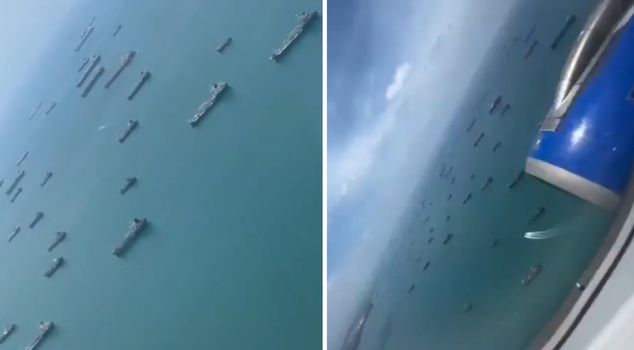
Iran's closure of the Strait of Hormuz, which is of great importance for global oil trade, in response to the US-Israel attacks has triggered a new crisis. The latest situation of the ships waiting in the strait was recorded by a plane passing over the area. The footage showed the ships lined up waiting.
A crisis that shook the global oil trade erupted as Iran closed the Strait of Hormuz to traffic.
LONG QUEUES FORM IN HORMUZ
Footage recorded from a plane passing over the region showed dozens of giant oil tankers waiting at sea, forming long queues for passage. This blockage in the strait, one of the world's most important waterways, has brought global energy shipments to a near standstill.
ENERGY MARKETS ON ALERT
This move, following tensions with the United States and Israel, has caused oil prices to rise rapidly worldwide. Experts warn that every hour the strait remains closed could leave irreparable damage on the global supply chain. The uncertainty regarding when ship traffic will return to normal seems to depend on diplomatic and military developments in the region.
MANY COUNTRIES HAVE HALTED OIL PRODUCTION
Due to the Strait of Hormuz, through which 20% of the world's daily oil demand (approximately 20 million barrels) is transported, being effectively closed to a large portion of commercial vessels, many countries that have not been able to carry out their shipments and have full storage tanks have had to reduce or halt oil production.
LOSS IN THE OIL MARKET REACHES 500 MILLION BARRELS
According to David Wech, Chief Economist at the UK-based data analytics company Vortexa, the loss in the oil market due to the war in the Middle East has reached 500 million barrels as of today. Approximately 190 million barrels of this amount are found in tankers stranded in the Gulf.
The loss in crude oil and petroleum product loadings from the Middle East is estimated to be 310 million barrels when considering the average daily loadings in 2025. This amount includes approximately 12 million barrels of crude oil/condensate and over 5 million barrels of refined products daily.
Excluding Iran's exports, this situation has seasonally pulled the amount of crude oil/condensate transported by sea from the Middle East to Asia to a record low level.
GULF COUNTRIES ON ALERT
According to data obtained by AA correspondent from Vortexa, of the mentioned 500 million barrel loss, 130 million barrels are from Saudi Arabia, 122 million barrels from the United Arab Emirates, 110 million barrels from Iraq, and 64 million barrels from Kuwait. Qatar's loss in this context is estimated to be 46 million, Iran's 15 million, and the total loss from other countries is 14 million barrels.
The International Energy Agency (IEA) had decided on March 11 to release 400 million barrels of strategic oil reserves, the highest amount in the agency's history. The loss in the oil market exceeds the amount of reserves that IEA countries will make available. According to Wech, the rate at which these barrels will be released into the market will fall significantly short of the daily loss of 17 million barrels.