31.03.2026 11:03
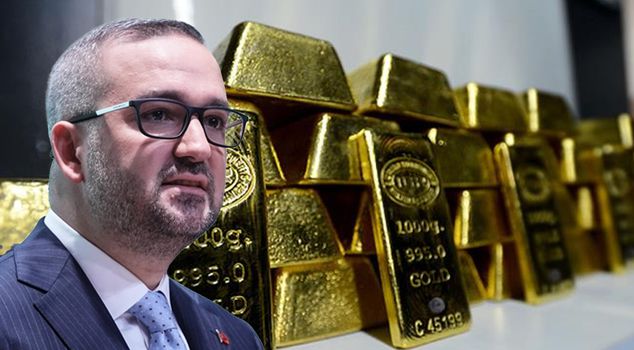
Central Bank President Fatih Karahan responded to claims that the Central Bank of the Republic of Turkey (TCMB) sold and exchanged 60 tons of gold due to the war. Karahan stated, "It is a completely natural choice to use gold-related transactions during periods when foreign currency liquidity needs to be supported."
The Central Bank of the Republic of Turkey (CBRT) Fatih Karahan stated to AA correspondent that he evaluated the effects of the war in the Gulf region on the Turkish economy and markets, as well as the measures taken.
Karahan drew attention to the fact that developments have shown their impact in various areas, from inflation to growth, energy to trade, and from the current account deficit to tourism, and stated that they have also taken measures to reduce inflationary effects.
In this context, Karahan reported that the implemented escalator mobile system against rising energy prices has reduced the inflationary impact.
Emphasizing that the increasing uncertainty will also have effects on investment appetite and private consumption, Karahan expressed that they expect any potential deterioration in the current balance to remain at manageable levels.
"WHEN THE MATURITY COMES, THE GOLD WILL RETURN TO OUR RESERVES"
Karahan stated that using gold-backed transactions during periods when foreign exchange liquidity needs to be supported is a very natural choice, saying, "A significant portion of the transactions is in the nature of forward gold-foreign exchange swaps, meaning that when the maturity comes, the mentioned gold will return to our reserves."
Karahan, who provided information that banks have turned to swap transactions with the Central Bank again, evaluated that "This situation shows that there is no foreign exchange liquidity problem in the system and that the exchange rate regime we are implementing is functioning healthily."
Emphasizing their proactive, flexible, and controlled approach, Karahan noted that the aim is to strengthen financial stability by supporting price stability.
"WE WILL PROVIDE THE TIGHTNESS NEEDED TO LIMIT THE INFLATIONARY EFFECTS OF DEVELOPMENTS"
Central Bank President Karahan answered the following questions:
QUESTION: How does the increase in oil and energy prices caused by the war in our region affect inflation in Turkey? What do the Central Bank's calculations show for the short and medium term?
ANSWER: The ongoing war has led to a significant increase in energy prices. This situation creates cost-based pressure on inflation. In addition to the direct effects of energy prices, we can also see indirect inflationary effects in different sectors. Our analyses show that a permanent 10% increase in oil prices raises consumer inflation by approximately 1.1 points within a year. The implemented escalator mobile system significantly limits the reflection of this effect on consumer prices. According to our calculations, the escalator mobile system reduces the impact of oil prices on inflation to one-third. The war will have both supply and demand-side effects on inflation in the medium term. Cost and supply disruptions have already begun to create supply-side pressure. Demand-side effects will shape depending on the domestic and foreign policies to be followed during this process. So far, we have taken measures to reduce inflationary effects without wasting time. Currently, the course of the war continues to maintain its uncertainty. We will provide the tightness needed to limit the inflationary effects of developments through expectations and pricing behaviors.
"WE BELIEVE THAT ANY POSSIBLE DETERIORATION IN THE CURRENT BALANCE WILL BE AT A MANAGEABLE LEVEL"
QUESTION: How has the war affected Turkey's growth and current account dynamics? How much have your forecasts changed?
ANSWER: We expect that rising energy costs, external uncertainties, and the potential weakening of external demand as a result will create downward pressure on economic activity. The increasing uncertainty will also have an effect on investment appetite and private consumption. Our analyses indicate that a 10% supply-side increase in oil prices leads to a decline of 0.4 to 0.7 points in the growth rate over a one-year period. Recent developments will affect the current balance differently through energy and non-energy items. Our analyses show that a $10 increase in oil prices causes a deterioration of approximately $3 to $4 billion in the annual net energy balance. If there is a corresponding increase in natural gas import prices, the impact can rise to $5 billion.
As for non-energy items, we can say that a potential weakening in global demand will have an increasing effect on the current account deficit through exports and tourism. However, the cooling of economic activity will positively affect the trade balance. Currently, the level of the current account deficit is below its historical average. We believe that any possible deterioration in the current balance that may arise from recent developments will be at a manageable level.
"WE ARE DETERMINED TO PROVIDE THE TIGHTNESS NEEDED FOR THE CONTINUATION OF THE DISINFLATION PROCESS"
QUESTION: Recently, a decrease in reserves has been observed. Are you considering making a change in the exchange rate regime with the foreign exit?
ANSWER: As we stated in the monetary policy text, we will continue the current exchange rate regime in 2026 as well. There have been capital outflows from developing countries during this period. Each country responds to this situation differently, taking into account the effects on the inflation outlook. The pressure on reserves is a normal result of changes in global risk appetite. We are also taking measures to limit the effects of this risk-averse behavior on the inflation outlook. With the emergence of the war, we switched to funding from the upper band. During this period, we started Turkish lira forward foreign exchange sales transactions with domestic residents. In addition, we brought forward our bond purchases to prevent a potential exit in money market funds. These measures have preserved the attractiveness of the Turkish lira in domestic markets. During this period, although there has been limited demand for gold and foreign exchange due to falling gold prices, the demand for foreign exchange from domestic residents has been limited compared to previous stress periods. I would like to emphasize once again that we are facing an external situation that negatively affects our fight against inflation. We are determined to provide the tightness needed for the continuation of the disinflation process.
"THE TRANSACTIONS WE HAVE MADE ARE AIMED AT STRENGTHENING OUR FOREIGN EXCHANGE POSITION"
QUESTION: Mr. President, another topic that is widely discussed in the public is your reserve policy. It is said that gold sales are being made from reserves. Foreign exchange swaps against Turkish lira are also one of the options. There are comments regarding the sustainability of your reserve policy during this process. What do you think about this?
ANSWER: The main purpose of holding reserves is to strengthen confidence in monetary and exchange rate policies and to protect our economy against potential negative effects of global or geopolitical developments. Over the years, we have increased our gold reserves. Our gold reserves, which were 377 tons in 2016, have doubled. As of March 2026, the share of our gold reserves in total reserves has exceeded 60%. Therefore, using gold-backed transactions during periods when foreign exchange liquidity needs to be supported is a very natural choice.
The increasing share of gold in reserves is closely related to the role of gold in our financial system. Banks can establish gold as part of the required reserves. The gold-backed bonds issued by our Ministry of Treasury and Finance are also an important part of the banking system. This situation necessitates the use of gold within the scope of liquidity management. Swap is one of the most commonly used tools in liquidity management. We manage the liquidity of the financial system through various types of swap transactions. With location swap transactions, we use gold within the country in international markets. Similarly, we are strengthening our foreign currency liquidity with the recent gold swaps against foreign currency we have conducted. Recently, we used some of our gold for gold swaps against foreign currency. In addition, we have also made some gold sales. At this point, I would like to emphasize that evaluating such transactions in central banking from a commercial profit-loss perspective is not correct. Our priority is financial stability and policy effectiveness. The transactions we conduct in this context aim to strengthen our foreign currency position.
"WE ARE FOLLOWING A PROACTIVE, FLEXIBLE, AND CONTROLLED APPROACH"
Moreover, a significant portion of these transactions is in the nature of forward gold-currency swaps. This means that when the maturity arrives, the mentioned gold will return to our reserves. Besides gold, we can also conduct currency swaps against Turkish lira with banks. Recently, with the decrease in swap transactions with abroad, there is a situation where foreign currency liquidity in the banking system has increased, while the need for Turkish lira funding has risen. Banks have started to request swap transactions with the Central Bank again. We have also prepared to resume currency swaps against Turkish lira. The banks' renewed interest in swap transactions with the Central Bank indicates that there is no foreign currency liquidity problem in the system and that the exchange rate regime we are implementing is functioning healthily. We consider all these transactions as part of our liquidity management. The maturity and volume of the transactions are under our control. Depending on the development of conditions, we can increase the transaction volume or decrease it with changing market conditions.
In summary, we are adopting a proactive, flexible, and controlled approach regarding reserve management and our liquidity tools. The aim of all our steps is to support price stability and strengthen financial stability.