30.06.2026 12:01
The temple, discovered 113 years ago in the Men Sanctuary in the Yalvaç district of Isparta and long thought to belong to Demeter, has been identified through recent research as belonging to the Goddess Hecate. Excavation Director Prof. Dr. Mehmet Özhanlı stated that the structure is the second known Temple of Hecate in Anatolia, adding that the discovery will enhance the historical and touristic significance of the region.
A remarkable discovery has been made at the Men Sacred Area, located on the summit of Mount Gemen at an altitude of 1600 meters in the Yalvaç district of Isparta.
The structure, uncovered during excavations in 1912-1913 and long referred to as the "Small Temple," has been determined not to belong to the Goddess Demeter as long believed, but to the Goddess Hekate.
"WE DOCUMENTED THAT IT BELONGS TO HEKATE"
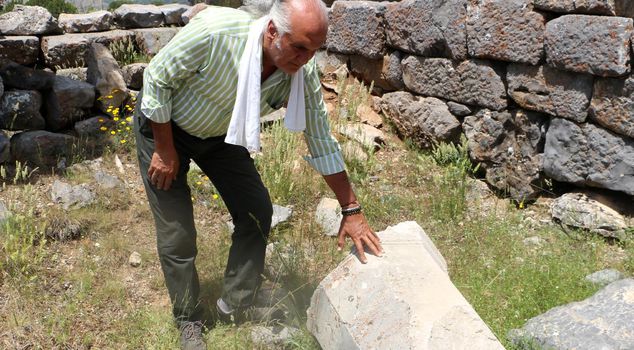
Prof. Dr. Mehmet Özhanlı, faculty member of the Department of Archaeology at Süleyman Demirel University's Faculty of Arts and Sciences and head of the excavation, stated that the mystery of the temple has been solved through ongoing studies and findings in the region.
Özhanlı said, "Our biggest discovery this year is a small temple found here. It was excavated in 1912-13 but identified as the 'Temple of Demeter.' However, through our studies here, we documented that it is a temple belonging to Hekate, the local goddess of Anatolia."
Noting that figurines and reliefs of the Goddess Hekate were uncovered in the excavations, Özhanlı expressed that findings related to Men also prove the structure is the Temple of Hekate.
"SHE REPRESENTS DEATH AND THE UNDERWORLD"
Prof. Dr. Özhanlı stated that Hekate is a goddess of Anatolian Carian origin, depicted in mythology as dominant over earth, sky, and sea, with three bodies and three heads.
Noting that Hekate's crown features a crescent depiction, Özhanlı said, "In connection with Men, she represents both the moon and the dark side of the moon. That is, she represents death and the underworld. Therefore, it is quite significant."
DOG GRAVES ALSO SUPPORTED THE FINDINGS
Özhanlı noted that two previously discovered dog graves, where the animals were sacrificed, in the ancient city of Pisidia Antiocheia are also connected to the Hekate cult.
Stating that Hekate is known as a goddess who rules over Kerberos, associated with the underworld, Özhanlı mentioned that the dog is the goddess's sacred animal and that the dog graves found in Antiocheia archaeologically support this cult.
TEMPLE WILL BE RESTORED
Explaining that the temple has a front area, a rear area, and a middle section, Özhanlı said that in ancient times, only the priest, not the public, could enter the temple.
Özhanlı noted that the octagonal base, where the goddess statue stood in the naos section, is preserved in its original location, and stated that although the structure was damaged during the Christianization process, the aim is to restore it using available materials.
SECOND TEMPLE OF HEKATE IN ANATOLIA
Recalling that the known Temple of Hekate in Anatolia is located in the Lagina Ancient City in Muğla Yatağan, Prof. Dr. Özhanlı stated that the structure in Yalvaç has been documented as the second Temple of Hekate. Özhanlı noted that this discovery will significantly contribute to tourism in both Antiocheia and Yalvaç.