22.12.2025 13:07
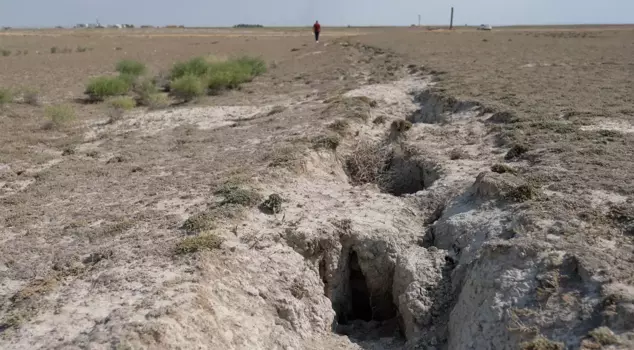
In the Konya Basin, subsidence events reaching up to 10 centimeters occur each year due to the decrease in groundwater levels and drought. The Chamber of Geological Engineers observes this situation through sinkholes and surface cracks, drawing attention to the fractures that also affect industrial areas.
In the Konya Basin, drought and the decrease in groundwater levels are causing not only sinkholes formed by soil subsidence but also surface cracks and vertical collapses. Şükrü Arslan, the President of the Chamber of Geological Engineers Konya Branch, stated, "With satellite data, the Konya Closed Basin is being monitored in Turkey. In measurements made using a comparative method from these satellite data, especially in some areas of the Konya Closed Basin, collapses reaching up to 10 centimeters per year are observed. The basin is a subsidence basin, and we can generally still talk about an active collapse. Our basin continues to subside."
DROUGHT, CLIMATE CHANGE, AND UNCONSCIOUS AGRICULTURAL IRRIGATION HAVE LED TO COLLAPSES
In Konya, the decrease in groundwater levels due to drought, climate change, and unconscious agricultural irrigation is increasing the number of surface cracks as well as sinkholes in the plain. Additionally, vertical collapses of nearly 10 centimeters occur each year in some parts of the basin. Şükrü Arslan, noting that collapses continue due to the expansion in the Konya Basin formed on the Anatolian Plate, stated the following:
"ACCORDING TO SATELLITE DATA, THESE COLLAPSES HAVE REACHED AN ANNUAL AVERAGE OF 10 CENTIMETERS IN SOME AREAS"
"When we look at Turkey as a whole from a tectonic perspective, we are located in a region where the Arabian Plate compresses from the south, the Anatolian Plate is in the middle, and the Eurasian Plate compresses from the north. In addition to this, collapses continue due to the expansion in the Konya Basin on the Anatolian Plate and the withdrawal of groundwater. According to satellite data, we can observe that in some areas, this situation has reached an annual average of 10 centimeters. Both the subsidence of this basin, the ongoing active movement, expansions, and the excessive consumption of groundwater, which results in the static level being pulled down, reflect as sinkholes in the Konya Closed Basin. Alongside the sinkholes, there are also surface cracks. In fact, this has been frequently discussed lately. The withdrawal of groundwater, due to excessive drought, causes shrinkage and contraction in the volumes of clay minerals that form blocks with different lithologies that create active or passive fault lines that have lost their energy. Consequently, cracks emerge along the fault line, and between these fractures, blocks form steps over time, which we refer to as terraces," he said.
SURFACE CRACKS HAVE REACHED INDUSTRIAL AREAS
Arslan stated that they have observed surface cracks in some industrial areas located in the city center, saying, "Previously, we used to see them widely in pastures and more rural areas. In recent years, they have started to become widespread in many places, including the central districts of Konya. The formation of these cracks can cause serious damage and harm to residential areas or structures. Recently, we have observed that several factories in industrial areas have been damaged, and there have been fractures in different regions of the Karatay district, which have also created static imbalances in the structures above them."